Introduction
Peter Thiel, the billionaire co-founder of PayPal and Palantir Technologies, has long been a figure of intrigue in both the tech and political spheres. Known for his early investments in companies like Facebook and his controversial support for conservative causes, Thiel has recently made headlines with a significant move: the purchase of over 470 acres of land in New Zealand for $50 million. This decision, as suggested by recent posts on X, is not driven by tax benefits or property value but by Thiel’s insights into the future of the American economy. This article explores the motivations behind Thiel’s investment, his history with New Zealand, and the broader implications for global economic trends.
Thiel’s New Zealand Connection
Thiel’s relationship with New Zealand began in 1995 when he first visited the country at age 28. His admiration for its natural beauty and perceived stability grew over time, culminating in his controversial acquisition of New Zealand citizenship in 2011. Despite spending only 12 days in the country—far less than the typical 1,350-day residency requirement—Thiel was granted citizenship under “exceptional circumstances” by then-Minister of Internal Affairs Nathan Guy. This decision sparked debate, with critics arguing it exemplified how wealth could bypass standard immigration protocols. Thiel justified his citizenship by describing New Zealand as a “utopia” that aligned with his vision of the future, promising to promote the country’s business interests through investments and philanthropy.
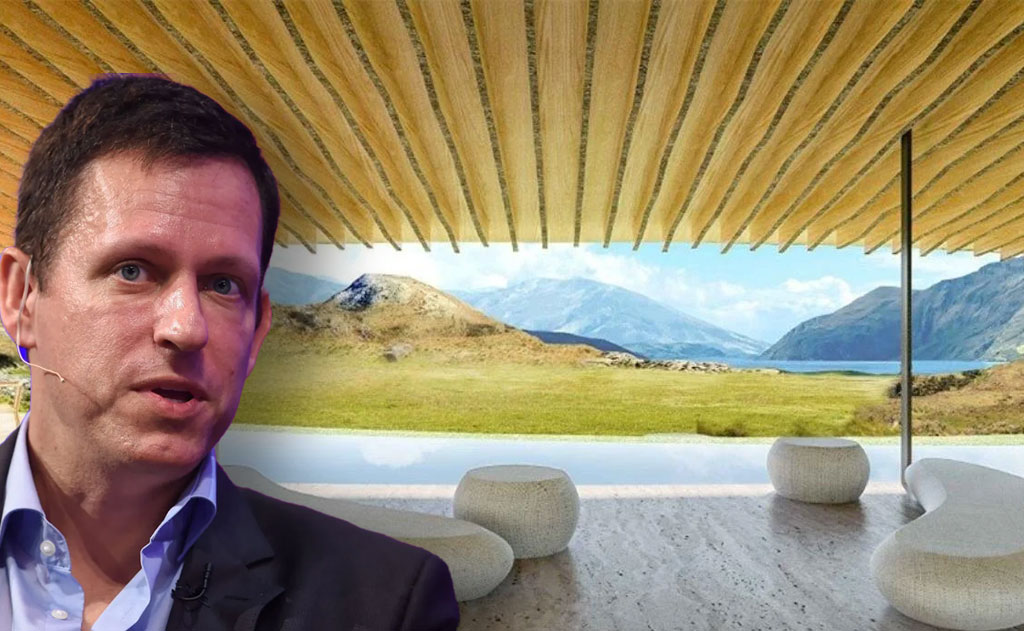
In 2015, Thiel purchased a 477-acre estate on the shores of Lake Wānaka for $13.5 million through his company, Second Star Limited. This property, located in the scenic South Island, was initially intended for a luxury lodge and meditation retreat. However, plans for the development were rejected by the Queenstown-Lakes District Council in 2022 and upheld by the Environment Court in 2024, citing adverse impacts on the area’s pristine landscape. Environmentalists and local residents argued that the proposed 10-bedroom complex, designed by renowned architect Kengo Kuma, would be an “eyesore” in an area classified as an “outstanding natural landscape.” Despite this setback, Thiel’s recent acquisition of additional land suggests a renewed commitment to New Zealand.
The $50 Million Land Purchase
Recent posts on X claim that Thiel has invested $50 million to acquire over 470 acres in New Zealand, a move interpreted not as a financial or tax-driven decision but as a strategic hedge against potential instability in the American economy. While specific details about the exact location and purpose of this new purchase remain unclear, it aligns with Thiel’s long-standing interest in New Zealand as a safe haven. The timing of this investment is notable, as Thiel has publicly expressed concerns about economic and political challenges in the United States, including what he describes as “confiscatory taxation” in California. In a 2024 interview on The Joe Rogan Experience, Thiel discussed the possibility of permanently relocating to New Zealand, citing its appeal as a stable, tech-friendly environment.
Thiel’s history of “prepping” for global uncertainties adds context to this move. New Zealand has long been viewed as a refuge for wealthy individuals seeking geopolitical stability, self-sufficiency, and isolation from global crises. In 2016, tech entrepreneur Sam Altman revealed plans to fly to Thiel’s New Zealand property in the event of a pandemic, highlighting its role as a potential “doomsday bunker.” Although Thiel has not confirmed plans to build an apocalypse-proof structure, the 477-acre Wānaka estate—still undeveloped—has been speculated to serve such a purpose. The new land acquisition could further this strategy, potentially expanding his footprint in a country he views as a hedge against global or American economic decline.
Economic Motivations and America’s Future
Thiel’s investment decisions are often seen as predictive, rooted in his deep understanding of global markets and political trends. Posts on X suggest that his latest New Zealand purchase is driven by “what he knows about America’s future economy,” implying concerns about economic instability, political polarization, or systemic risks in the U.S. Thiel’s libertarian views and support for Donald Trump’s political agenda, including a $15 million contribution to J.D. Vance’s 2022 Senate campaign, reflect his skepticism of centralized government policies and economic overreach. His decision to shift significant capital to New Zealand may signal a belief that the U.S. faces challenges such as inflation, regulatory burdens, or social unrest that could undermine its economic dominance.
Thiel’s wealth, estimated at $20.8 billion by Forbes as of May 2025, has been bolstered by recent successes, including the quadrupling of Palantir’s value to $190 billion and a doubling of his fintech startup Ramp’s valuation to $13 billion. These gains contrast with his gradual withdrawal from New Zealand’s business landscape. His venture capital firm, Valar Ventures, once a significant player in New Zealand’s tech sector, has largely wound down operations in the country. Investments in companies like Xero and Vend yielded substantial returns—estimated at $30 million for Thiel and his co-investors—but his focus has shifted back to the U.S. and global fintech markets. The decision to invest $50 million in New Zealand land, therefore, appears less about immediate financial gain and more about long-term strategic positioning.
New Zealand’s Appeal to the Ultra-Wealthy
New Zealand’s allure for billionaires like Thiel extends beyond its natural beauty. Its remote location, stable governance, and potential for self-sufficiency in food, water, and energy make it a prime destination for “preppers” anticipating global crises. The country saw a surge in interest from wealthy Americans following the 2016 U.S. election, with citizenship inquiries increasing fourteenfold in the days after Donald Trump’s victory. Other tech moguls, such as Google co-founder Larry Page, have also secured residency or property in New Zealand, reinforcing its status as a haven for the ultra-rich. Until July 2022, New Zealand’s Investor 1 Resident Visa program allowed high-net-worth individuals to gain residency by investing NZ$10 million over three years, a pathway Thiel leveraged through his investments and $1 million donation to the 2011 Christchurch earthquake relief fund.
However, Thiel’s case has not been without controversy. His fast-tracked citizenship and land purchases have fueled debates about whether New Zealand’s policies enable wealthy foreigners to “buy” access to the country. Critics, including members of the Labour Party, have argued that Thiel’s minimal time in New Zealand and lack of ongoing commitment undermine the country’s egalitarian values. His undeveloped Wānaka estate and the recent dissolution of Valar Ventures’ New Zealand operations have furthered perceptions that his interest in the country is primarily as a fallback rather than a genuine commitment to its economy or society.
Implications for the Global Economy
Thiel’s investment in New Zealand raises broader questions about the confidence of global elites in the stability of Western economies. His actions reflect a trend among the ultra-wealthy to diversify their assets geographically, seeking safe havens in politically stable, geographically isolated regions. New Zealand’s appeal lies in its ability to weather global disruptions, from pandemics to economic collapses. Thiel’s move could signal a lack of faith in America’s long-term economic resilience, particularly as political divisions deepen and economic policies face scrutiny.
Moreover, Thiel’s pivot to New Zealand aligns with his history of exploring unconventional solutions to systemic risks. His involvement in projects like The Seasteading Institute, which aimed to create autonomous floating communities, and Bluebook Cities, a proposed crypto-based utopian city, suggests a pattern of seeking alternatives to traditional nation-states. While these ventures have faced setbacks, his New Zealand investment indicates a continued pursuit of secure, self-sufficient environments.
Conclusion
Peter Thiel’s $50 million investment in over 470 acres of New Zealand land is more than a real estate transaction—it’s a calculated move informed by his perspective on America’s economic future. As a billionaire with a track record of prescient investments, Thiel’s decision underscores New Zealand’s growing status as a refuge for the global elite. While his earlier ventures in the country, such as Valar Ventures, have waned, his land acquisitions signal a long-term strategy to hedge against potential instability. For readers of NRI Globe, this story highlights the intersection of wealth, geopolitics, and foresight, raising questions about the future of global economic stability and the role of safe havens like New Zealand in an uncertain world.