In a remarkable display of teamwork and compassion, a young bottlenose dolphin calf entangled in a fishing line was successfully freed and reunited with its mother in Florida’s Indian River Lagoon. The rescue, which took place in late July 2024, highlights the critical efforts of marine conservationists to protect vulnerable marine life and underscores the ongoing threat of marine debris. This inspiring story, reported on July 29, 2025, has captured the hearts of many and serves as a call to action for responsible environmental stewardship. Here’s the full story for www.nriglobe.com.
A Paddleboarder’s Discovery Sparks Action
The rescue began in early July 2024 when a paddleboarder spotted a dolphin calf swimming alongside its mother in the Indian River Lagoon, a biodiverse estuary along Florida’s Atlantic Coast. Upon closer inspection, the observer noticed a fishing line tightly wrapped around the calf’s right pectoral flipper and body, posing a severe risk to its health by restricting movement and cutting off circulation. The sighting was promptly reported to the Florida Fish and Wildlife Conservation Commission (FWC) Wildlife Alert Hotline, triggering a coordinated response from marine rescue experts.
The Coastal Stewards, a nonprofit conservation organization, along with teams from SeaWorld Orlando, the Clearwater Marine Aquarium, the Hubbs-SeaWorld Research Institute (HSWRI), and the National Marine Mammal Foundation (NMMF), mobilized to plan the rescue. Aerial imagery confirmed the severity of the entanglement, revealing tissue damage to the calf’s flipper. NOAA and independent veterinary experts determined that without intervention, the calf’s injuries could be life-threatening.
A High-Stakes Rescue Operation
After weeks of planning, a multi-agency team of scientists, field biologists, veterinarians, and rescue experts convened on July 29, 2024, for a high-stakes operation. The team faced significant challenges, including the calf’s young age, its compromised physical condition, and unpredictable weather in the lagoon. For nearly nine hours, the rescuers searched the area without success. As dusk approached, deteriorating weather forced them to postpone the operation until the following morning.
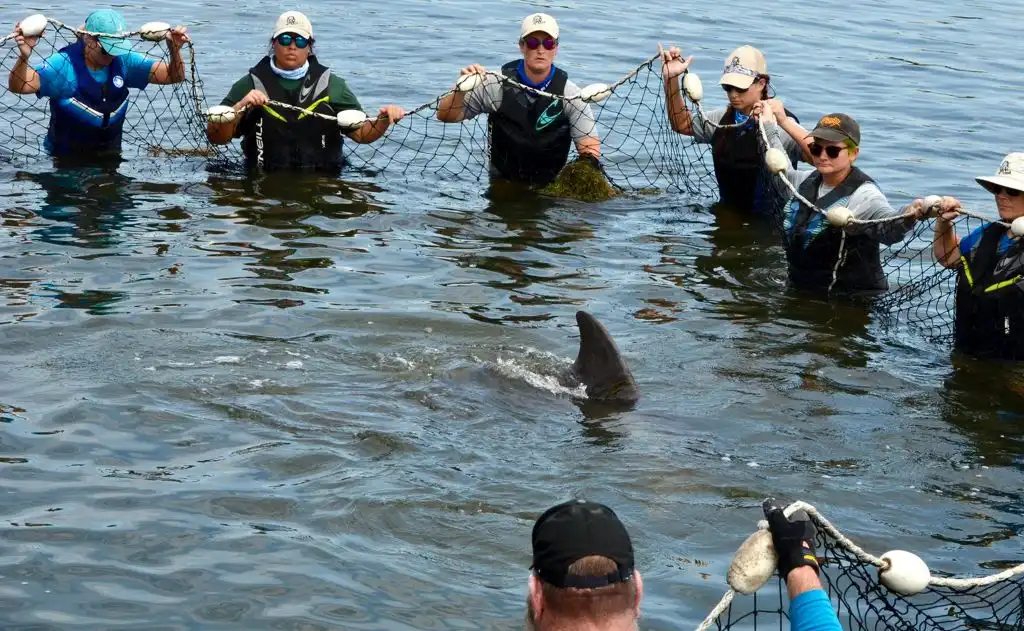
On July 30, 2024, the team resumed their efforts with renewed determination. Using a specialized boat, they encircled the mother and calf in a net within the shallow, 3-foot-deep waters of the lagoon. The net’s circumference was gradually reduced from 80 yards to bring the dolphins closer to the handlers while ensuring both animals remained calm. To minimize stress, the mother was held facing her calf, allowing them to maintain visual contact and communicate through whistles. Dr. Mike Walsh from the University of Florida led the veterinary team, carefully removing the fishing line, which had caused significant tissue damage to the calf’s flipper.
The entire procedure was completed in under 30 minutes, with the dolphins in human care for less than 10 minutes, a testament to the team’s efficiency and expertise. After the line was removed, veterinarians noted some tissue loss but expressed optimism about the calf’s recovery, citing dolphins’ remarkable ability to heal in the wild. The mother was fitted with a VHF radio-transmitting tag to allow researchers to monitor the pair’s health and behavior post-rescue.
A Joyful Reunion and Promising Recovery
Once freed, the mother and calf swam off together, joining two other mom-and-calf pairs in the lagoon. Ten days later, HSWRI researchers resighted the pair, noting encouraging signs of recovery. The calf was observed chasing fish and swimming independently from its mother, indicating improved health and strength. The successful reunion and the calf’s progress have been celebrated as a triumph of conservation efforts, with social media posts on X praising the rescuers’ dedication. One user wrote, “A heartwarming rescue unfolded off Florida’s Brevard County, saving a dolphin calf from a crab trap line!”
The Bigger Picture: Marine Debris and Dolphin Safety
This rescue underscores the growing threat of marine debris, particularly fishing lines and nets, which are a leading cause of mortality for dolphins, manatees, and other marine species in Florida’s waters. The Coastal Stewards emphasized the importance of properly disposing of fishing gear to prevent entanglements. The Indian River Lagoon, a critical habitat for bottlenose dolphins, has seen multiple such incidents, with a 2019 rescue in Englewood, Florida, also involving a calf entangled in fishing line around its fluke and mouth.
The NMMF and its partners continue to conduct several rescue operations annually, playing a vital role in safeguarding marine mammal populations. However, experts warn that preventing entanglements requires public awareness and action. The FWC encourages anyone who spots an injured or entangled marine animal to call their Wildlife Alert Hotline at 1-888-404-3922.
A Call to Protect Our Oceans
The successful rescue of this dolphin calf is a powerful reminder of the impact of human activity on marine ecosystems and the importance of collective action to protect wildlife. The collaborative efforts of the Coastal Stewards, SeaWorld Orlando, Clearwater Marine Aquarium, HSWRI, NMMF, and FWC demonstrate the strength of unified conservation initiatives. As the calf swims freely with its mother, this story inspires hope and calls for greater responsibility in preserving our oceans for future generations.