
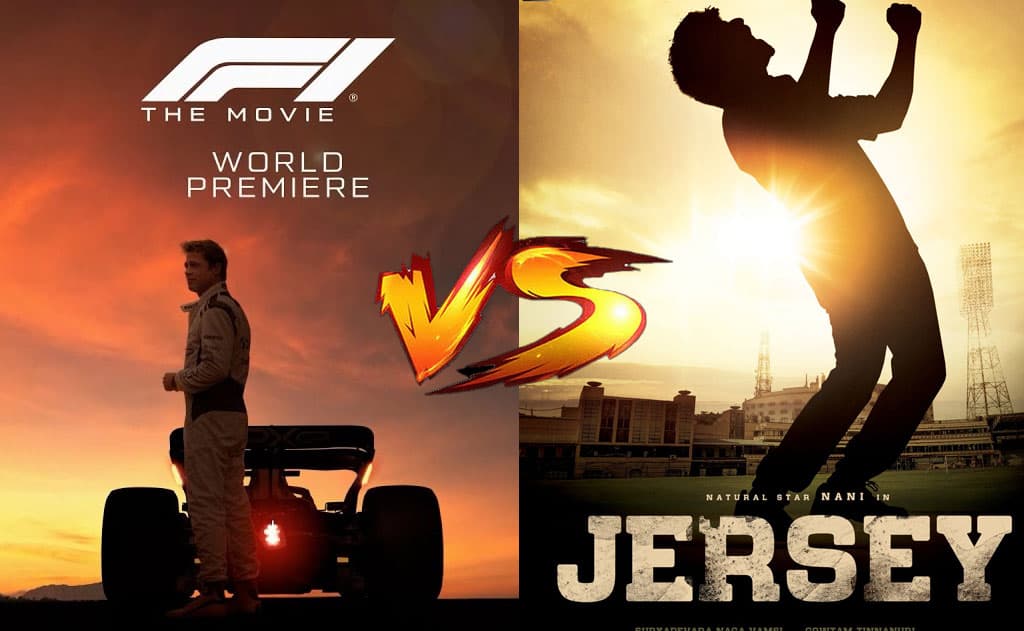
Imagine two films, one roaring with the high-octane thrill of Formula 1 racing, the other grounded in the emotional grit of a cricketer’s comeback. F1: The Movie and Jersey may seem worlds apart—one a Hollywood blockbuster fueled by speed and spectacle, the other a Telugu sports drama anchored in raw human struggle—but they share a surprising kinship. Both tell stories of underdogs chasing redemption against all odds, yet their approaches couldn’t be more different. Buckle up as we pit F1 against Jersey in a head-to-head comparison that explores their narratives, themes, and emotional impact, all while drawing parallels that have sparked buzz among fans and filmmakers alike.
The Premise: Racing Against Time
In F1: The Movie, directed by Joseph Kosinski (Top Gun: Maverick), Brad Pitt plays Sonny Hayes, a former Formula 1 prodigy who crashed out of the sport in the ‘90s. Lured back by his old friend and team owner Ruben (Javier Bardem), Sonny joins the struggling Apex GP team to mentor rookie Joshua Pearce (Damson Idris) and save the team from collapse. It’s a high-stakes redemption story set against the glitzy, dangerous world of F1, complete with jaw-dropping visuals and a $200 million budget.
On the other hand, Jersey (2019), a Telugu gem directed by Gowtam Tinnanuri, follows Arjun (Nani), a failed cricketer in his mid-30s who abandoned his dreams for a stable life. Motivated by his son’s wish for a cricket jersey and his own unfulfilled passion, Arjun risks his health—battling a heart condition—to make a comeback and play for India. It’s a deeply personal tale of sacrifice and perseverance, lauded for its emotional depth and Nani’s career-defining performance.
The Connection: Producer Naga Vamsi, who backed Jersey, sparked conversation by comparing F1’s ending to Jersey, noting similarities in their emotional stakes and underdog spirit. Both films hinge on protagonists defying age and doubt, with medical risks looming large—Sonny’s past crash and Arjun’s arrhythmia. Yet, while F1 races toward a triumphant finish, Jersey’s climax is a heart-wrenching gut punch that elevates it to iconic status.
Narrative Style: Spectacle vs. Soul
F1 is a cinematic adrenaline rush, designed to pull audiences into the cockpit with IMAX-worthy visuals and Hans Zimmer’s pulsating score. Filmed on real F1 circuits with unprecedented access, it captures the sport’s glamour and danger—think cars zipping at 200 mph and crashes that elicit gasps. The plot, however, leans on familiar sports movie tropes: a veteran mentoring a cocky rookie, a romance with technical director Kate (Kerry Condon), and a team defying the odds. While critics praise its immersive racing sequences, some call the story predictable, with shallow characters and excessive corporate branding (hello, Expensify logos). It’s a crowd-pleaser that prioritizes spectacle over emotional depth.
Jersey, by contrast, is an intimate, character-driven drama that uses cricket as a backdrop rather than the main event. The film dives deep into Arjun’s personal struggles—financial woes, family pressures, and his own self-doubt. The cricket scenes, while well-executed, take a backseat to emotional moments, like Arjun’s bond with his son or his quiet determination to prove himself. Anirudh Ravichander’s soulful score and Nani’s raw performance make every scene resonate, with the climax leaving audiences in tears. Critics have hailed it as one of the best Telugu films of the decade for its heartfelt storytelling and universal themes.
The Verdict: F1 is a rollercoaster you experience; Jersey is a journey you feel. If F1 is a glossy love letter to Formula 1’s global appeal, Jersey is a raw, relatable ode to chasing dreams against life’s harsh realities.
Themes: Glory vs. Sacrifice
Both films explore redemption, but their approaches diverge. F1 is about reclaiming glory—Sonny Hayes, once “the greatest that never was,” returns to prove his worth and save a team. The stakes are high but external: win a race, or the team folds. The film celebrates teamwork and perseverance, with Sonny’s laid-back charisma (channeling Steve McQueen) and Joshua’s growth adding charm. Yet, its focus on F1’s glitz and technical jargon can feel overwhelming for non-fans, and the predictable arc doesn’t always hit emotionally.
Jersey’s redemption is deeply personal. Arjun’s fight isn’t just to play cricket but to be a hero in his son’s eyes and reclaim his self-respect. The film’s core theme—“it’s never too late to dream”—is tempered by sacrifice, as Arjun risks his life knowing his heart condition could kill him. This selflessness, paired with the film’s unflinching portrayal of failure, makes Jersey resonate universally, especially for audiences in India and the diaspora who connect with its family-centric narrative.
The Connection: As Naga Vamsi noted, F1’s climax, where Sonny defies expectations to race despite past trauma, echoes Jersey’s high-stakes medical drama. But while F1 opts for a feel-good Hollywood ending, Jersey’s tragic climax amplifies its emotional weight, making it unforgettable.
Cinematic Craft: Hollywood Shine vs. Tollywood Heart
F1 is a technical marvel, leveraging cutting-edge camera work and real F1 access to create visceral racing scenes. Shot during actual Grand Prix weekends, it features cameos from drivers like Max Verstappen and Lewis Hamilton (a producer), adding authenticity. However, its $200 million budget sometimes feels like a glossy ad for F1, with critics noting clunky dialogue and underdeveloped female characters, like Kate, who falls into trope territory. Hans Zimmer’s score is a standout, but the film’s reliance on clichés keeps it from being a classic.
Jersey, made on a modest budget, shines through its simplicity. Sanu John Varghese’s cinematography captures the gritty beauty of Hyderabad’s cricket fields, while Anirudh’s music elevates every emotion. The film’s pacing, though occasionally predictable, is anchored by stellar performances—Nani’s raw intensity, Shraddha Srinath’s understated strength, and Ronit Kamra’s heart-melting turn as Arjun’s son. Its National Film Awards for Best Telugu Feature and Best Editing are well-earned, proving Tollywood can rival global cinema with heart alone.
The Verdict: F1 dazzles with scale; Jersey captivates with soul. For NRI audiences, Jersey’s cultural resonance and emotional depth may hit closer to home, while F1’s universal appeal makes it a fun, if less profound, ride.
Audience Appeal: Global Thrills vs. Cultural Roots
F1 targets a broad audience, capitalizing on Formula 1’s global surge (thanks to Drive to Survive). Its IMAX-ready visuals and star power—Brad Pitt earned $30 million—make it a summer blockbuster, grossing $144 million worldwide. It’s a gateway for new fans, with only 18% of U.S. test audiences familiar with F1, though purists may nitpick inaccuracies (e.g., unrealistic race scenarios).
Jersey speaks to the heart of Indian and NRI audiences, particularly those who value family and resilience. Its universal story of chasing dreams later in life transcends borders, earning acclaim at the International Indian Toronto Film Festival. While it didn’t chase box office records, its critical success and emotional impact have made it a modern Telugu classic.
The Connection: Fans on X have noted that F1 focuses on the sport’s thrill, while Jersey prioritizes Arjun’s personal journey over cricket itself. This distinction—sport as spectacle versus sport as metaphor—defines their appeal.
Final Lap: Which Film Wins?
F1: The Movie is a high-speed thrill ride that delivers on spectacle but coasts on a familiar track. It’s perfect for fans craving action and newcomers to F1’s glitzy world. Jersey, however, is a masterclass in emotional storytelling, turning a sports drama into a universal tale
Continue reading — NRI Globe pillar guide: Study Abroad from India — USA/UK/Canada/Australia/Germany
Related NRI Globe Coverage
- Remembering Uday Kiran on His 12th Death Anniversary: The Tragic Tale of Tollywood's Hat-Trick Hero
- They Call Him OG: A Gritty Tale of Vengeance and Redemption
- The Bad Guys 2: A Snappy, Stylish Sequel That Soars with Heart and Humor
- Saiyaara Movie Review: A Soulful Romance with Heart and Harmony
- Worldwide OTT Releases This Week — September 17-21, 2026 (Netflix, Prime Video, Max, Disney+, Apple TV+, JioHotstar) NRI Family Guide
- Fall 2026 Hollywood Movie Preview for NRI Families — October, November, December Big Releases (Oscar Contenders, Marvel, Family Films)
- Hollywood This Week — September 17-21, 2026 New Movie Releases, Box Office Update and Where to Watch (NRI Family Guide)
- OTT Releases October 2026 for NRI Families — What's New on Netflix, Prime Video, JioHotstar (USA, UK, Canada, Australia)
Fresh from NRI Globe
- YouTuber Nandu's World (Rama Nandana) UK Visa & Job Fraud Case: Full Details + Key Lessons for NRIs (2026)
- Dussehra / Vijayadashami 2026 Events Country-Wise — Global NRI Directory (Ram Lila, Ravana Dahan, Durga Puja Pandals, Ayudha Puja Venues + Booking)
- Diwali 2026 Events Country-Wise — Global NRI Directory (White House, Leicester, London Trafalgar, Toronto, Auckland, Sydney Parramasala, Fiji, Mauritius, Trinidad, South Africa and More)
- Diwali / Deepavali 2026 Country-Wise NRI Celebrations — Complete Global Guide (USA, UK, Canada, Australia, Fiji, Mauritius, Trinidad, South Africa, UAE and 30+ Countries)