
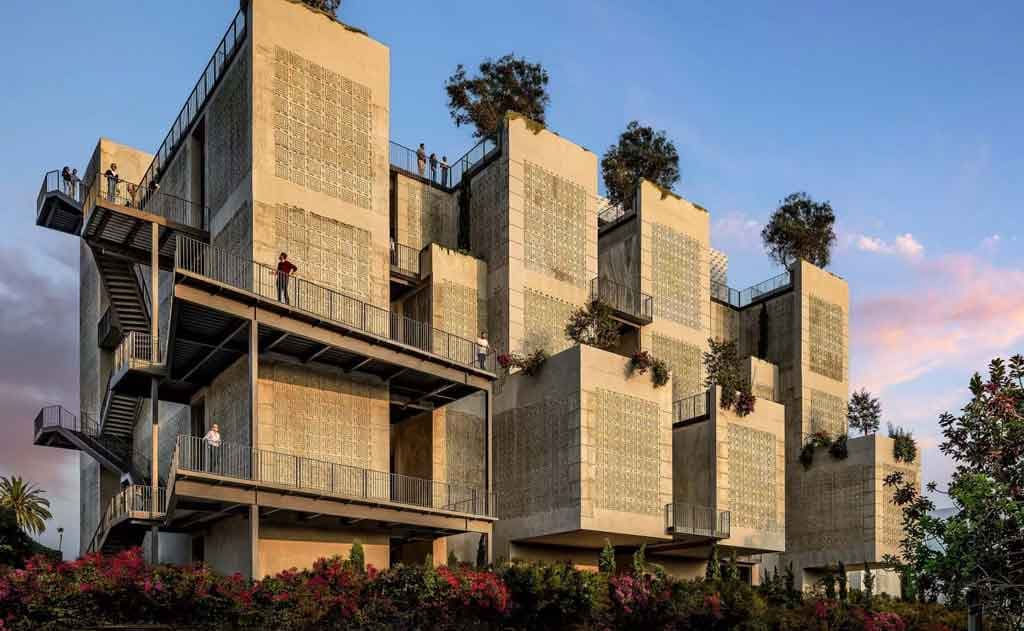
On January 2, 2025, Hollywood Forever Cemetery unveiled the first phase of the Gower Mausoleum, a striking five-story, 100-foot-tall structure designed to serve as a vertical resting place for Los Angeles’ elite, including its vibrant Indian diaspora. Located in the heart of Hollywood, this eco-brutalist monument, designed by Lehrer Architects LA and Arquitectura y Diseño, blends monumental concrete architecture with lush greenery, offering 22,500 crypts and 30,000 niches for cremated remains. For Non-Resident Indians (NRIs) in the U.S., particularly the 4.8 million-strong community in California, the mausoleum represents not only a modern solution to burial space constraints but also a cultural touchstone that resonates with their values of legacy, community, and environmental consciousness. This article explores the Gower Mausoleum’s design, its significance for Hollywood and the NRI community, and its role in redefining funerary spaces.
A Vertical Monument for a Modern Era
Hollywood Forever Cemetery, a 53-acre historic landmark established in 1899, is the final resting place of icons like Judy Garland, Rudolph Valentino, and Hattie McDaniel, as well as contemporary figures like Johnny Ramone and Chris Cornell. Known for its cultural events—film screenings, concerts, and the annual Día de los Muertos celebration—the cemetery has long been a community hub. The Gower Mausoleum, located adjacent to Paramount Studios and aligned with the Hollywood Sign, addresses Los Angeles’ critical shortage of burial spaces by going vertical, a necessity in a densely packed urban environment.
The mausoleum’s first phase, completed over four and a half years, includes 5,000 crypts and 8,000 niches, with two floors already sold out. Future phases, set to begin in spring 2025, will add 16,500 crypts and 22,000 niches, culminating in a 400-foot-long, 160,000-square-foot structure that will house over 50,000 deceased. Tyler Cassity, Hollywood Forever’s co-owner and president, emphasized its role in meeting “our community’s needs for death care,” while also serving the living through its innovative design.
Architectural Innovation and Eco-Brutalism
Designed by Michael B. Lehrer of Lehrer Architects LA and Roberto Sheinberg of Arquitectura y Diseño, the Gower Mausoleum is a testament to eco-brutalism, blending the stark concrete forms of 20th-century Brutalism with vibrant greenery. Its poured-in-place concrete structure, supported by a honeycomb of three-inch slabs, features cantilevered volumes extending over Gower Street, creating a dramatic streetscape. The design draws inspiration from minimalist artists like Donald Judd and Carl Andre, as well as ancient structures like Mesopotamian ziggurats and Mexican mastabas, evoking both permanence and spirituality.
The interiors are airy, with open breezeways, natural light, and Brazilian quartzite-lined corridors that provide texture and aid navigation. Studio-MLA’s landscape design integrates water walls, Italian cypresses, rosemary, bougainvillea, and rooftop gardens with olive trees and blue palms, offering 360-degree views of the Hollywood Hills, Pacific Ocean, and San Gabriel Mountains. Over time, climbing vines will envelop the concrete facade, transforming it into a living landmark. “This isn’t just a storage facility for the departed,” Lehrer told the Los Angeles Times. “It’s about making a place for the living to connect with the past while being inspired by their surroundings.”
Significance for the NRI Community
For NRIs, particularly those in California’s tech, entertainment, and professional sectors, the Gower Mausoleum holds unique appeal. The Indian diaspora values legacy and family continuity, often maintaining strong ties to cultural traditions around death and remembrance. The mausoleum’s modern design, with affordable burial options and digital memorials, aligns with these values while catering to urban lifestyles. Ricardo Pentreath, a Hollywood resident who purchased four crypts, noted its personal significance: “I used to bring my family to teach them how to drive here. This is a quad, so hopefully I’ll be here and maybe some of my children will join me.”
The NRI community in Los Angeles, numbering over 700,000, includes prominent figures in Hollywood, such as filmmakers and actors, who may see the mausoleum as a prestigious resting place. Its proximity to Paramount Studios and cultural events like Día de los Muertos resonates with NRIs familiar with vibrant community gatherings in India, such as Diwali or memorial ceremonies. Posts on X reflect enthusiasm, with @CBSEveningNews highlighting the mausoleum’s role as a “new five-story building for the deceased” at Hollywood Forever, home to stars revered by NRIs. However, some expressed concerns about its imposing design, with @MollyP25131886 questioning its fit in an “area of outstanding beauty.”
The mausoleum’s eco-friendly design, with passive ventilation and greenery, appeals to NRIs’ growing environmental consciousness, a priority for younger professionals in tech hubs like Silicon Valley. Its digital remembrance films, offered by Hollywood Forever, also align with the diaspora’s tech-savvy culture, allowing families to preserve legacies in a modern format. For NRIs with relatives in India, the mausoleum’s accessibility and cultural significance make it a viable option for honoring loved ones without the logistical challenges of repatriation.
Community and Cultural Impact
Hollywood Forever has redefined cemeteries as spaces for the living, hosting yoga, film screenings, and cultural festivals. The Gower Mausoleum extends this legacy, offering contemplative spaces for visitors like Vanessa Morales, who found comfort in its design: “My grandmother will rest here forever, but we come to take in the moment.” For NRIs, this community focus mirrors Indian traditions of collective mourning and celebration, making the cemetery a welcoming space for diverse diaspora groups.
The mausoleum’s alignment with Hollywood’s cultural landmarks enhances its appeal. Its views of the Hollywood Sign and Paramount Studios connect it to the entertainment industry, a draw for NRIs in film and media. The annual Día de los Muertos event, which attracts thousands with altars and performances, echoes Indian festivals, fostering a sense of belonging for NRIs. The cemetery’s revitalization since 1998, including affordable burial options, ensures accessibility for middle-class NRI families, a contrast to India’s often costly cremation and memorial practices.
Challenges and Future Phases
The mausoleum’s scale and design have sparked debate. Its $200 million construction cost and vertical approach, while innovative, face scrutiny for altering Hollywood Forever’s historic landscape. Some NRIs, like those in @NRI_Voice posts on X, worry about affordability, though Cassity emphasized inclusive pricing. The next phases, set to add 16,500 crypts and 22,000 niches by 2027, will test the project’s ability to balance growth with community needs. Engineering challenges, addressed by Brandow & Johnston, ensured structural integrity without compromising openness, but future expansions must maintain this balance.
Conclusion
The Gower Mausoleum, Hollywood’s newest landmark, redefines funerary spaces with its eco-brutalist design and community focus. For the NRI community, it offers a modern, culturally resonant resting place that honors legacy while embracing environmental and technological innovation. As a symbol of Hollywood’s enduring allure, it connects the Indian diaspora to the city’s cultural fabric, providing a space for reflection and celebration. With future phases on the horizon, the mausoleum promises to extend Hollywood Forever’s legacy for decades, serving as a bridge between the living and the departed in the heart of Tinseltown.
Related NRI Globe Coverage
- Tesla Diner Opens in Hollywood: A Retro-Futuristic Charging and Dining Experience
- Fall 2026 Hollywood Movie Preview for NRI Families — October, November, December Big Releases (Oscar Contenders, Marvel, Family Films)
- Hollywood This Week — September 17-21, 2026 New Movie Releases, Box Office Update and Where to Watch (NRI Family Guide)
- September 2026 Major Hollywood Movie Releases: Practical Magic 2, Onslaught, Resident Evil, The Uprising & More
- Hollywood and Country Music Pay Tribute to Dolly Parton — Specials, Memories, and Legacy Coverage Dominate US Screens
- Anne Hathaway Joins Tom Cruise in Highly Anticipated Days of Thunder 2 — Release Date and Casting Details Revealed
- NRI Guide to Hollywood Films with Indian Talent and Stories: 2026 Landscape
- NRI Stories on Hollywood and Global OTT in 2026: The Diaspora Content Wave Has Structural Reasons
Fresh from NRI Globe
- YouTuber Nandu's World (Rama Nandana) UK Visa & Job Fraud Case: Full Details + Key Lessons for NRIs (2026)
- Dussehra / Vijayadashami 2026 Events Country-Wise — Global NRI Directory (Ram Lila, Ravana Dahan, Durga Puja Pandals, Ayudha Puja Venues + Booking)
- Diwali 2026 Events Country-Wise — Global NRI Directory (White House, Leicester, London Trafalgar, Toronto, Auckland, Sydney Parramasala, Fiji, Mauritius, Trinidad, South Africa and More)
- Diwali / Deepavali 2026 Country-Wise NRI Celebrations — Complete Global Guide (USA, UK, Canada, Australia, Fiji, Mauritius, Trinidad, South Africa, UAE and 30+ Countries)