
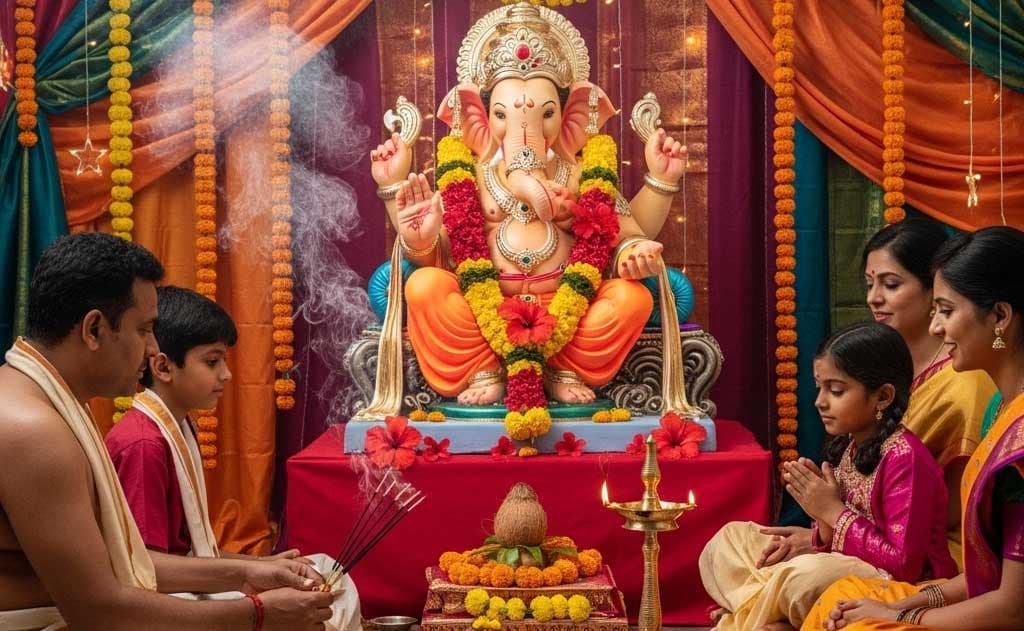
Ganesh Chavithi (Vinayaka Chaturthi) is one of the most celebrated Hindu festivals across the globe. For NRIs, celebrating this festival away from India is a way to stay connected with traditions, family values, and spirituality. Performing Ganesh Puja at home brings prosperity, removes obstacles, and strengthens cultural roots for children growing up abroad.
Here’s a simple, step-by-step guide to perform Ganesh Chavithi Puja at home, even if you are living outside India, along with the significance of each step.
Step 1: Preparation at Home
- Clean the house and decorate the Puja corner with flowers or rangoli.
- Place a clay Ganesh idol (eco-friendly idols are available online in many countries). If not available, you can also place a framed picture of Lord Ganesha.
- Arrange Puja essentials: flowers, fruits, coconut, turmeric, kumkum, incense sticks, diya, and sweets (Modak, Laddu, or any sweet available locally).
Why it matters: Cleanliness and preparation symbolize purity and readiness to welcome divine energy into the home.
Step 2: Sankalpa (Intention of Worship)
- Sit with family members and state your intention for performing the Puja (prayers for health, success, and removal of obstacles).
- Keep a small Kalash (pot with water, mango leaves, and a coconut) near the idol.
Why it matters: Sankalpa is your spiritual commitment, aligning thoughts and prayers with Lord Ganesha’s blessings.
Step 3: Avahana (Inviting Lord Ganesha)
- Light a diya (lamp) and incense sticks.
- Sprinkle a little turmeric rice (Akshata) in front of the idol while chanting: “Om Gan Ganapataye Namah.”
Why it matters: This step symbolizes welcoming Lord Ganesha into your home and heart.
Step 4: Shodashopachara Puja (16 Offerings – Simplified for Abroad)
Traditionally, 16 offerings are made, but NRIs can simplify with available items:
- Meditation – Close eyes, visualize Ganesha.
- Offering seat – Symbolic gesture by placing flowers.
- Offering water & sandal paste – If sandal paste is not available, use turmeric.
- Flowers & Durva Grass – If Durva is not available, offer any fresh green leaves or flowers.
- Incense & Lamp – Light incense and diya.
- Naivedyam (Food Offering) – Offer Modaks, Laddus, or any sweets like cookies, chocolates if traditional sweets are unavailable.
- Aarti – Perform Aarti with family, singing or playing Ganesh Aarti online.
Why it matters: The offerings represent devotion, gratitude, and sharing the best we have with the Divine.
Step 5: Ganesh Aarti with Family
- Perform Ganesh Aarti with a ghee or camphor lamp.
- Involve children by letting them clap and sing along.
Why it matters: Aarti spreads positivity, togetherness, and devotion within the family.
Step 6: Optional Homam (If Possible)
- If you are part of a temple or Indian community abroad, join a group Homam (Havan).
- At home, a simple offering of ghee and rice to the lamp can be done as symbolic Homam.
Why it matters: Fire rituals purify the home and strengthen prayers.
Step 7: Prasadam & Sharing
- Distribute sweets and prasadam among family and friends.
- Invite neighbors or friends to join the celebration and explain the festival’s significance, helping promote Indian culture abroad.
Why it matters: Sharing prasadam builds community, love, and unity.
Step 8: Ganesh Visarjan for NRIs
- Traditionally, idols are immersed in water. NRIs can do this in an eco-friendly way:
- Use a small clay idol and immerse it in a bucket of water at home, later pour the water into your garden.
- If using a photo, conclude the Puja with prayers, symbolizing visarjan in the heart.
Why it matters: Visarjan teaches us detachment and reminds us that everything is temporary, but God’s blessings remain with us always.
Related NRI Globe pillar guide: Returning to India — Complete Checklist for NRIs
Deeper Devotional Reading on Hindutone
For the ritual, scriptural and spiritual side of Ganesh Chaturthi — mantras, katha, spiritual meaning, temple lore and community devotion — our sister publication Hindutone covers Ganesh Chaturthi in depth:
- Ganesh Chaturthi Hub on Hindutone — the complete festival category with pujas, aartis, katha and rituals.
- Ganesh Mandapam Dos and Don’ts — a traditional guide to correct mandapam setup and worship etiquette.
- Ganesh Nimajjanam in Mumbai — the world’s largest Visarjan and its living traditions.
- Ganesh Nimajjanam in Hyderabad — Khairatabad, Tank Bund and the Telangana Visarjan story.
- The Deeper Spiritual Meaning of the Syamantaka Story — a contemplative reading of the moon-viewing avoidance and mithya dosha.
- Importance of the Ganesh Mantra “Vakratunda Mahakaya” — the meaning and power of the foundational Ganesh sloka.
- The Birth Story of Lord Ganesha — the classical Puranic account of the elephant-headed God.
- The Five Stories of Ganesh Chaturthi — the myths and legends behind the ten-day festival.
- Ganesh Festival’s Role in India’s Freedom Struggle — how Lokmanya Tilak transformed it into a public celebration.
- Shree Siddhivinayak Temple — the story and darshan of Mumbai’s most-visited Ganesh shrine.
NRI Globe focuses on diaspora practicalities — permissions, kits, community celebrations, recipes, songs and city guides. Hindutone focuses on the deeper devotional side — mantras, katha, temples and rituals. Together they cover the full Ganesh Chaturthi experience for Hindu families around the world.
Related NRI Globe Coverage
- Vinayaka Chavithi 2026: Date, Puja Muhurat, Timings, Rituals & Complete Guide for NRIs
- Top Telugu, Tamil and Kannada Ganesh Songs for NRI Families | Ganesh Chaturthi 2026
- Ganesh Chaturthi Puja at Home for NRI Families — Timing, Sankalpa & Substitutions (USA/UK/CA/AUS)
- Ganesh Chaturthi in Boston 2026 — Massachusetts Temples, Puja Timings & Events (NRI Guide)
- Ganesh Visarjan Abroad 2026: What NRIs Can and Cannot Do in the US, UK, Canada, Australia and the Gulf
- Sri Vinayaka Chavithi vs Ganesh Chaturthi — Regional Differences (Telugu, Tamil, Marathi, Gujarati) for NRIs 2026
- Ganesh Chaturthi 2026 for Kids Born Abroad — Activities, Stories, Crafts + Fun Learning Guide
- Ganesh Chaturthi 2026 Puja Vidhi + Muhurat + 21 Modak Types — Complete Ritual Guide for NRIs
Fresh from NRI Globe
- YouTuber Nandu's World (Rama Nandana) UK Visa & Job Fraud Case: Full Details + Key Lessons for NRIs (2026)
- Dussehra / Vijayadashami 2026 Events Country-Wise — Global NRI Directory (Ram Lila, Ravana Dahan, Durga Puja Pandals, Ayudha Puja Venues + Booking)
- Diwali 2026 Events Country-Wise — Global NRI Directory (White House, Leicester, London Trafalgar, Toronto, Auckland, Sydney Parramasala, Fiji, Mauritius, Trinidad, South Africa and More)
- Diwali / Deepavali 2026 Country-Wise NRI Celebrations — Complete Global Guide (USA, UK, Canada, Australia, Fiji, Mauritius, Trinidad, South Africa, UAE and 30+ Countries)