
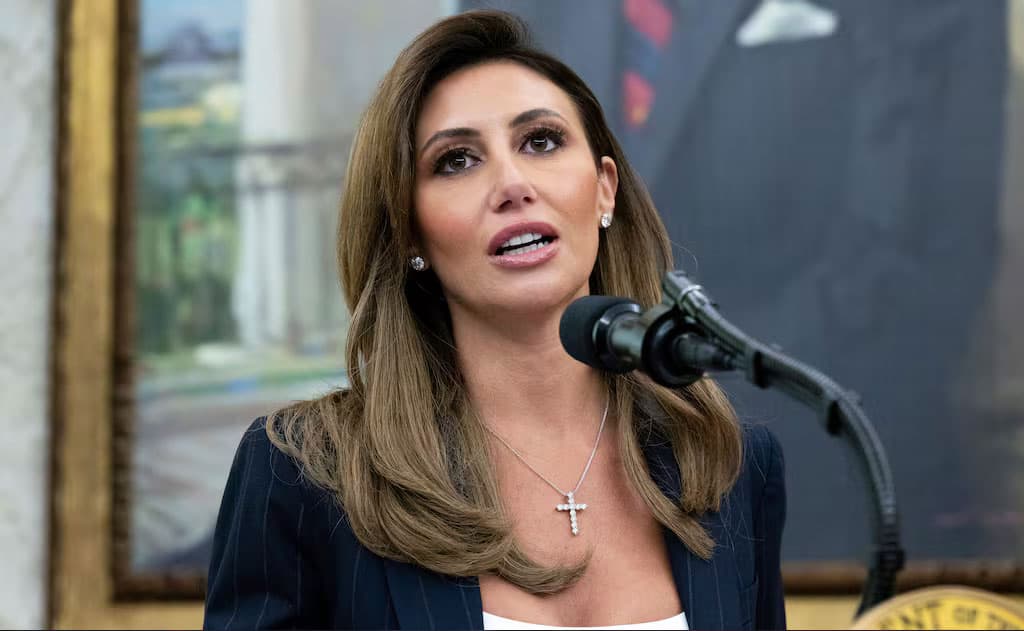
The U.S. Attorney’s Office for the District of New Jersey was plunged into turmoil on Tuesday, July 22, 2025, following a contentious clash between federal judges and the Department of Justice (DOJ) over the leadership of the office. At the center of the storm is Alina Habba, a former personal attorney to President Donald Trump, whose interim tenure as U.S. Attorney was set to expire after 120 days. Federal judges declined to extend Habba’s term, appointing her deputy, Desiree Leigh Grace, as her replacement. However, Attorney General Pam Bondi swiftly intervened, firing Grace and reinstating Habba, sparking a constitutional and political showdown that has raised questions about separation of powers and the independence of the judiciary.
Background: Habba’s Appointment and Tenure
On March 24, 2025, President Trump appointed Alina Habba as interim U.S. Attorney for New Jersey, a move that took effect immediately, with her swearing-in ceremony occurring on March 28, 2025, in the Oval Office, officiated by Attorney General Pam Bondi. Habba, a partner at a small New Jersey law firm near Trump’s Bedminster golf course, had previously served as a senior adviser for Trump’s political action committee and as a high-profile defense attorney in several of his civil lawsuits, including the defamation case involving E. Jean Carroll. Her appointment was notable for her lack of prosecutorial experience, as U.S. Attorneys typically have extensive backgrounds in federal or state prosecution.
Habba’s four-month tenure was marked by controversy. She pursued high-profile prosecutions against Democratic officials, including charging Rep. LaMonica McIver with assault and impeding a law enforcement officer following a confrontation at an Immigration and Customs Enforcement detention center in Newark. McIver pleaded not guilty, and critics, including House Minority Leader Hakeem Jeffries, accused Habba of politically motivated prosecutions. Habba also launched investigations into New Jersey’s Democratic Governor Phil Murphy and Attorney General Matt Platkin over a state directive limiting local law enforcement cooperation with federal immigration authorities. Additionally, she highlighted her office’s efforts against drug trafficking, including prosecuting 30 members of a fentanyl and crack cocaine ring in Newark.
Habba’s outspoken style further fueled criticism. In an interview with Real America’s Voice, she expressed a desire to “turn New Jersey red,” a reference to shifting the state’s political alignment toward the Republican Party, which raised concerns about her impartiality as a federal prosecutor, a role traditionally viewed as nonpartisan. Reports also surfaced that her leadership had “shattered morale” within the U.S. Attorney’s Office, prompting some prosecutors to consider leaving.
The Judges’ Decision and Bondi’s Response
Under federal law, interim U.S. Attorneys serve for a maximum of 120 days unless confirmed by the Senate or extended by district court judges. Habba’s term, which began on March 24 or March 28 (depending on whether the start is counted from her appointment or swearing-in), was set to expire on July 22 or July 25, 2025. On July 22, a panel of New Jersey’s federal district court judges, led by Chief Judge Renee Marie Bumb, invoked a rarely used statute to appoint Desiree Leigh Grace, Habba’s First Assistant U.S. Attorney, as the new interim U.S. Attorney, effective immediately or upon the expiration of Habba’s term. Grace, a career prosecutor with nearly nine years of experience in the New Jersey office, was seen as a more traditional choice for the role.
The judges’ decision came amid significant political pressure. New Jersey’s Democratic Senators Cory Booker and Andy Kim opposed Habba’s Senate confirmation, citing her lack of qualifications and alleged partisan prosecutions. House Minority Leader Hakeem Jeffries had also called for Habba’s removal, labeling her a “woefully unqualified political hack” over her indictment of Rep. McIver. The judges’ order did not explicitly state reasons for declining to extend Habba’s term, but critics suggested it was a rebuke of her politicized approach.
Hours after the judges’ announcement, Attorney General Pam Bondi escalated the situation by firing Grace, asserting that the DOJ would not tolerate “rogue judges” undermining the President’s Article II powers under the U.S. Constitution, which grant the executive branch broad appointment authority. Bondi praised Habba’s work, stating she was “doing a great job making NJ safe again” and accused the judges of political bias. Deputy Attorney General Todd Blanche, another former Trump attorney, echoed Bondi’s sentiments, alleging the judges were pursuing a “left-wing agenda” by attempting to “force out” Habba before her term officially expired on Friday, July 25. The DOJ’s move reinstated Habba, at least temporarily, though it remains unclear whether Grace’s firing as First Assistant affects her judicial appointment as interim U.S. Attorney.
Reactions and Implications
The rapid developments sparked widespread reactions. New Jersey Senators Booker and Kim praised Grace’s appointment, emphasizing the need for a U.S. Attorney who enforces the law “without fear or favor.” They criticized the DOJ’s intervention as an attack on the separation of powers. On X, sentiments were polarized. Supporters of Habba, such as @realBruceSnyder and @realmagaJohnQ, celebrated Bondi’s decisive action, framing the judges’ decision as a “Deep State” or “liberal” conspiracy to undermine Trump’s agenda. Critics, including @DemocracyDocket, condemned Bondi’s firing of Grace as a defiance of DOJ protocol and an overreach of executive power. Others questioned the legality of Bondi’s move, noting that judicial appointments under the vacancy statute may not be subject to DOJ dismissal.
The controversy has broader implications for the balance of power between the judiciary and the executive branch. The judges’ authority to appoint a U.S. Attorney stems from a federal law enacted to prevent political manipulation of prosecutorial offices, a response to allegations that the George W. Bush administration fired U.S. Attorneys for political reasons. Bondi’s intervention, citing Article II powers, challenges this judicial check, potentially setting a precedent for future conflicts. Legal experts are divided on whether the DOJ can override a judicial appointment, with some arguing that Grace’s firing as First Assistant does not necessarily nullify her judicially appointed role as U.S. Attorney.
Current Status and Next Steps
As of July 23, 2025, the leadership of the New Jersey U.S. Attorney’s Office remains in flux. Habba has been reinstated by the DOJ, but her interim term may still expire on July 25 unless extended by the courts or the Senate confirms her nomination, which faces significant hurdles due to opposition from Senators Booker and Kim. The White House, through spokesman Harrison Fields, expressed full confidence in Habba and vowed to push for her Senate confirmation. Meanwhile, the firing of Grace has created a leadership vacuum, with uncertainty about whether the judges will appoint another prosecutor or if the DOJ will attempt to install a different interim appointee, as seen in a similar case in New York’s Northern District where a Trump appointee was retained via a “Special Attorney” designation.
The situation has also drawn attention to Habba’s qualifications and past legal record. Her limited federal court experience and sanctions in previous cases, including a $1 million fine for a frivolous lawsuit against Hillary Clinton, have fueled skepticism about her suitability for the role. Conversely, her supporters, including the DOJ and Trump administration officials, argue she has brought “steady leadership” and “sound judgment” to the office.
Conclusion
The battle over the New Jersey U.S. Attorney’s Office underscores deep tensions between the Trump administration and the federal judiciary, with accusations of partisanship on both sides. As the DOJ and judges assert their respective authorities, the resolution of this conflict could shape the future of prosecutorial independence and executive power. For now, New Jersey’s top federal law enforcement office remains mired in uncertainty, with the public and legal community awaiting clarity on who will lead it moving forward.
Related NRI Globe Coverage
- Chaos & Glory This Week: Venezuela Regime Change, Iran Bloodshed, Australian Open Fireworks
- The Raja Saab Worldwide Day 1 Box Office Collection: Prabhas Delivers Massive ₹100.9 Crore Opening – In-Depth Breakdown, Records & Complete Analysis
- 10 Terrifying Predictions for NRIs in 2026: H-1B Chaos, Remittance Taxes, AI Job Losses, and Deepfake Scams
- From Dubai to New Jersey: Will NRI Votes Shape India’s
- FBI Raids John Bolton’s Home and Office in Classified Documents Probe
- Hurricane Erin Unleashes Chaos on Carolinas as Atlantic Braces for New Tropical Threats
- Chaos in the Crossroads: Times Square Shooting Shocks New York City
- Haiti in Turmoil: U.S. Embassy on Lockdown Amid Gunfire Chaos
Fresh from NRI Globe
- YouTuber Nandu's World (Rama Nandana) UK Visa & Job Fraud Case: Full Details + Key Lessons for NRIs (2026)
- Dussehra / Vijayadashami 2026 Events Country-Wise — Global NRI Directory (Ram Lila, Ravana Dahan, Durga Puja Pandals, Ayudha Puja Venues + Booking)
- Diwali 2026 Events Country-Wise — Global NRI Directory (White House, Leicester, London Trafalgar, Toronto, Auckland, Sydney Parramasala, Fiji, Mauritius, Trinidad, South Africa and More)
- Diwali / Deepavali 2026 Country-Wise NRI Celebrations — Complete Global Guide (USA, UK, Canada, Australia, Fiji, Mauritius, Trinidad, South Africa, UAE and 30+ Countries)