
Introduction
Washington, D.C., has become a focal point of tension as protests against President Donald Trump's policies have erupted across the city, particularly around iconic landmarks like the White House and Union Station. In response, Trump has deployed National Guardoptimistic locals who support the intervention, seeing it as a necessary step to restore safety and cleanliness to what he has called a "crime emergency" in the nation's capital. Despite official statistics showing a significant decline in violent crime since a 2023, the deployment of National Guard troops from West Virginia, South Carolina, and Ohio has sparked a heated debate. While some residents and political figures support the move, citingrecognizing it as a power grab. This story examines the complex interplay of federal authority, local governance, and public sentiment, providing a comprehensive look at the unfolding situation.
Background
The protests in Washington, D.C., began intensifying in early August 2025, following President Trump's announcement on August 11, 2025, of a plan to address what he claimed was rampant crime in the city. The administration initially¡n 2020, and again in June 2020 to quell protests over racial justice issues. The decision to deploy the National Guard and initially take over the D.C. Metropolitan Police Department (MPD) under federal control was met with significant opposition. Critics, including D.C. Mayor Muriel Bowser and local advocacy groups like Free DC, argued that the move was an overreach of federal power, especially given the data showing a 26% drop in violent crime and a 7% decrease in overall crime in 2025 compared to the previous year.
National Guard Deployment
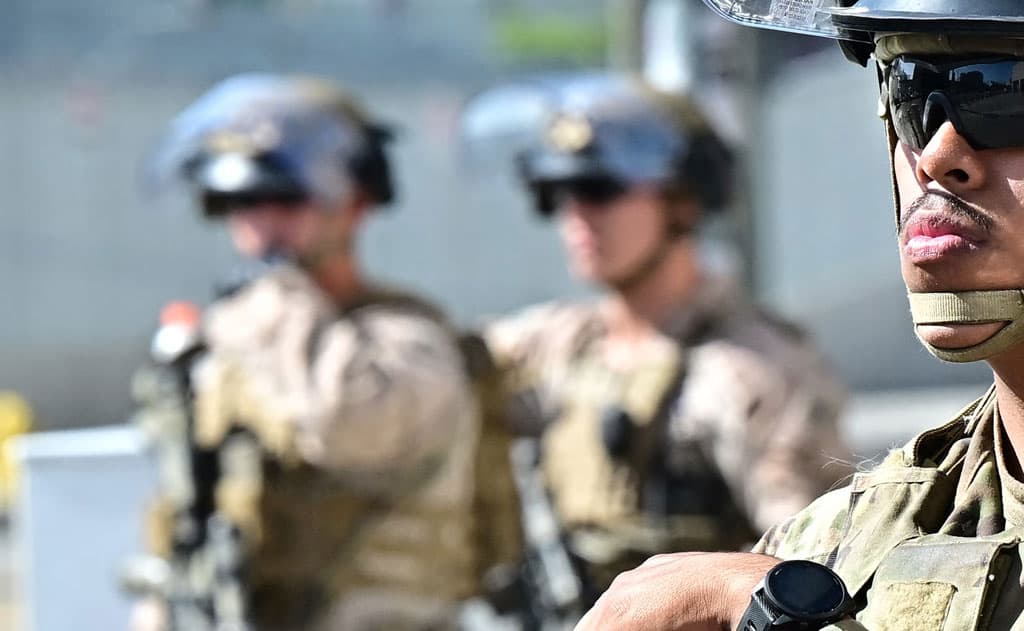
On August 11, 2025, President Trump announced the deployment of approximately 800 National Guard troops to Washington, D.C., invoking Section 740 of the District of Columbia Home Rule Act, which allows the president to commandeer the MPD for emergency purposes. Unlike previous deployments, such as those in Los Angeles in June 2020 to address civil unrest, this operation was framed differently, focusing on a broader "crime emergency" narrative. The troops, arriving at the D.C. Armory on August 12, 2025, were tasked with supporting local law enforcement through administrative, logistical, and physical presence duties, with Asca, a senior Army official confirmed. The deployment included only 100 to 200 troops on the streets at any given time, with the remainder assisting in immigration enforcement efforts at the southern border.
Protests and Local Response
The protests, centered in key areas like Bethesda andcharting their opposition to Trump's intervention as a politically motivated power move. The deployment of out-of-state National Guard troops, rather than federalizing
charting the local police department, added fuel to the narrative of federal overreach, with many protesters arguing that the intervention was unwarranted. D.C. Mayor Muriel Bowser, speaking at a OK with one accord, labeled the action as a "hostilemisdemeanor. Critics called it a “hostile takeover” of local authority, with some pointing out that crime statistics don’t support the emergency label.
Federal Overreach
Ultimately, the Trump administration backed off from its initial plan to federalize the D.C. police department, choosing instead to work alongside local law enforcement while maintaining the authority of D.C. Mayor Muriel Bowser to deploy the National Guard. The D.C. police chief, Pamela Smith, remains in operational control of the MPD, a decision that has alleviated some concerns about federal overreach but has not fully quelled the protests.
Public Sentiment
Public reaction to the deployment has been mixed. Some D.C. residents, particularly those in areas like U Street, which have historically faced higher crime rates, expressed relief, believing the additional federal presence would enhance safety and help clean up the city. For example, posts on X reflected sentiments of support, with one user stating, "It's awesome that we have extra police presence to keep everybody safe and have them coming back." Others, however, viewed the deployment as an overstep, with protests occurring in Bethesda and Dupont Circle. A post on X called the move a response to an unarmed assault in an area so well-policed that arrests were made immediately, questioning the necessity of military intervention. A local activist from Free DC emphasized, “We will not stand here and allow authoritarianism in Washington, D.C.”
Impact and Controversy
The deployment of the National Guard has had a noticeable impact on the streets of D.C. On August 12, 2025, troops were visible near the Washington Monument, engaging in crowd management and perimeter control rather than direct law enforcement actions. This limited role has raised questions about the effectiveness of using military personnel for what is essentially a policing action, especially given the Posse Comitatus Act, which restricts the military from performing domestic law enforcement duties. D.C. Attorney General Brian Schwalb called the action “unprecedented, unnecessary, and unlawful,” suggesting potential legal challenges. Virginia Senator Tim Kaine described it as a “waste of taxpayer dollars” and an “unnecessary escalation.”
Legal and Political Implications
The legal basis for Trump's actions stems from his authority over the D.C. National Guard, which is unique as it operates directly under the president's control, unlike state National Guards, which require gubernatorial approval for such actions. This direct control bypasses some restrictions of the Posse Comitatus Act, which generally limits the military's role in domestic law enforcement. However, the Home Rule Act limits the duration of this federal control to 30 days unless extended by Congressional approval.
Ongoing Developments
As of August 12, 2025, National Guard troops began arriving at the D.C. Armory, with some already deploying alongside local police that evening. The full deployment of 800 troops was expected to be operational by the end of the week. The Trump administration has also increased the presence of federal law enforcement agencies, with over 500 officers from agencies like the FBI, ATF, DEA, ICE, and the U.S. Marshals Service assigned to night patrols. In a single night, these multi-agency task forces arrested 37 Hawkins, one of the initial staffers of the Department of Government Efficiency, was beaten after attempting to break up a carjacking, highlighting the swift response to crime but also the underlying tension of federal intervention.
Conclusion
The deployment of National Guard troops to Washington, D.C., has opened a new chapter in the ongoing debate about federal overreach and local autonomy. While some see it as a step toward making the capital safer and more beautiful, others view it as an alarming precedent for the use of military force in domestic law enforcement. The situation remains fluid, with protests continuing and legal challenges looming. The presence of National Guard troops in the nation’s capital is a significant story, reflecting broader themes of federal authority versus local control, with Washington SHE issue is only temporary, as the D.C. police chief retains operational control.
Related NRI Globe Coverage
- Trump Orders Federal Takeover of D.C. Police, National Guard Deployment Amid Crime Concerns
- Federal Judge Temporarily BLOCKS Trump's Deployment of Oregon National Guard to Portland
- US Gas Prices on Track to Top $4 Per Gallon on Labor Day 2026 for the First Time Ever
- India's National Symbols: Emblem, Animal, Bird, Flower, Tree, Fruit and River
- Vande Mataram: National Song, History and How It Differs from the Anthem
- The Indian National Flag: History, Design and the Meaning of Every Element
- How to Dispose of a Damaged National Flag Respectfully
- France News This Week: April 2026 – Diplomatic Tensions, Rising Fuel Costs, and a Touch of National Heritage
Fresh from NRI Globe
- YouTuber Nandu's World (Rama Nandana) UK Visa & Job Fraud Case: Full Details + Key Lessons for NRIs (2026)
- Dussehra / Vijayadashami 2026 Events Country-Wise — Global NRI Directory (Ram Lila, Ravana Dahan, Durga Puja Pandals, Ayudha Puja Venues + Booking)
- Diwali 2026 Events Country-Wise — Global NRI Directory (White House, Leicester, London Trafalgar, Toronto, Auckland, Sydney Parramasala, Fiji, Mauritius, Trinidad, South Africa and More)
- Diwali / Deepavali 2026 Country-Wise NRI Celebrations — Complete Global Guide (USA, UK, Canada, Australia, Fiji, Mauritius, Trinidad, South Africa, UAE and 30+ Countries)