
By NRIGlobe Desk | March 2, 2026
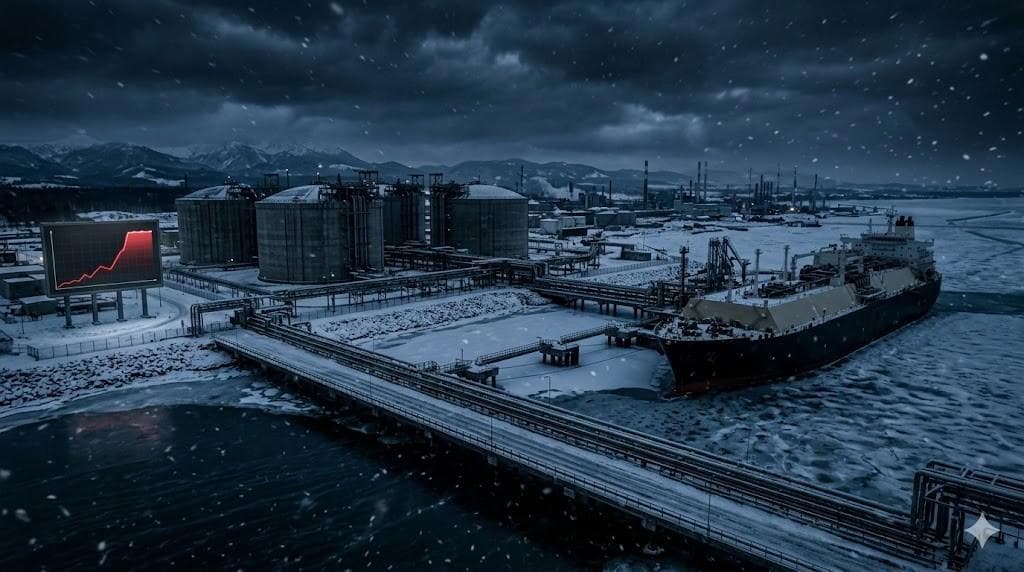
European natural gas prices have skyrocketed more than 50% in the past 48 hours following an unexpected announcement from Qatar that it is halting production at several key LNG facilities due to a major technical failure and safety concerns. The sharp rally — the largest single-week move since the 2022 energy shock — has sent shockwaves through power markets, utilities, and households across the continent just as colder weather sets in.
What Happened: Qatar’s Sudden Production Halt
On February 28, 2026, QatarEnergy declared force majeure on multiple LNG trains at the North Field East and North Field South expansion projects, citing “critical safety and integrity issues” discovered during routine inspections. While no official timeline for resumption has been given, industry sources indicate repairs could take 4–12 weeks, removing up to 25–30 million tonnes per annum (MTPA) of LNG from global supply — roughly 8–10% of the world’s total seaborne LNG.
Qatar is the world’s largest LNG exporter and supplies roughly 15–18% of Europe’s LNG imports in a typical winter. The sudden loss has triggered immediate panic buying on the TTF (Title Transfer Facility) benchmark in the Netherlands — Europe’s main gas trading hub.
Price Movements – Record Spike in Days
- TTF front-month March contract: +52% since February 27 close (from €38/MWh to over €58/MWh as of March 2 morning)
- April–June contracts: +38–45% in sympathy
- UK NBP benchmark: Similar surge, crossing £5.00/therm for the first time since March 2023
- Asian JKM LNG spot prices also jumped +28%, tightening global supply further
This marks the largest weekly percentage gain in European gas prices since the immediate aftermath of Russia’s invasion of Ukraine in 2022.
Why It’s Hitting Europe So Hard Right Now
Several factors have amplified the impact:
- Low storage levels — European gas storage is at ~38% (well below the five-year average for early March).
- Reduced Norwegian pipeline flows — maintenance and unplanned outages have cut Norwegian exports by ~15–20% this week.
- Limited LNG alternatives — U.S. Gulf Coast terminals are already at near-full utilization shipping to Europe and Asia; new Australian and Qatari volumes were already committed.
- Cold snap forecast — ECMWF and GFS models show a strong high-pressure block over Scandinavia and Western Russia next week, pushing temperatures 4–7°C below normal across Germany, France, UK, and Benelux.
- Power sector switching — Coal-to-gas switching has accelerated as coal plants reach emission limits and gas becomes the marginal fuel.
Immediate Consequences for European Households & Industry
- Household bills — Suppliers in Germany, Netherlands, France, Italy, and the UK have already issued force majeure notices on fixed-price contracts and warned of emergency surcharges.
- Industrial curtailments — Fertilizer, chemicals, glass, and ceramics plants in Germany and the Netherlands have begun reducing output or shutting down lines.
- Electricity prices — Day-ahead power prices in Germany and France surged 70–110% intraday on March 1–2.
- Political pressure — Emergency meetings of EU energy ministers scheduled for March 4; calls for coordinated strategic reserve releases and accelerated renewable permitting.
What Happens Next?
Analysts are watching three critical variables:
- Duration of Qatar outage — If resolved in 4–6 weeks, the spike may moderate by late April. Longer delays could push summer injection season into deficit.
- U.S. LNG response — Can U.S. terminals divert more cargoes from Asia to Europe without triggering Asian spot price blowouts?
- Weather — A prolonged cold spell through mid-March could force rationing in Central Europe.
For Indian diaspora families and businesses in Europe — many in Germany, UK, Netherlands, and Belgium — the surge comes at the worst possible time: heating bills already elevated from last winter’s volatility, combined with high inflation and cost-of-living pressures.
NRIGlobe will continue to track developments, including any emergency EU measures, LNG cargo rerouting, and statements from QatarEnergy.
NRIGlobe.com brings you real-time global energy updates and diaspora-focused analysis. Share your experience with rising energy costs in Europe below.
#EuropeanGasCrisis #QatarLNG #NaturalGasPrices2026 #EnergySecurityEurope #TTFPriceSurge
Related NRI Globe Coverage
- US News Weekly NRI Briefing — September 9, 2026 (Tariffs, Jobs, Gas Prices, H-1B, Visa, Diaspora)
- Labor Day 2026 Gas Prices Hit Record High — How It's Affecting NRI Travel Plans Across the USA
- US Gas Prices on Track to Top $4 Per Gallon on Labor Day 2026 for the First Time Ever
- Iran Blockade 2026: Impact on NRIs & Gas Prices
- Trump Imposes Up-to-100% Tariffs on Foreign-Made Drones (Effective Sep 3, 2026) — DJI, Chinese Suppliers Hit Hard
- Women Accounted for 98% of US Job Gains in August 2026 — What It Means for the Economy & NRIs
- Iran War 2026: Why Fuel Prices Still Rising in India
- Europe March 2026: Impact on Indian NRIs & Students
Fresh from NRI Globe
- YouTuber Nandu's World (Rama Nandana) UK Visa & Job Fraud Case: Full Details + Key Lessons for NRIs (2026)
- Dussehra / Vijayadashami 2026 Events Country-Wise — Global NRI Directory (Ram Lila, Ravana Dahan, Durga Puja Pandals, Ayudha Puja Venues + Booking)
- Diwali 2026 Events Country-Wise — Global NRI Directory (White House, Leicester, London Trafalgar, Toronto, Auckland, Sydney Parramasala, Fiji, Mauritius, Trinidad, South Africa and More)
- Diwali / Deepavali 2026 Country-Wise NRI Celebrations — Complete Global Guide (USA, UK, Canada, Australia, Fiji, Mauritius, Trinidad, South Africa, UAE and 30+ Countries)