
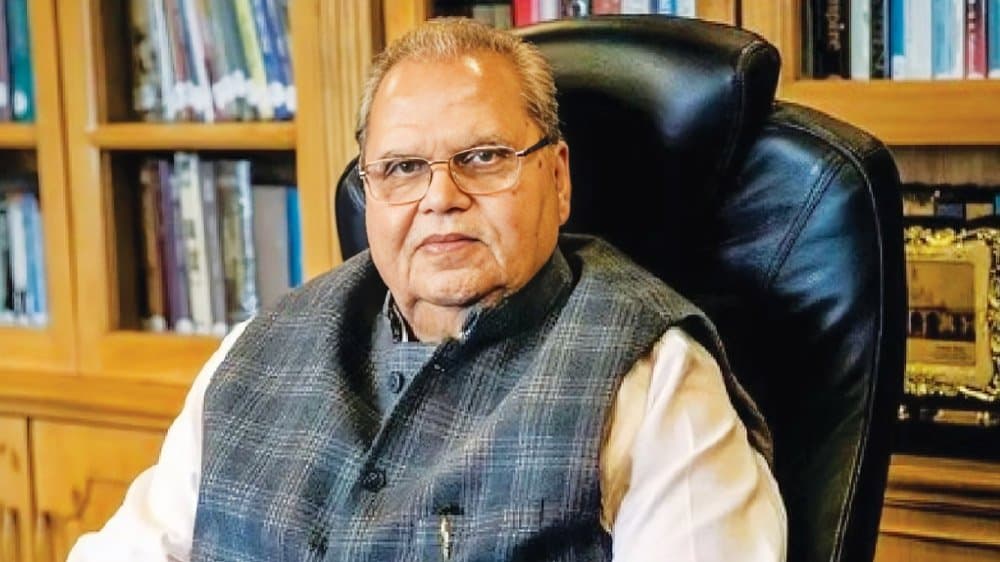
Former Governor Satyapal Malik Dies at 79: A Legacy of Candor and Controversy
Satyapal Malik, a towering figure in Indian politics whose career spanned over five decades, passed away on August 5, 2025, at the age of 79. He succumbed to a prolonged kidney-related ailment at Delhi’s Ram Manohar Lohia Hospital, where he had been under intensive care since May 2025. His death, coinciding with the sixth anniversary of the abrogation of Article 370, marks the end of a remarkable journey defined by political versatility, outspoken criticism, and a commitment to public welfare.
Early Life and Political Beginnings
Born on July 24, 1946, in Hisawada village in Uttar Pradesh’s Baghpat district, Malik hailed from a Jat family. His political journey began in the mid-1960s, inspired by the socialist ideology of Dr. Ram Manohar Lohia. A graduate with a Bachelor of Science and LLB from Meerut University, Malik emerged as a student leader, serving as president of the Meerut College Students Union and later the Students Union at Meerut University (now Chaudhary Charan Singh University). His early activism laid the foundation for a career marked by boldness and conviction.
Malik’s first electoral success came in 1974 when he was elected as an MLA from Baghpat on the ticket of Chaudhary Charan Singh’s Bharatiya Kranti Dal, defeating his nearest rival from the Communist Party of India. Over the years, he aligned with multiple political parties, including the Lok Dal, Congress, Janata Dal, and Samajwadi Party, showcasing his adaptability in India’s dynamic political landscape. He served as a Rajya Sabha MP from 1980 to 1989 and as a Lok Sabha MP from Aligarh from 1989 to 1991, representing the Janata Dal. In 1990, he briefly held the position of Union Minister of State for Parliamentary Affairs and Tourism.
Gubernatorial Tenure and Key Moments
Malik’s gubernatorial career began in 2017 when he was appointed Governor of Bihar, with a brief additional charge of Odisha in 2018. Later that year, he took on the pivotal role of Governor of Jammu and Kashmir, becoming the first politician appointed to the post since the onset of militancy in the region. His tenure from August 2018 to October 2019 was marked by two seismic events: the abrogation of Article 370 on August 5, 2019, which revoked Jammu and Kashmir’s special status and bifurcated the state into two Union Territories, and the Pulwama terror attack in February 2019, which claimed the lives of 40 CRPF personnel.
As Governor, Malik facilitated urban local body and panchayat elections, a move seen as a step toward reviving grassroots democracy in a tense political environment. However, his role in the abrogation of Article 370 sparked controversy. Critics argued that constitutional procedures, particularly the requirement for concurrence with the state government, were bypassed. Malik himself later revealed he was informed of the decision only a day prior and was instructed to approve it swiftly, stating, “It was their government. Whether they wanted to keep it or remove it, why would I object?”
Following his stint in Jammu and Kashmir, Malik served as Governor of Goa (2019–2020) and Meghalaya (2020–2022). His candid remarks often put him at odds with the central government. In Goa, he criticized the state’s COVID-19 response and ration distribution, while in Bihar, he alleged widespread corruption in politician-owned BEd colleges.
Controversies and Outspoken Criticism
Malik’s relationship with the Bharatiya Janata Party (BJP) and the Narendra Modi-led government deteriorated around 2020–2021, particularly after he vocally supported the farmers’ protests against the now-repealed farm laws. He condemned the government’s handling of the protests, warning against the alienation of farmers, particularly Sikhs, and highlighted the deaths of over 600 protesters. His remarks, such as “You cannot send farmers back humiliated,” resonated with many but strained his ties with the BJP.
His most explosive allegations came in a 2023 interview with journalist Karan Thapar, where he flagged significant security lapses in the Pulwama attack. Malik claimed that the attack, carried out by a suicide bomber from the Pakistani terror outfit Jaish-e-Mohammed, resulted from “grave intelligence failure” and negligence by the Central Reserve Police Force (CRPF) and the Union Home Ministry. He alleged that the CRPF’s request for air transport was denied, forcing personnel to travel by road, making them vulnerable to the attack. Malik further claimed that Prime Minister Narendra Modi and National Security Advisor Ajit Doval instructed him to remain silent on these lapses, suggesting the blame would be shifted to Pakistan. These statements triggered a political storm, with the BJP questioning his credibility by sharing past clips of him praising the government.
Malik also accused the government of inaction on corruption. He claimed he was offered bribes of up to ₹150 crore to approve contracts linked to powerful interests, including an Ambani-linked group and a senior RSS leader, during his tenure as Governor. He alleged that his transfer from Goa to Meghalaya in 2020 was a result of raising these issues with the Prime Minister. In 2025, the Central Bureau of Investigation (CBI) named him in a chargesheet related to alleged corruption in the Kiru Hydro Electric Project, a charge Malik denied, claiming it was an attempt to intimidate him.
Advocacy and Legacy
Malik’s outspokenness extended beyond security and governance. His support for the farmers’ protests brought him closer to the Opposition, notably Congress leader Rahul Gandhi, who interviewed him in 2023 and visited him in the hospital in May 2025. Malik’s critiques, including his claim that the 2019 Lok Sabha elections were “fought on the bodies of our soldiers” in reference to the Pulwama attack, underscored his willingness to challenge the establishment, even at personal cost.
Despite controversies, Malik’s legacy is one of resilience and candor. As a Jat leader from Uttar Pradesh, he championed the concerns of farmers and marginalized communities. His tenure as Governor during critical moments in Jammu and Kashmir’s history, coupled with his fearless commentary on national issues, cemented his reputation as a politician unafraid to speak truth to power. Prime Minister Narendra Modi, in a condolence message, expressed sadness at his passing, noting, “My thoughts are with his family and supporters in this hour of grief. Om Shanti.”
Final Days and Tributes
Malik’s health had been deteriorating since May 2025, when he was admitted to Ram Manohar Lohia Hospital with a complicated urinary tract infection. His condition worsened, leading to refractory septic shock, hospital-acquired pneumonia, and multi-organ dysfunction. Despite aggressive medical interventions, including dialysis and ventilatory support, he developed disseminated intravascular coagulation (DIC) and acute kidney injury, passing away at 1:12 PM on August 5, 2025. His mortal remains were taken to his residence in R K Puram, with his cremation scheduled for August 6 at Lodhi crematorium.
Tributes poured in from across the political spectrum. Aam Aadmi Party leaders described him as a “fearless leader” who spoke boldly on national issues. Social media posts on X reflected mixed sentiments, with some lauding his courage in exposing alleged government failures, while others criticized his shifting political allegiances. One post noted, “He was the first to raise his voice for the jawans who died in the Pulwama attack,” highlighting his advocacy for security personnel.
Conclusion
Satyapal Malik’s life was a tapestry of service, controversy, and conviction. From his roots as a student leader to his role as a governor during pivotal moments in India’s history, he navigated the complexities of Indian politics with a rare outspokenness. His criticisms of the Pulwama attack, the abrogation of Article 370, and government policies on farmers’ welfare sparked debates that will continue to shape his legacy. As India reflects on his contributions, Malik will be remembered as a leader who, in his own words, sought to “tell the truth” to his countrymen, no matter the cost.
Related NRI Globe Coverage
- Jesse Jackson Dies at 84: Civil Rights Legacy
- Former CNN Anchor Don Lemon Arrested in LA
- Vince Zampella Death: Call of Duty Co-Creator Vince Zampella Dies at 55 in Tragic
- Joshua Jahn Kills One Detainee in Dallas ICE Facility Shooting, Dies by Suicide
- Nobel Peace Prize Controversy: Three Committee Members Oppose Trump’s 2026 Bid
- Microsoft Engineer Pratik Pandey Dies at Silicon Valley Campus
- Former Gymnastics Coach Arrested on Child Pornography Charges in FBI Raid
- Tristan Rogers, General Hospital’s Robert Scorpio, Dies at 79: A Soap Opera Legend Remembered
Fresh from NRI Globe
- YouTuber Nandu's World (Rama Nandana) UK Visa & Job Fraud Case: Full Details + Key Lessons for NRIs (2026)
- Dussehra / Vijayadashami 2026 Events Country-Wise — Global NRI Directory (Ram Lila, Ravana Dahan, Durga Puja Pandals, Ayudha Puja Venues + Booking)
- Diwali 2026 Events Country-Wise — Global NRI Directory (White House, Leicester, London Trafalgar, Toronto, Auckland, Sydney Parramasala, Fiji, Mauritius, Trinidad, South Africa and More)
- Diwali / Deepavali 2026 Country-Wise NRI Celebrations — Complete Global Guide (USA, UK, Canada, Australia, Fiji, Mauritius, Trinidad, South Africa, UAE and 30+ Countries)