
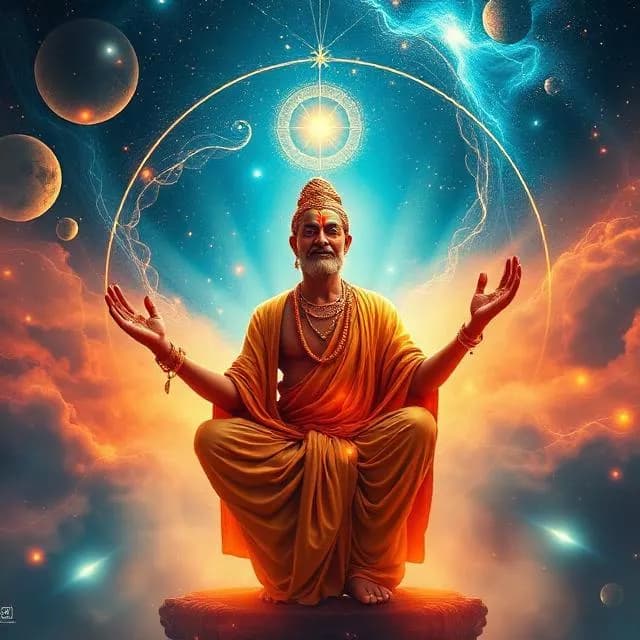
From the Vedas to Quantum Physics: How Indian Wisdom
The early 20th century marked a revolutionary shift in science with the emergence of quantum mechanics—a field that challenged long-held notions of reality, causality, and observation. Remarkably, several of the era's most influential physicists found profound intellectual and philosophical resonance in ancient Indian texts. The Upanishads, Bhagavad Gita, Vedas, and Vedanta philosophy offered frameworks for understanding unity, consciousness, and interconnectedness that aligned strikingly with quantum discoveries.
Niels Bohr, Werner Heisenberg, J. Robert Oppenheimer, and Erwin Schrödinger—visionaries who shaped modern physics—drew inspiration from these Hindu scriptures. For the global Indian diaspora and those fascinated by India's contributions to world knowledge, this convergence highlights how timeless Indian wisdom continues to influence cutting-edge thought across borders.
Niels Bohr: Questioning Reality Through the Upanishads
Niels Bohr, the pioneering Danish physicist whose work on atomic structure and quantum complementarity earned him the 1922 Nobel Prize, frequently turned to the Upanishads for deeper insight.
He openly shared:
“I go into the Upanishads to ask questions.”
Advertisement
Bohr was captivated by the Upanishadic declaration of unity: Atman (individual self) equals Brahman (universal self). He described this as:
“...the quintessence of deepest insight into the happenings of the world.”
For Bohr, quantum complementarity—where light behaves as both wave and particle depending on observation—mirrored the non-dualistic resolution of apparent contradictions in Vedanta. The role of the observer in quantum measurement echoed Indian philosophical views on consciousness as fundamental to reality. Bohr's engagement with Eastern thought, including the yin-yang symbol on his coat of arms, reflected a broader appreciation for holistic perspectives that Indian traditions embody.
Werner Heisenberg: Finding Clarity in Indian Philosophy
Werner Heisenberg, whose uncertainty principle revealed fundamental limits to precise measurement in nature, experienced philosophical upheaval in developing quantum theory. A 1929 visit to India proved transformative, particularly his discussions with Rabindranath Tagore on Indian philosophy.
Heisenberg later reflected:
“After the conversations about Indian philosophy, some of the ideas of Quantum Physics that had seemed so crazy suddenly made much more sense.”
He went on to say:
“Quantum theory will not look ridiculous to people who have read Vedanta.”
Concepts like Maya (illusion) and the interconnected, non-absolute nature of phenomena helped Heisenberg reconcile quantum indeterminacy with a coherent worldview. While his equations were derived purely through mathematics, Indian philosophy provided a cultural and intellectual bridge, making the "weirdness" of quantum mechanics feel less alien.
J. Robert Oppenheimer: Strength from the Bhagavad Gita
J. Robert Oppenheimer, the brilliant physicist who led the Manhattan Project, developed a deep personal connection to Indian scriptures. In the 1930s, he learned Sanskrit and mastered the Bhagavad Gita in its original form, calling it one of the most profound philosophical texts he knew.
During the Trinity nuclear test in 1945, as the first atomic explosion lit the desert sky, Oppenheimer recalled verses from the Gita's cosmic vision:
“Now I am become Death, the destroyer of worlds.”
(Drawing from Chapter 11, Verse 32, where Lord Krishna reveals his universal form as time, the great destroyer.)
He also evoked the blinding splendor: “If the radiance of a thousand suns were to burst at once into the sky...”
The Gita's teachings on duty (dharma), detachment, and selfless action guided Oppenheimer through the moral weight of his work. Like Arjuna facing battle, he saw his role as unavoidable yet fraught. In later years, reflecting on nuclear responsibility, he continued to draw wisdom from the text, becoming an advocate for international control of atomic weapons.
Oppenheimer considered access to Vedic literature “the greatest privilege this century may claim over all previous centuries.”
Erwin Schrödinger: Vedanta as Scientific Mirror
Erwin Schrödinger, whose wave mechanics equation remains central to quantum theory, had perhaps the most explicit and sustained engagement with Vedanta. He saw direct parallels between his physics and Advaita philosophy:
“The unity and continuity of Vedanta are reflected in the unity and continuity of wave mechanics... entirely consistent with the Vedanta concept of All in One.”
Schrödinger embraced the core teaching:
“Vedanta teaches that consciousness is singular, all happenings are played out in one universal consciousness and there is no multiplicity of selves.”
And: “The multiplicity is only apparent. This is the doctrine of the Upanishads.”
The quantum wave function—a unified field of possibilities—mirrored Brahman, the unchanging reality beneath the illusion of separate forms (Maya). Schrödinger read the Upanishads and Gita regularly, even naming his beloved dog Atman.
Enduring Parallels: Quantum Science and Indian Wisdom
These pioneers identified compelling alignments:
- Non-Duality (Advaita): Atman-Brahman oneness resembles quantum entanglement and non-locality—distant particles linked instantaneously, suggesting underlying unity.
- Consciousness and Observation: The observer's role in collapsing quantum possibilities parallels Vedanta's view that reality manifests through consciousness.
- Illusion and Probability: Maya veils true unity, much like superposition hides definite states until measured.
- Interconnectedness: Vedic views of an interdependent cosmos prefigure modern quantum field theories.
These scientists did not claim to derive formulas from scriptures, but found in Indian philosophy a mature tradition ready to embrace paradox, unity, and consciousness—ideas Western science was only beginning to confront.
A Proud Legacy for the Global Indian Community
For NRIs and people of Indian heritage worldwide, the influence of Hindu philosophy on these quantum giants is a source of cultural pride. It affirms India's ancient contributions to human understanding—ideas born on the banks of the Saraswati and Ganga now echoing in laboratories from Copenhagen to Los Alamos.
In an era of quantum computing, artificial intelligence, and renewed interest in consciousness, the insights of the Vedas and Upanishads remain remarkably relevant. As these pioneers demonstrated, true progress often emerges when diverse intellectual traditions meet.
Related NRI Globe Coverage
- JWST Confirms Hubble Tension – New Physics in 2026?
- YouTuber Nandu's World (Rama Nandana) UK Visa & Job Fraud Case: Full Details + Key Lessons for NRIs (2026)
- US Crime News 2026 — Top Trend Categories NRIs Are Watching (Organized Retail Theft, Auto Theft, Cybercrime, Hate Crimes, Fentanyl, AI-Enabled Fraud)
- US Crime & Safety This Week — September 17-21, 2026 (NRI Family Guide, FBI Alerts, H-1B/Immigration Scams, Tech Support Fraud, Emergency Resources)
- Japan's Centenarian Population Surpasses 100,000 for the First Time in History
- Major US News This Week (September 14-15, 2026): Supreme Court Blocks Trump Mail Voting Rules, AI Debate Explodes, Space Weapons Confirmed
- How AI Is Changing NRI Life 2026 — Visas, Jobs, Money, Family and the New Frauds
- $5,000 Trump Dividend Proposal — Complete Details, Feasibility & NRI Impact Analysis (Nov 2026 Midterms)
Fresh from NRI Globe
- Dussehra / Vijayadashami 2026 Events Country-Wise — Global NRI Directory (Ram Lila, Ravana Dahan, Durga Puja Pandals, Ayudha Puja Venues + Booking)
- Diwali 2026 Events Country-Wise — Global NRI Directory (White House, Leicester, London Trafalgar, Toronto, Auckland, Sydney Parramasala, Fiji, Mauritius, Trinidad, South Africa and More)
- Diwali / Deepavali 2026 Country-Wise NRI Celebrations — Complete Global Guide (USA, UK, Canada, Australia, Fiji, Mauritius, Trinidad, South Africa, UAE and 30+ Countries)
- Dussehra / Vijayadashami 2026 Country-Wise NRI Celebrations — USA, UK, Canada, Australia, New Zealand, UAE, Singapore, Germany, Netherlands and More