
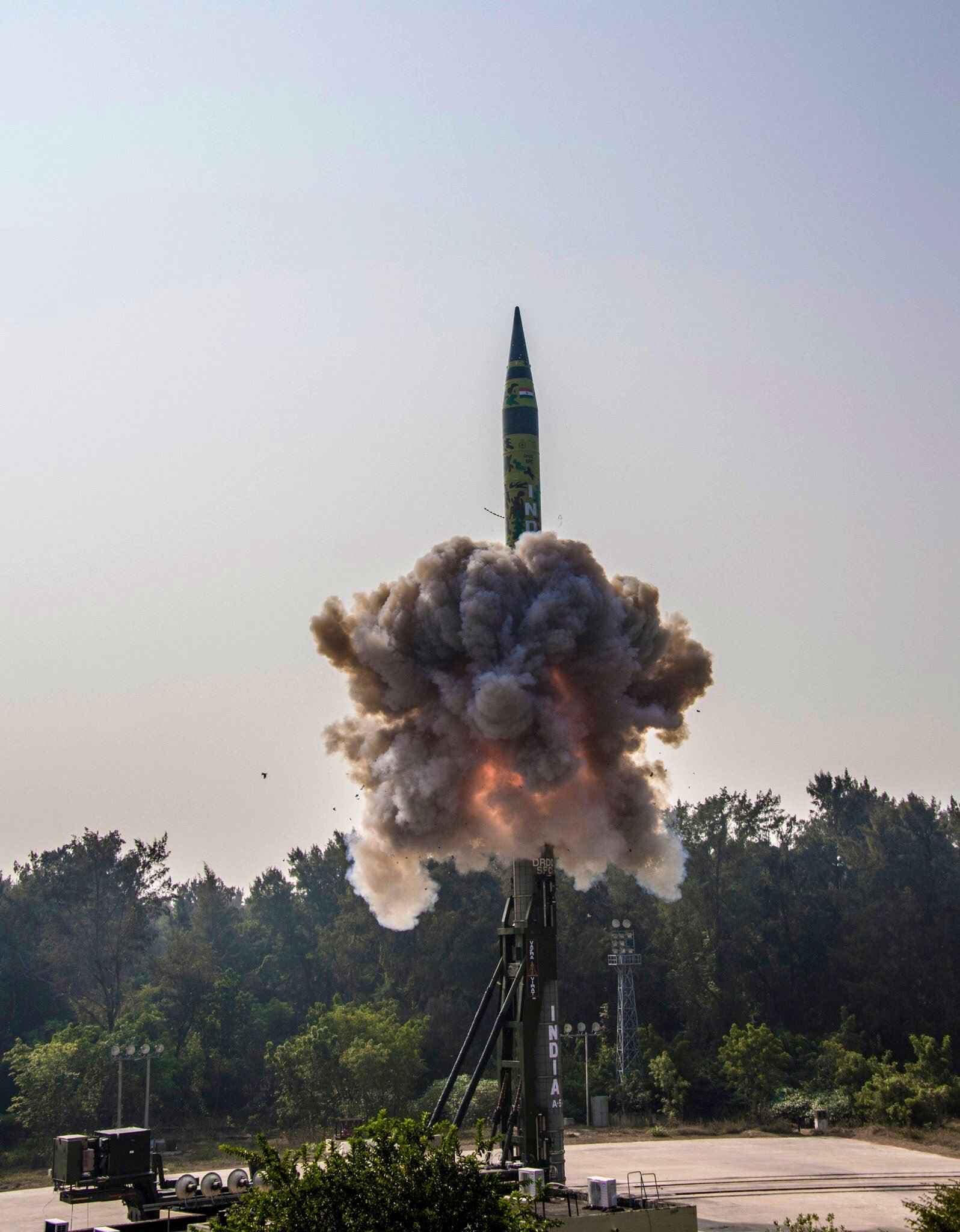
India's Agni-5 Missile Test Powers Up Strategic Defense
Chandipur, Odisha, August 20, 2025 – India successfully test-fired its nuclear-capable Agni-5 intermediate-range ballistic missile (IRBM) from the Integrated Test Range (ITR) at Chandipur, Odisha, marking a significant milestone in bolstering the nation’s strategic defense capabilities. Conducted under the aegis of the Strategic Forces Command (SFC), the launch validated all operational and technical parameters, reaffirming the missile’s reliability and readiness for deployment. The test, carried out by the Defence Research and Development Organisation (DRDO), underscores India’s commitment to maintaining a credible minimum deterrence posture while adhering to its no-first-use nuclear policy.
The Agni-5, a three-stage, solid-fueled missile, is the most advanced in India’s Agni series, which forms the backbone of the country’s land-based nuclear deterrence. With a range exceeding 5,000 kilometers, the missile can target almost the entire Asian continent, including northern parts of China, and parts of Europe and Africa. Its advanced features include Multiple Independently Targetable Re-entry Vehicle (MIRV) technology, enabling a single missile to deliver multiple warheads to different targets, significantly enhancing its strategic effectiveness. The missile’s canisterized, road-mobile launch system ensures greater operational flexibility and reduced preparation time, while lightweight composite materials improve its efficiency and reliability.
The successful test comes amid evolving regional and global security dynamics, particularly following heightened tensions with Pakistan and ongoing strategic competition with China. The Agni-5’s extended range and MIRV capabilities are seen as a direct response to China’s advancing missile and missile defense programs, ensuring India’s ability to counter potential threats from its eastern frontier. The missile’s precision, guided by a ring laser gyro-based inertial navigation system and flexseal thrust vector control, was highlighted by DRDO officials as a testament to India’s indigenous technological prowess.
Defence Minister Rajnath Singh congratulated the DRDO and SFC, describing the test as a “major boost to India’s defense capabilities.” Prime Minister Narendra Modi also praised the scientists, emphasizing the test’s role in advancing India’s self-reliance in defense technology, aligning with the government’s “Aatmanirbhar Bharat” initiative. “This achievement strengthens our strategic deterrence and reaffirms India’s commitment to peace and stability through a robust defense posture,” Modi stated on social media.
The test follows the successful March 2024 launch of the Agni-5 under Mission Divyastra, which demonstrated its MIRV capabilities for the first time, placing India among an elite group of nations with this advanced technology. The August 2025 test, part of routine user trials, further validated the missile’s combat readiness and operational reliability. According to defense officials, the Agni-5 can carry a nuclear warhead weighing up to 1.5 tonnes, with potential upgrades to extend its range beyond 7,000 kilometers through weight reduction and advanced materials.
The Strategic Vision Institute, a Pakistan-based think tank, expressed concerns over the test, warning that India’s missile advancements could pose risks to regional stability. However, international responses were muted, with NATO Secretary General Anders Fogh Rasmussen previously stating in 2025 that India’s missile program does not constitute a threat to NATO or its allies. U.S. experts from The Heritage Foundation noted that the lack of global criticism reflects the growing acceptance of India’s strategic advancements as a counterbalance to China’s rising influence.
This test also comes at a time when India is reducing its dependence on defense imports, with the DRDO leading efforts to develop cutting-edge technologies. The Agni-5, alongside other missiles like the Prithvi-II, Agni-I, and the newly tested Pralay, strengthens India’s nuclear triad, which includes land, air, and sea-based delivery systems. The successful launch reinforces India’s position as a global strategic power, capable of deterring potential adversaries while maintaining its commitment to a no-first-use nuclear doctrine.
As India continues to enhance its missile arsenal, including the development of the Agni-VI with a potential range of 12,000 kilometers, the nation is signaling its readiness to address emerging security challenges. The Agni-5 test on August 20, 2025, not only showcases India’s technological advancements but also serves as a powerful message of sovereignty and deterrence in an increasingly complex geopolitical landscape.
Sources: Ministry of Defence, India;
Related NRI Globe Coverage
- Davos 2026 Day 1 Highlights: India's Historic Presence & What It Means for NRIs Worldwide
- India's IT Minister Challenges IMF's 'Second-Tier' AI Label at Davos
- Trump's Greenland Interest: Strategic Priorities and Global Reactions – An NRI Perspective
- Why NRIs Celebrate January 1: The Colonial History Behind India's New Year
- ISRO HOPE Mission: Ladakh Analogue Site for Moon and Mars Tests
- From Vegas Lights to India’s Data Centers: AWS
- From Dubai to New Jersey: Will NRI Votes Shape India’s
- India’s PMO Cites “Trust Deficit” in Refusing Talks with White House, Confirms Dainik Jagran
Fresh from NRI Globe
- YouTuber Nandu's World (Rama Nandana) UK Visa & Job Fraud Case: Full Details + Key Lessons for NRIs (2026)
- Dussehra / Vijayadashami 2026 Events Country-Wise — Global NRI Directory (Ram Lila, Ravana Dahan, Durga Puja Pandals, Ayudha Puja Venues + Booking)
- Diwali 2026 Events Country-Wise — Global NRI Directory (White House, Leicester, London Trafalgar, Toronto, Auckland, Sydney Parramasala, Fiji, Mauritius, Trinidad, South Africa and More)
- Diwali / Deepavali 2026 Country-Wise NRI Celebrations — Complete Global Guide (USA, UK, Canada, Australia, Fiji, Mauritius, Trinidad, South Africa, UAE and 30+ Countries)