
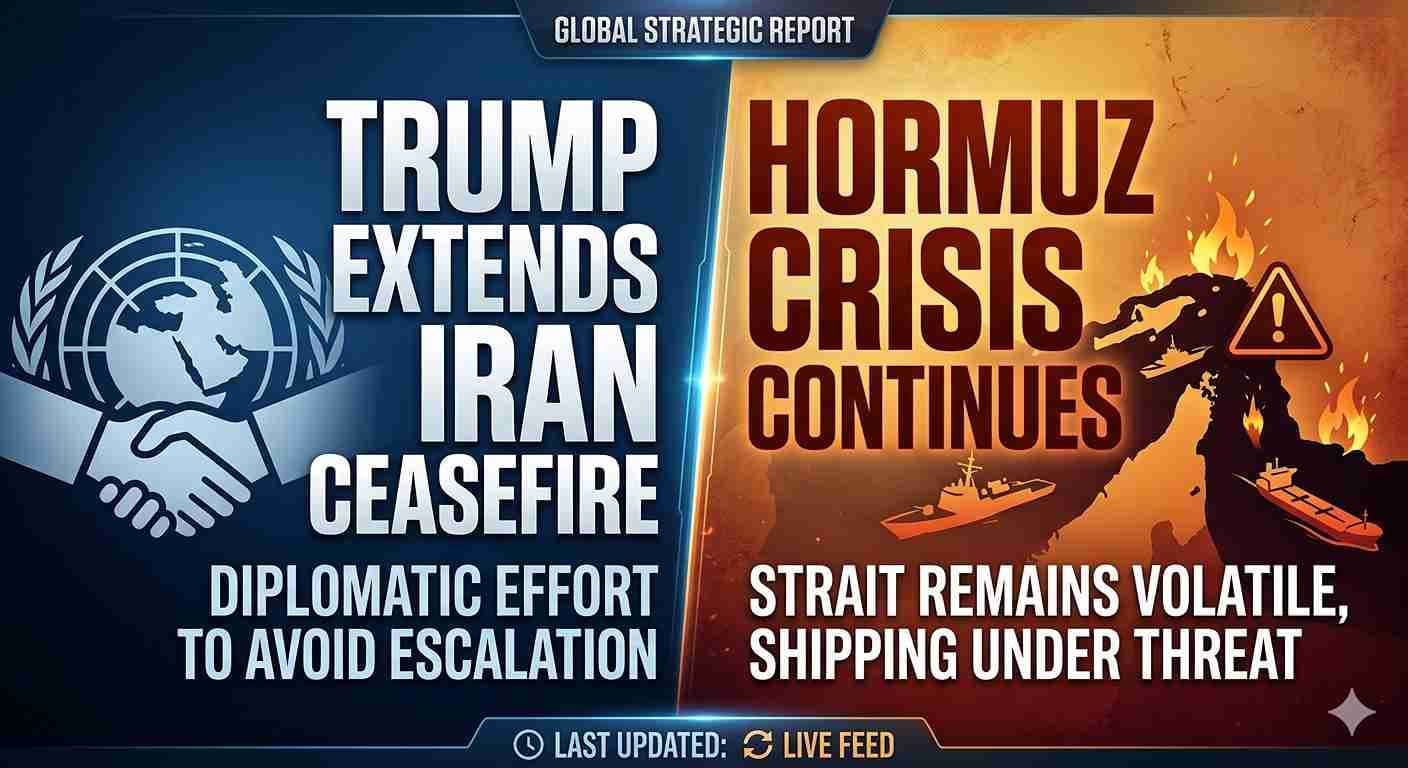
President Donald Trump announced an indefinite extension of the US-Iran ceasefire on April 21, 2026. The move gives Iranian leaders additional time to submit a unified proposal. The naval blockade of Iranian ports stays active.
TL;DR
- Ceasefire extended indefinitely; blockade remains in force.
- Over 220,000 Indians repatriated from Gulf states since February.
- Strait of Hormuz disruptions raise risks for oil prices and remittances.
- NRIs should register with Indian embassies and review emergency plans.
- Rupee volatility and higher fuel costs may affect family budgets in India.
Background on the Ceasefire Extension
Trump posted the decision on Truth Social. He referenced requests from Pakistani officials and described Iranian leadership as fractured. The original two-week pause was scheduled to end April 22.
US forces will maintain readiness. Vice President JD Vance postponed a planned visit to Pakistan. Iran must still deliver a credible proposal that addresses nuclear concerns. NRI communities in the Gulf track these statements because any shift in posture can alter flight schedules and remittance corridors within days.
Comparative timelines from earlier regional pauses show that extensions of this length often coincide with quiet diplomatic shuttles rather than open negotiations. Families in Kerala and Tamil Nadu who receive monthly transfers from Dubai or Doha report monitoring the same social-media posts that Indian missions later confirm through official channels.
The ceasefire extension reflects broader patterns in Middle Eastern conflict management. When military operations pause, the underlying economic and diplomatic pressures do not disappear. Instead, they accumulate beneath the surface. For NRIs, this means that even during periods of reduced direct violence, the threat of sudden resumption remains. Insurance premiums for workers in conflict-adjacent zones often increase during extended pauses because underwriters view them as periods of maximum uncertainty rather than genuine stability.
Current Military and Diplomatic Status
Conflict opened February 28, 2026, with US and Israeli strikes on Iranian sites. Supreme Leader Ali Khamenei was killed. Iran launched retaliatory missiles. A brief ceasefire began in early April but frayed after the seizure of the cargo ship Touska.
The Strait of Hormuz remains contested. Reports suggest a significant portion of global oil shipments pass through this waterway. Recent reporting on the Trump administration's approach to the Hormuz blockade indicates that US naval deployments continue to enforce freedom of navigation, though commercial shipping insurers have raised premiums substantially.
Indian naval assets positioned near the Gulf of Oman continue routine patrols that protect flagged vessels carrying petroleum products and expatriate workers. Embassy wardens in Muscat and Abu Dhabi receive daily updates on tanker movements that feed into consular advisories sent to registered citizens. The coordination between Indian Navy operations and Ministry of External Affairs communications ensures that NRIs receive timely warnings before major shipping disruptions occur.
Analysis of the GCC crisis and Iran's April attacks provides additional context on how regional powers view the blockade and its implications for trade routes. Gulf Cooperation Council members—Saudi Arabia, UAE, Qatar, Kuwait, Bahrain and Oman—have all issued separate advisories to their expatriate populations, creating a layered communication structure that NRIs must navigate.
Table: Potential NRI Exposure Areas
| Area | Short-term Risk | Longer-term Risk |
|---|---|---|
| Employment in Gulf | Project delays in oil, construction | Contract reductions if prices stay high |
| Remittances | Delayed transfers | Lower volumes if workers return |
| Travel | Flight cancellations | Visa processing slowdowns |
| Family finances in India | Higher petrol and LPG costs | Broader inflation pressure |
Safety Considerations for Indians in the Gulf
More than 220,000 Indian nationals have returned home since fighting began. Those remaining in the UAE, Saudi Arabia, Qatar, Kuwait and Oman continue to monitor developments. The extension offers a brief window of reduced direct conflict risk.
Indian embassies advise citizens to update contact details. Non-essential travel into the region should be postponed. Families with members in multiple countries may want duplicate copies of passports and insurance documents. In practice, consulates in Dubai and Riyadh have opened extra registration desks that process updates within 48 hours for those already on the Madad portal.
Workers in construction camps near industrial zones receive daily briefings from company security teams that reference the same Ministry of External Affairs circulars posted on embassy websites. Several state governments in India have set up dedicated helplines that forward verified messages to relatives when an NRI registers a location change. Tamil Nadu, Gujarat and Maharashtra have been particularly active in establishing these communication channels because their populations represent the largest share of Gulf-based workers.
The registration process itself serves multiple purposes beyond simple record-keeping. When an NRI updates their location and contact information with an embassy, they enter a priority queue for evacuation assistance if conditions deteriorate rapidly. Historical precedent from the 1990-91 Gulf War shows that registered citizens received evacuation notices 48 to 72 hours before commercial flights were suspended, while unregistered nationals faced much longer delays in departure. Modern registration systems operate faster, but the underlying principle remains unchanged: official recognition by your home country's diplomatic mission can mean the difference between orderly departure and chaotic scrambling.
Economic Channels Affecting NRIs
Oil-price spikes transmit quickly to Indian households. Higher crude costs raise petrol, diesel and cooking-gas prices. NRIs sending monthly support may notice reduced purchasing power for relatives.
Rajnath Singh, India's Defence Minister, noted that Hormuz disruptions carry direct consequences for national energy security. Currency markets often react to such events with rupee softening against the dollar. Data from the Reserve Bank of India show that a sustained 10 percent rise in Brent crude typically adds 0.8 to 1.2 percentage points to wholesale inflation within two quarters.
Professionals in logistics, hospitality and energy sectors report delayed project timelines. Some companies have introduced temporary hiring freezes. Engineers on fixed-term contracts in Abu Dhabi describe clauses that allow employers to extend notice periods by 30 days when regional tensions trigger force-majeure declarations. For NRIs dependent on contract renewals, such provisions can create unexpected gaps in employment and income.
Remittance data compiled by the World Bank for South Asia indicate that Gulf outflows account for roughly 55 percent of total receipts to India. A prolonged closure of even one Hormuz lane would force carriers to reroute around Africa, adding 12 to 15 days and roughly 8 percent to freight costs that ultimately appear in landed prices of refined products. Global impact analysis of the Trump administration's Iran ceasefire explores how extended pauses in conflict can paradoxically increase economic uncertainty because markets cannot price in stable long-term expectations.
The relationship between oil prices, remittance volumes and family finances in India creates a complex feedback loop. When crude prices spike, NRI employers often face margin pressure that leads to wage freezes or reduced bonus structures. Simultaneously, families in India experience higher living costs for fuel and electricity. This dual squeeze—lower remittances combined with higher expenses—can force families to draw down savings or defer medical treatment. Elderly parents of NRIs in the Gulf have reported postponing cataract surgeries or dental work during periods of high oil-price volatility because the remittance transfers that typically fund such expenses become less predictable.
First-hand Perspective from a Dubai-based NRI Engineer
One mid-level project manager who has lived in Dubai for nine years described weekly calls with his parents in Kerala. They rely on his transfers for medical expenses. He keeps two months of salary in a separate emergency account denominated in dirhams. He also renewed his evacuation insurance last month after checking policy wording on war-exclusion clauses. His employer circulated an internal memo urging staff to avoid social-media speculation about military movements. The manager now logs weekly updates with the Indian consulate app and shares the same checklist with five colleagues from different states.
Colleagues from Punjab and Karnataka maintain parallel lists that include local hospital contacts and alternate airport options via Oman. One of them arranged power-of-attorney documents with a sibling in Kochi so that property-related decisions can proceed without physical presence if commercial flights are grounded again. These informal networks of NRIs—often organized by state of origin or professional discipline—function as early-warning systems that sometimes detect emerging risks before official channels confirm them.
The engineer also described the psychological dimension of living under extended ceasefire conditions. The absence of active conflict does not eliminate anxiety; it merely transforms it. Workers report difficulty concentrating on projects when they know that a military escalation could occur within hours. Sleep disruption, heightened vigilance and stress-related health issues have become common among NRIs who have remained in the Gulf. Some employers have begun offering mental-health support through employee assistance programs, recognizing that productivity losses from anxiety can exceed the costs of preventive counseling.
Family dynamics shift as well. Parents in India worry about their adult children in the Gulf in ways they did not before the conflict. Spouses separated by geography—one partner working in the Gulf, the other managing family affairs in India—face decisions about whether to reunite temporarily or maintain separation to preserve employment. These personal calculations, multiplied across hundreds of thousands of NRI households, create secondary economic effects that extend far beyond oil prices and remittance corridors.
Broader Implications for NRI Financial Planning
The ceasefire extension introduces a planning horizon that is neither short-term nor clearly long-term. NRIs must make financial decisions under conditions of genuine uncertainty. Should they accelerate property purchases in India while remittance volumes remain stable, or should they build larger emergency reserves in case employment is disrupted? Should they renew multi-year insurance policies at current rates, or wait for clarity on the geopolitical situation?
Financial advisors working with NRI clients report increased demand for scenario-planning services. Rather than assuming a single baseline forecast, advisors now construct multiple scenarios—one in which the ceasefire holds and regional stability gradually improves, another in which conflict resumes within weeks, and a third in which the current stalemate persists for months or years. Each scenario implies different optimal strategies for currency hedging, insurance coverage and remittance timing.
The extended ceasefire also affects visa and immigration planning. Some NRIs who had planned to return to India permanently are reconsidering, because the current pause offers a window in which to complete pending projects and maximize final earnings. Others are accelerating their return timelines because they view the ceasefire as temporary and prefer to be in India if conditions deteriorate. These migration flows, in turn, affect labor markets in both the Gulf and India, creating ripple effects in sectors ranging from construction to information technology.
Next steps
Register or update details with the nearest Indian mission. Review employer emergency protocols and personal insurance coverage. Track official advisories from the Ministry of External Affairs rather than unverified social channels. Maintain modest cash reserves in stable currencies if feasible. Consider consulting a financial advisor who specializes in NRI planning to stress-test your household budget under multiple scenarios. Document property ownership and financial accounts with a trusted family member in India who holds power-of-attorney authority. Review visa and travel insurance policies to confirm that war-related disruptions are covered or explicitly excluded.
Sources
- US Department of State
- Ministry of External Affairs, Government of India
- U.S. Energy Information Administration
- Trump Iran Ceasefire and Hormuz Blockade Coverage
- Global Impact Analysis of Trump US Iran Ceasefire
- GCC Crisis and April Hormuz Iran Attacks Analysis
Related NRI Globe Coverage
- Shadows Over the Gulf: The Fragile 2026 Iran War Ceasefire — May 8 Update for NRIs
- Iran War Latest Updates April 2026: US Fighter Jet Shot Down, Trump Warns of More Strikes, Strait of Hormuz Crisis Deepens
- NATO Split on US Iran War 2026: Impact on India
- Iran War 2026: Impact on NRIs in USA
- GCC News March 2026: Iran War Hits NRIs Hard
- Iran War 2026: Impact on NRIs in GCC Countries
- Iran War 2026: Impact on Indian NRIs in GCC
- Iran War 2026 Impact on NRIs: Safety, Jobs & Economy
Fresh from NRI Globe
- YouTuber Nandu's World (Rama Nandana) UK Visa & Job Fraud Case: Full Details + Key Lessons for NRIs (2026)
- Dussehra / Vijayadashami 2026 Events Country-Wise — Global NRI Directory (Ram Lila, Ravana Dahan, Durga Puja Pandals, Ayudha Puja Venues + Booking)
- Diwali 2026 Events Country-Wise — Global NRI Directory (White House, Leicester, London Trafalgar, Toronto, Auckland, Sydney Parramasala, Fiji, Mauritius, Trinidad, South Africa and More)
- Diwali / Deepavali 2026 Country-Wise NRI Celebrations — Complete Global Guide (USA, UK, Canada, Australia, Fiji, Mauritius, Trinidad, South Africa, UAE and 30+ Countries)