
TL;DR
- HOPE station in Tso Kar Valley opened in 2025 to replicate lunar and Martian conditions at 4,530 meters elevation.
- First 10-day crew mission ran in August 2025 with two analogue astronauts studying physiology and operations.
- Facility supports Gaganyaan preparations and India's 2040 crewed lunar landing target.
- Public-private partnership with Protoplanet and academic institutes drives low-cost inflatable habitat tests.
- Data from isolation experiments will refine life-support and medical protocols for long-duration spaceflight.
Site Selection Rationale in Ladakh
Tso Kar Valley offers natural parallels to extraterrestrial environments through its elevation, temperature swings, and soil composition. Researchers selected the location after comparing multiple high-altitude deserts in India. The thin atmosphere reduces oxygen availability, forcing crews to adapt in ways similar to habitat conditions on Mars. Isolation from nearby settlements adds psychological realism that indoor laboratories cannot replicate.
Local terrain includes saline flats and rocky outcrops that mirror regolith properties encountered during rover traverses. These features allow teams to practice sample collection without traveling off-planet. Weather records from the valley show prolonged periods below freezing, which helps validate thermal control systems.
The high ultraviolet radiation index at this altitude is another factor that influenced the site selection. On Mars, the absence of a protective magnetosphere exposes surface hardware and any future crew to elevated radiation levels. While Tso Kar cannot fully replicate Martian radiation, the UV environment there is meaningfully more intense than at lower elevations, offering a useful proxy for testing suit materials, surface equipment coatings, and crew protocols around UV exposure. The combination of aridity, cold, and reduced atmospheric pressure makes the valley arguably the most Mars-analogous terrain accessible within India's borders.
Facility Modules and Engineering Choices
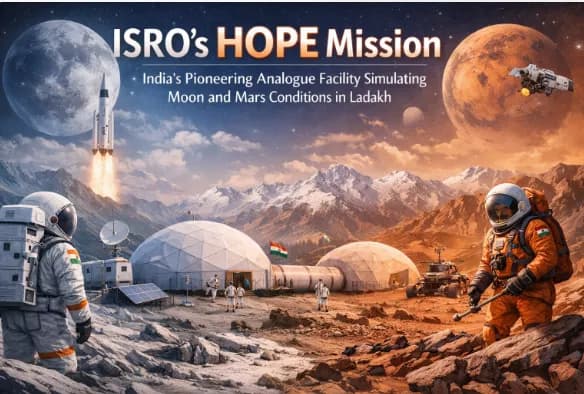
Two inflatable units form the core of the station. The larger habitat provides living space for up to four people while the utility module houses recycling equipment. Designers chose inflatable architecture to reduce transport weight compared with rigid containers. Hydroponic trays inside the habitat test food production under low-light and low-pressure conditions.
Power comes from a hybrid solar and battery setup sized for the short daylight hours common at that latitude. Waste processing units recycle water and generate oxygen through electrolysis. All systems transmit telemetry via satellite link to ground teams in Bengaluru.
Inflatable habitats are increasingly favoured in analogue and prospective planetary research because they can be compressed for transport and then pressurised on-site, reducing the logistical burden of reaching remote or resource-constrained locations. The engineering trade-off involves ensuring that the membrane materials maintain structural integrity across large temperature differentials — a challenge that Tso Kar's climate actively stress-tests. Data gathered on material performance under repeated freeze-thaw cycles feeds back into design iterations, making each mission season an incremental refinement exercise rather than a static demonstration. The hydroponic component is particularly relevant to long-duration missions, where resupply from Earth becomes impractical and crews must produce a portion of their own food to maintain nutritional adequacy and psychological well-being.
First Crew Mission Outcomes
The HOPE station was inaugurated and began operational use in 2025, according to reports from the facility's partners. Two researchers completed the initial mission run after medical screening and acclimatisation. They logged daily health metrics and performed geological sampling tasks. Results showed measurable changes in blood oxygen saturation and sleep patterns that align with prior high-altitude studies. The crew also maintained a hydroponic garden that supplied fresh greens throughout the stay.
Ground control monitored psychological indicators through scheduled video calls and questionnaires. Early analysis indicates that structured daily routines reduced reported stress levels. These observations add to the body of knowledge on small-team dynamics during confined operations. The crew members, drawn from research and aerospace backgrounds according to reports from the programme's organisers, were selected following a competitive screening process designed to mirror candidate evaluation methods used for longer-duration spaceflight.
The physiological data collected during this first mission is expected to inform baseline models for Indian crew members, who may respond differently to hypoxic stress than populations studied predominantly in Western analogue programmes. Establishing India-specific baselines matters because life-support thresholds, medication protocols, and exercise countermeasures are all calibrated against physiological norms. Sleep disruption at altitude is a well-documented phenomenon, and understanding how it interacts with mission task demands helps planners build realistic work-rest schedules for Gaganyaan and subsequent missions. The geological sampling component, while secondary to the human factors focus, also generated preliminary data on soil mineralogy that could inform future rover instrument calibration work.
Comparison of Global Analogue Sites
| Site | Location | Elevation (m) | Key Strength | Primary Operator |
|---|---|---|---|---|
| HOPE | Tso Kar, India | 4530 | High UV and aridity | ISRO / Protoplanet |
| HI-SEAS | Hawaii, USA | 2500 | Long-duration isolation | University of Hawaii |
| NEEMO | Florida, USA | Underwater | Extreme confinement | NASA |
| MDRS | Utah, USA | 1500 | Geology simulation | Mars Society |
The table highlights how HOPE's altitude provides a distinct advantage for hypoxia research that lower sites cannot match. India's location also reduces travel costs for South Asian research teams. Compared with established facilities such as HI-SEAS and MDRS, HOPE introduces a combination of extreme cold, high ultraviolet radiation, and low atmospheric pressure that together create a more demanding test environment for both hardware and human physiology.
Each analogue facility in the table above was designed with a particular research priority in mind, and that context shapes the kind of data each generates. NEEMO, for instance, uses underwater confinement to simulate the communication delays and limited egress options of deep-space missions, but it cannot replicate altitude-related physiological stress. MDRS in Utah prioritises geological fieldwork and crew operations procedures in a desert setting, but its relatively modest elevation means hypoxia is not a significant variable. HI-SEAS has produced some of the most cited long-duration isolation data in the field, yet its volcanic terrain and elevation differ considerably from the cold-arid profile of Tso Kar. HOPE therefore occupies a complementary rather than competing position within the global network of analogue research infrastructure, and data sharing between these programmes could strengthen the overall evidence base for human spaceflight planning.
Public-Private Model and NRI Contributions
Protoplanet led module construction while ISRO supplied oversight and launch support infrastructure. Several Indian-origin engineers based abroad contributed remote design reviews during the planning phase. NRI aerospace specialists with backgrounds in habitat engineering described the collaboration as a practical bridge between diaspora expertise and domestic execution. Remote participation allowed specialists living overseas to apply lessons from internationally funded projects without relocating full-time. This approach keeps talent networks active across borders and accelerates knowledge transfer on environmental control systems. Continued engagement from overseas researchers could expand the range of experiments run at the site in coming years.
For NRI professionals in aerospace, life sciences, or systems engineering, the HOPE programme represents a tangible route to contributing to India's human spaceflight ambitions from abroad. The Human Space Flight Centre, listed as a primary institutional contact on the ISRO portal, has indicated openness to academic and industry partnerships that could include diaspora-led research proposals.
The public-private structure itself carries broader implications for how India funds and scales space infrastructure. Rather than relying solely on government budgets, the HOPE model distributes development costs and expertise across institutional partners. For NRI investors or entrepreneurs with interests in the space sector, this signals a maturing ecosystem where private entities can take on substantive technical roles alongside ISRO rather than functioning purely as contractors. Those with domain knowledge in closed-loop life support, biomedical monitoring, or advanced materials may find that the HOPE programme offers a relatively accessible entry point for proposing collaborative experiments, particularly as the mission cadence is expected to increase in subsequent years.
Link to National Space Roadmap
HOPE data feeds directly into crew training timelines for the first Gaganyaan flight. Protocols tested here will inform medical checklists and resource management aboard the planned Bharatiya Antariksh Station. Long-term planners view the facility as a stepping stone toward surface operations on the Moon by 2040. Each completed analogue run reduces uncertainty around human performance limits in reduced-gravity and low-pressure settings.
The broader significance of a domestic analogue facility extends beyond any single mission. India joins a small group of nations operating purpose-built environments for pre-mission human factors research. As the ISRO official website outlines, the organisation's human spaceflight programme is scaling rapidly, and ground-based simulation infrastructure is a recognised prerequisite for safe crewed operations. HOPE fills a gap that previously required Indian researchers to seek access at foreign facilities, often at significant logistical cost.
Having a domestic facility also strengthens India's position in international space cooperation discussions. Nations that operate analogue research infrastructure tend to be more attractive partners for joint mission planning because they can demonstrate an existing commitment to the methodical, ground-based preparation that responsible human spaceflight demands. For the Gaganyaan programme specifically, the ability to iterate on crew protocols domestically — rather than depending on access agreements with foreign partners — reduces both scheduling uncertainty and the risk of knowledge remaining siloed outside India. Over time, the HOPE station could also serve as a training venue for astronaut candidates from partner nations, deepening bilateral space relationships in a practical rather than purely diplomatic way.
Next steps
Monitor ISRO announcements for the 2026 mission schedule. Researchers interested in participation should track open calls from the Human Space Flight Centre. Institutions may explore partnership routes through established academic collaborators listed on the ISRO portal.
Sources
Related NRI Globe Coverage
- Elon Musk’s Mars Mission: SpaceX’s Starship and the Future of Humanity
- US Rescues Colonel in Iran After 48-Hour Mission
- Davos 2026 Day 1 Highlights: India's Historic Presence & What It Means for NRIs Worldwide
- India's IT Minister Challenges IMF's 'Second-Tier' AI Label at Davos
- America Returns to the Moon: NASA's Artemis II Launch Window Opens February 6, 2026 – A Milestone for Global Indians & NRIs
- Russia's Cancer Vaccine Breakthrough 2026: What It Means for NRIs – Personalized mRNA Hope for Melanoma & More
- Wolf Supermoon January 3, 2026: The First Full Moon of the Year – A Spectacular Start for NRIs Worldwide
- Why NRIs Celebrate January 1: The Colonial History Behind India's New Year
Fresh from NRI Globe
- YouTuber Nandu's World (Rama Nandana) UK Visa & Job Fraud Case: Full Details + Key Lessons for NRIs (2026)
- Dussehra / Vijayadashami 2026 Events Country-Wise — Global NRI Directory (Ram Lila, Ravana Dahan, Durga Puja Pandals, Ayudha Puja Venues + Booking)
- Diwali 2026 Events Country-Wise — Global NRI Directory (White House, Leicester, London Trafalgar, Toronto, Auckland, Sydney Parramasala, Fiji, Mauritius, Trinidad, South Africa and More)
- Diwali / Deepavali 2026 Country-Wise NRI Celebrations — Complete Global Guide (USA, UK, Canada, Australia, Fiji, Mauritius, Trinidad, South Africa, UAE and 30+ Countries)