
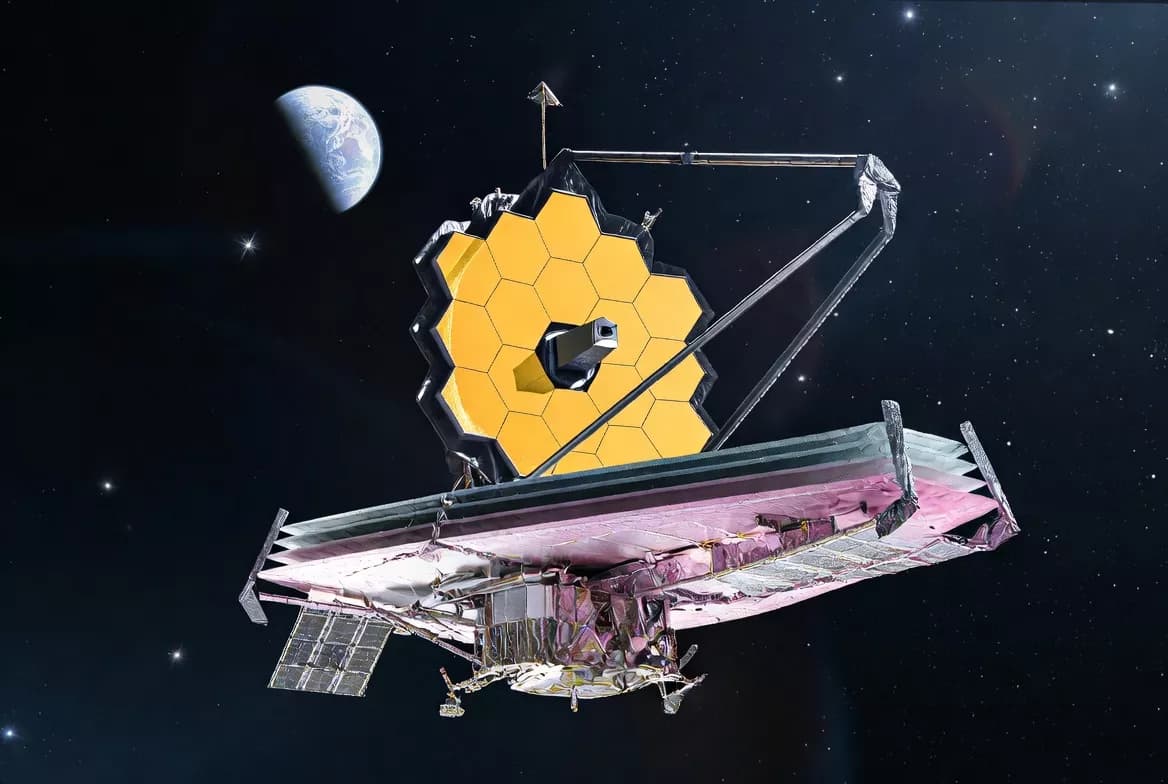
James Webb Space Telescope Confirms Hubble Tension: Is Unknown Physics Reshaping Our Understanding of the Universe in 2026?
The James Webb Space Telescope (JWST), NASA's premier observatory launched in 2021, continues to deliver groundbreaking revelations that challenge the very foundations of modern cosmology. As of January 2026, JWST's latest observations have solidified one of the most persistent puzzles in science: the Hubble Tension. This discrepancy in the measured rate of the universe's expansion suggests that something fundamental may be missing from our current models—potentially pointing to unknown physics, evolving dark energy, modified gravity, or entirely new cosmic phenomena.
Far from resolving the crisis, recent JWST data—combined with Hubble Space Telescope measurements—has deepened the mystery, ruling out simple measurement errors and forcing cosmologists to confront the possibility that the standard Lambda-CDM model (which includes dark matter, dark energy, and general relativity) is incomplete. In this in-depth exploration, we dive into the Hubble Tension, JWST's pivotal role, recent 2025-2026 developments, implications for physics, and what the future holds for our understanding of the cosmos.
What Is the Hubble Tension? A Cosmic Discrepancy Explained
The Hubble Constant (H₀) measures how fast the universe is expanding—expressed in kilometers per second per megaparsec (km/s/Mpc). Edwin Hubble first estimated this in the 1920s, but precision measurements have revealed a stark conflict.
- Local (late-universe) measurements: Using nearby objects like Cepheid variable stars (which act as "standard candles" for distance) and Type Ia supernovae, teams like SH0ES (led by Nobel laureate Adam Riess) find H₀ ≈ 73 km/s/Mpc. JWST has refined these with sharper infrared imaging, confirming values around 72-74 km/s/Mpc and ruling out errors like stellar crowding at high confidence (>8σ in some analyses).
- Early-universe (cosmic microwave background) predictions: Data from the Planck satellite and recent cosmic microwave background (CMB) maps, including final results from the Atacama Cosmology Telescope (ACT) in late 2025, predict H₀ ≈ 67-68 km/s/Mpc under the standard ΛCDM model.
This 5-6σ mismatch—far beyond statistical flukes—has been dubbed the Hubble Tension. It's not just a minor disagreement; it implies the universe expands faster today than models predict from its infancy 13.8 billion years ago.
JWST's infrared prowess (4x better resolution and 10x sensitivity than Hubble in near-infrared) has been crucial in cross-checking distances to Cepheid stars in galaxies up to 130 million light-years away. In December 2024 and throughout 2025, large JWST studies (analyzing over 1,000 Cepheids) confirmed Hubble's higher local value, erasing doubts about measurement artifacts.
JWST's Key Contributions to the Hubble Tension Debate (2024-2026 Updates)
Since operations began, JWST has transformed cosmology:
- Cepheid and Supernova Distance Ladder Refinements JWST's NIRCam instrument resolves individual stars in distant galaxies with unprecedented clarity, minimizing dust and crowding effects. Adam Riess's team (Johns Hopkins University) used JWST data in late 2024 to reaffirm H₀ ≈ 73 km/s/Mpc, calling it a "crucial cross-check" that the tension is real—not instrumental error.
- Time-Delay Cosmography and Gravitational Lensing In December 2025, the TDCOSMO collaboration (including University of Tokyo researchers) used JWST alongside ground-based telescopes to study strongly lensed quasars. They derived H₀ ≈ 71.6 km/s/Mpc (precision ~4.6%), aligning more with local measurements than early-universe ones. This independent method strengthens the case for new physics.
- Gravitationally Lensed Supernovae January 2026 brought exciting news: JWST's VENUS program discovered rare multiply-imaged supernovae (SN Ares and SN Athena) in galaxy clusters. These "time-delay" events could provide single-step, ultra-precise H₀ measurements in coming years—potentially settling whether the value favors 73 or 67 km/s/Mpc.
- Early-Universe Challenges Beyond Expansion JWST has also spotted "impossibly" mature galaxies, massive black holes, and "little red dots" (likely young supermassive black holes) just 200-300 million years after the Big Bang. These suggest accelerated structure formation, possibly linked to the tension via evolving dark energy or modified gravity.
Some studies (e.g., Chicago-Carnegie Hubble Program using JWST + Tip of the Red Giant Branch stars) report H₀ ≈ 70.4 km/s/Mpc, hinting at partial convergence—but Cepheid-based analyses persist in showing tension.
Why the Hubble Tension Matters: Hints of New Physics
If not measurement error, what explains the mismatch?
- Evolving Dark Energy: Dark energy (driving acceleration) might change over time, stronger now than in the early universe.
- New Particles or Forces: Early dark energy, extra neutrino species, or unknown matter could alter expansion history.
- Modified Gravity: Alternatives to general relativity (e.g., MOND-like theories) on cosmic scales.
- Systematic Biases in Models: Though JWST rules out many local errors, early-universe assumptions (e.g., CMB interpretation) remain under scrutiny.
The tension exceeds 5σ in multiple probes, approaching "crisis" status for ΛCDM. As Adam Riess noted, "With two flagship telescopes confirming each other, we must take this seriously—it's a challenge but an incredible opportunity."
Other JWST Discoveries Fueling Cosmological Debates
JWST isn't just about expansion—its infrared gaze pierces cosmic dust to reveal the "cosmic dawn":
- Unexpectedly Massive Early Galaxies: "Universe breaker" candidates appeared too large/mature too soon, though reanalyses suggest they're less extreme.
- Rapid Black Hole Growth: Supermassive black holes in place by 500 million years post-Big Bang challenge formation timelines.
- Dark Stars Hypothesis: Hypothetical objects powered by dark matter annihilation could explain bright, blue "monster" galaxies and red dots.
- Preferred Galaxy Rotation: Some data hints at universal spin, sparking wild ideas like black hole cosmology.
These anomalies collectively stress-test cosmology, suggesting our models oversimplify early galaxy/black hole assembly.
The Road Ahead: Will JWST Resolve the Crisis?
Ongoing JWST programs (e.g., more lensed supernovae, deeper surveys) promise higher precision. Upcoming missions like Euclid, Roman Space Telescope, and DESI (baryon acoustic oscillations) will provide independent checks.
If tension persists at >5σ with reduced errors, it could herald a paradigm shift—much like dark energy's discovery in 1998. Cosmologists are optimistic: crises drive progress.
Conclusion: A Universe Full of Surprises
The James Webb Space Telescope has not only confirmed the Hubble Tension but amplified it, hinting that unknown physics lurks beyond our current grasp. From refining the expansion rate to unveiling an unexpectedly dynamic early universe, JWST reminds us how much remains mysterious.
As data pours in during 2026, one thing is clear: the cosmos is more profound and complex than we imagined. Stay tuned— the next breakthrough could rewrite textbooks.
What are your thoughts on the Hubble Tension? Could new physics await discovery? Share in the comments!
Latest NRI News & Global Updates:
Health, Wellness & Lifestyle for NRIs
https://nriglobe.com/lifestyle/
Latest NRI News & Global Updates
https://nriglobe.com/news/
Business & Finance News for NRIs
https://nriglobe.com/business/
Investment Guides for NRIs
https://nriglobe.com/investment/
Jobs & Career Opportunities for NRIs
https://nriglobe.com/jobs/
Related NRI Globe Coverage
- From the Vedas to Quantum Physics: How Indian Wisdom
- India’s PMO Cites “Trust Deficit” in Refusing Talks with White House, Confirms Dainik Jagran
- Senate Confirms Jeanine Pirro as U.S. Attorney for the District of Columbia
- YouTuber Nandu's World (Rama Nandana) UK Visa & Job Fraud Case: Full Details + Key Lessons for NRIs (2026)
- US Crime News 2026 — Top Trend Categories NRIs Are Watching (Organized Retail Theft, Auto Theft, Cybercrime, Hate Crimes, Fentanyl, AI-Enabled Fraud)
- US Crime & Safety This Week — September 17-21, 2026 (NRI Family Guide, FBI Alerts, H-1B/Immigration Scams, Tech Support Fraud, Emergency Resources)
- Japan's Centenarian Population Surpasses 100,000 for the First Time in History
- Major US News This Week (September 14-15, 2026): Supreme Court Blocks Trump Mail Voting Rules, AI Debate Explodes, Space Weapons Confirmed
Fresh from NRI Globe
- Dussehra / Vijayadashami 2026 Events Country-Wise — Global NRI Directory (Ram Lila, Ravana Dahan, Durga Puja Pandals, Ayudha Puja Venues + Booking)
- Diwali 2026 Events Country-Wise — Global NRI Directory (White House, Leicester, London Trafalgar, Toronto, Auckland, Sydney Parramasala, Fiji, Mauritius, Trinidad, South Africa and More)
- Diwali / Deepavali 2026 Country-Wise NRI Celebrations — Complete Global Guide (USA, UK, Canada, Australia, Fiji, Mauritius, Trinidad, South Africa, UAE and 30+ Countries)
- Dussehra / Vijayadashami 2026 Country-Wise NRI Celebrations — USA, UK, Canada, Australia, New Zealand, UAE, Singapore, Germany, Netherlands and More