
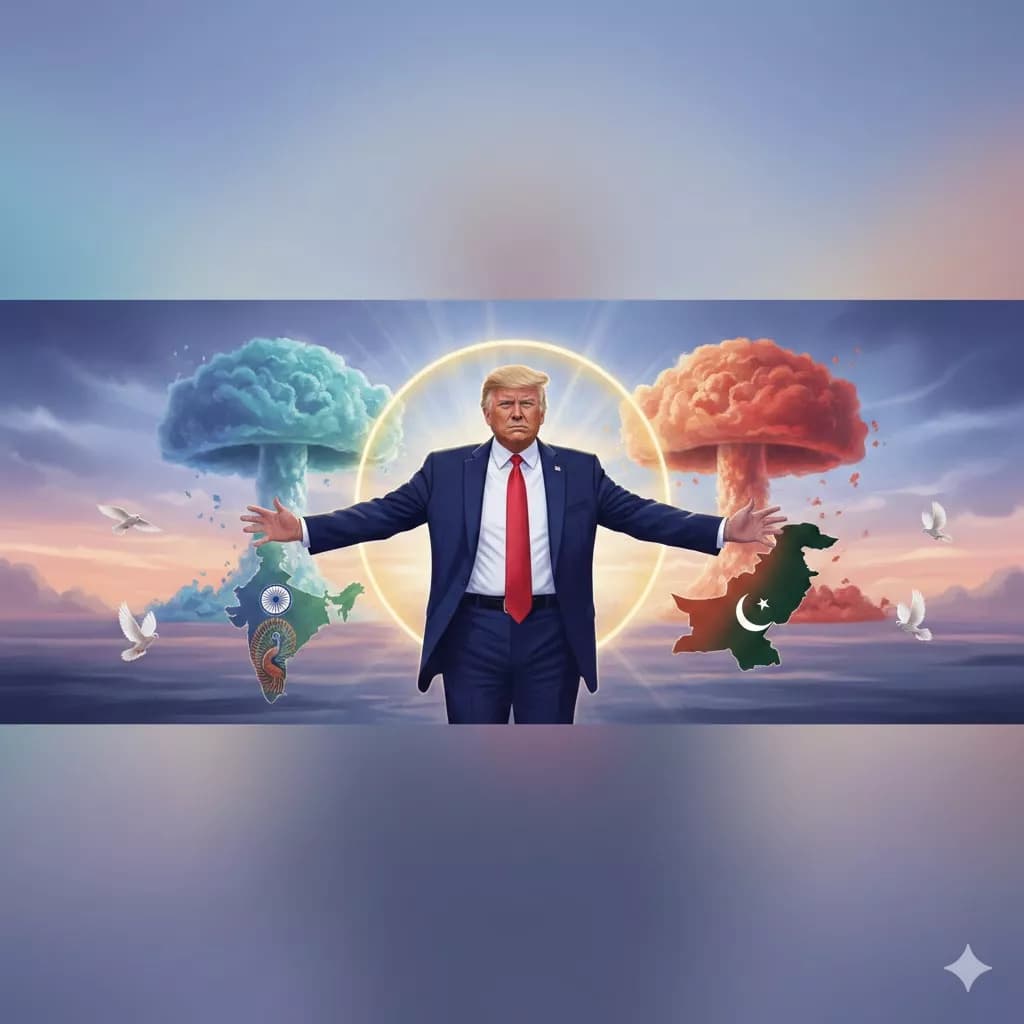
US President Donald Trump asserted in his February 2026 address that American action prevented nuclear escalation between India and Pakistan. The claim drew immediate attention across South Asian diplomatic circles, international media, and diaspora communities worldwide, largely because it diverged sharply from the official accounts published by both New Delhi and Islamabad in the weeks following the May 2025 ceasefire.
Key Points from the Address
- Trump described a May 2025 crisis that ended after four days of exchanges.
- He credited direct US intervention with saving millions of lives.
- Both governments have not confirmed third-party involvement in the ceasefire.
The address was notable for the specificity of its language. Characterizing a conflict as nearly nuclear in scope is an extraordinary assertion, and such framing carries consequences beyond domestic politics. When a head of state makes claims of this magnitude without corresponding confirmation from the parties directly involved, analysts and diaspora observers alike are left to weigh the statement against the documented record. That documented record, as discussed below, does not corroborate the intervention narrative.
Sequence of Events in 2025
The April 22 attack in Pahalgam killed civilians, with Indian authorities linking it to groups based in Pakistan. Operation Sindoor followed on May 7 with strikes on nine sites. Pakistan countered with its own operations. The Directors General of Military Operations agreed to a ceasefire on May 10 via their hotline.
The DGMO hotline is a dedicated, secure communication channel between the senior military officers of India and Pakistan who are responsible for operational matters. It has existed for decades and has been used in previous periods of heightened tension to de-escalate without requiring political leaders to make public concessions. Its use in May 2025 was consistent with established protocol and was the mechanism cited in official statements from both sides.
Public records show no joint announcement of external mediation at the time. Several analysts who follow South Asian security affairs have noted that the available evidence points to a bilateral military channel — specifically the DGMO hotline — as the mechanism that halted hostilities, with no corroborating official record of decisive outside intervention. The absence of a joint statement acknowledging foreign brokerage is itself significant, because such arrangements, when they occur, are typically acknowledged at least in general terms by at least one of the parties involved.
Statements from Both Capitals
New Delhi described the outcome as resulting from its military actions and bilateral talks. Islamabad issued no confirmation of any appeal to foreign leaders. These positions align with long-standing policies that favor direct communication over outside involvement.
India's preference for bilateralism in matters related to Pakistan has been a consistent feature of its foreign policy posture for many decades. This preference is rooted in the view that third-party involvement, however well-intentioned, can complicate the resolution of disputes that are considered internal or bilateral in nature. Pakistan, for its part, has at various times sought international attention on the Kashmir question, but its silence on the mediation claim in this instance is notable given that acknowledging such involvement might have served its diplomatic interests.
NRIs in the United States and elsewhere have followed the pattern of repeated claims about mediation. Many note that India has maintained its bilateral stance on Kashmir for decades. Community discussions in cities such as New York, London, and Dubai often highlight how external narratives can affect diaspora perceptions of regional stability. One recurring observation is that families with ties on both sides of the border prefer measured reporting that sticks to verified military statements rather than unconfirmed diplomatic stories.
Over the past year, several professional networks of Indian-origin engineers and physicians have circulated timelines drawn only from official press releases. This approach reduces confusion when relatives ask for context during festival calls or community events. The Ministry of External Affairs, one of the sources cited in this article, has consistently published communiqués that describe the ceasefire as a product of direct military-to-military contact rather than foreign brokerage. Diaspora readers are encouraged to consult those primary releases directly when evaluating competing accounts.
Comparison of Claims and Records
| Claim | Indian Position | Pakistani Position | Public Evidence |
|---|---|---|---|
| US mediation ended fighting | Denied | No confirmation | Ceasefire via DGMO hotline only |
| Millions of lives saved | No statement | No statement | No independent verification |
| Prime Minister at personal risk | No statement | No statement | No corroborating record |
Reading this table alongside the official communiqués published by the Ministry of External Affairs and the White House provides useful context. The White House has not released a contemporaneous document from May 2025 that details the specific intervention described in the February 2026 address. That gap between a retrospective speech claim and the absence of a contemporaneous official record is a key reason why analysts and diaspora commentators have approached the assertion with caution rather than acceptance.
Impact on Diaspora Discussions
Community forums among NRIs show renewed focus on how Washington frames South Asian security. Participants often compare current statements with past episodes where third-party roles were later clarified through declassified documents. The emphasis remains on primary military communiqués rather than speech excerpts.
For NRIs navigating family conversations across borders, the distinction between a claimed diplomatic intervention and a documented bilateral ceasefire carries practical weight. Misinformation about the severity or resolution of a conflict can influence decisions ranging from travel plans to remittance timing. Grounding discussions in official statements — such as those published by the Ministry of External Affairs and the White House, both cited here — provides a more reliable foundation than social-media summaries of political speeches.
Community leaders in several cities have also pointed out that diaspora members sometimes face pressure to take sides in narratives shaped by the political contexts of their host countries. Maintaining familiarity with primary sources from both New Delhi and Islamabad helps individuals respond to such pressure with documented facts rather than secondhand accounts.
There is also a generational dimension worth considering. Younger NRIs who grew up outside South Asia often encounter the region's security dynamics primarily through the lens of their host country's media environment. When a prominent political figure in that host country makes a dramatic claim about averting nuclear war, it can shape the baseline assumptions that younger diaspora members bring to family discussions. Older community members who lived through previous India-Pakistan crises — and who remember how those episodes were reported at the time versus how they were characterized years later — often serve as informal correctives, pointing to the importance of checking what the governments themselves actually said.
Beyond family conversations, the claim also has implications for NRIs who engage in advocacy, policy discussions, or civic participation in their host countries. Being able to distinguish between a political speech and a verified diplomatic record is a practical skill in those contexts. The sources linked at the bottom of this article — the Ministry of External Affairs and the White House — are the appropriate starting points for that kind of verification, and both are publicly accessible without subscription or registration.
Next steps
Monitor official releases from the Ministry of External Affairs and Pakistan Foreign Office for any updates. Cross-reference future remarks against contemporaneous DGMO statements.
Sources
Ministry of External Affairs India
Related NRI Globe Coverage
- NRI Alert: Iran War Escalates After Trump Warning
- Iran War Latest Updates April 2026: US Fighter Jet Shot Down, Trump Warns of More Strikes, Strait of Hormuz Crisis Deepens
- Trump-Zelensky Meeting: Ukraine War Talks Amid Crimea and NATO Tensions
- Trump-Putin Summit Set for Next Week: Can They End the Ukraine War
- Trump Sets August 8 Ceasefire Deadline, Deploys Nuclear Submarines Amid Russia Tensions
- Trump’s Explosive Claim: 5 Jets Downed in India-Pakistan War – PM Modi Must Address the Truth
- Major US News This Week (September 14-15, 2026): Supreme Court Blocks Trump Mail Voting Rules, AI Debate Explodes, Space Weapons Confirmed
- $5,000 Trump Dividend Proposal — Complete Details, Feasibility & NRI Impact Analysis (Nov 2026 Midterms)
Fresh from NRI Globe
- YouTuber Nandu's World (Rama Nandana) UK Visa & Job Fraud Case: Full Details + Key Lessons for NRIs (2026)
- Dussehra / Vijayadashami 2026 Events Country-Wise — Global NRI Directory (Ram Lila, Ravana Dahan, Durga Puja Pandals, Ayudha Puja Venues + Booking)
- Diwali 2026 Events Country-Wise — Global NRI Directory (White House, Leicester, London Trafalgar, Toronto, Auckland, Sydney Parramasala, Fiji, Mauritius, Trinidad, South Africa and More)
- Diwali / Deepavali 2026 Country-Wise NRI Celebrations — Complete Global Guide (USA, UK, Canada, Australia, Fiji, Mauritius, Trinidad, South Africa, UAE and 30+ Countries)