
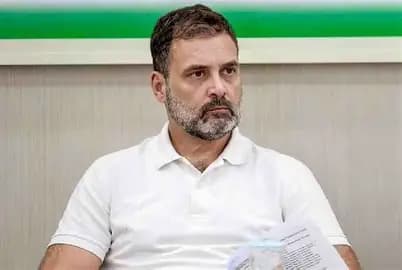
Rahul Gandhi Alleges Modi’s Silence on Trump’s Tariff Threats Linked to U.S. Adani Investigation
On August 6, 2025, Rahul Gandhi, India’s Leader of Opposition and Congress MP, sparked controversy by alleging that Prime Minister Narendra Modi’s inability to counter U.S. President Donald Trump’s repeated tariff threats stems from an ongoing U.S. investigation into the Adani Group. In a post on X, Gandhi claimed, “India, please understand: The reason PM Modi cannot stand up to President Trump despite his repeated threats is the ongoing U.S. investigation into Adani. One threat is to expose the financial links between Modi, AA, and Russian oil deals. Modi’s hands are tied.” This explosive statement, unaccompanied by specific evidence, has reignited debates about India-U.S. relations, the Adani Group’s global dealings, and India’s energy trade with Russia. This article, crafted for www.nriglobe.com, delves into the allegations, the context of Trump’s threats, the Adani investigation, and the broader implications for India’s economy and the Indian diaspora.
Context: Trump’s Tariff Threats and India’s Russian Oil Trade
The controversy emerges amid escalating tensions between India and the United States over India’s continued purchase of Russian crude oil, which accounts for roughly one-third of India’s imported oil. On August 4, 2025, President Trump announced a 25% tariff on Indian goods, effective August 27, citing India’s role in buying “massive amounts” of Russian oil and allegedly reselling it for profit. Trump escalated his rhetoric on August 5, stating on Truth Social that tariffs would be raised “very substantially” within 24 hours, accusing India of “not caring how many people in Ukraine are being killed by the Russian war machine.” Stephen Miller, Trump’s deputy chief of staff, echoed this sentiment, claiming India’s oil purchases are “financing” Russia’s war in Ukraine.
India’s Ministry of External Affairs (MEA) responded sharply, calling the U.S. and EU’s targeting of India’s oil trade “unjustified and unreasonable.” MEA spokesperson Randhir Jaiswal highlighted the hypocrisy, noting that the U.S. and EU continue trade with Russia in sectors like uranium, fertilizers, and chemicals, with Trump himself admitting ignorance about U.S. imports of these commodities. Indian officials emphasized that the nation’s energy policy is driven by market dynamics and national interests, with no plans to halt Russian oil imports.
Prime Minister Modi, in a public address on August 4, took a defiant stance, promoting the “Make in India” initiative to boost domestic consumption and reduce reliance on foreign markets. He urged citizens to buy local goods, signaling India’s resolve to maintain its economic independence despite U.S. pressure. Modi’s government has not instructed oil refiners to stop purchasing Russian crude, leaving the decision to commercial entities, including state-run and private firms like those in the Adani Group.
Rahul Gandhi’s Allegations: The Adani Connection
Gandhi’s August 6 post on X directly linked Modi’s silence to a U.S. investigation into the Adani Group, a conglomerate led by billionaire Gautam Adani, a figure often associated with close ties to Modi’s Bharatiya Janata Party (BJP). Gandhi’s use of “AA” likely refers to Adani, though he has previously accused Modi of favoritism toward both Adani and Mukesh Ambani, another Indian industrialist. The Congress party amplified Gandhi’s claims, alleging that Modi is “too scared to speak” and “stuck in the middle” between Trump and his “billionaire friends.”
The U.S. investigation, unsealed in a New York court in November 2024, accuses Gautam Adani, his nephew Sagar Adani, and six others of paying approximately $265 million in bribes to Indian officials between 2020 and 2024 to secure solar energy contracts. These contracts, projected to yield $2 billion in profits over 20 years, involved Adani Green Energy Ltd., which won a massive 8-gigawatt solar deal in 2020. The U.S. Securities and Exchange Commission (SEC) alleges that Adani concealed these bribes from international investors, including U.S. investors, violating securities laws. Additionally, the U.S. Department of Justice is probing whether the Adani Group imported Iranian petrochemicals, further complicating its legal challenges. The Adani Group has denied all allegations, calling them “baseless” and asserting compliance with governance standards.
Gandhi’s claim that the investigation threatens to “expose financial links between Modi, AA, and Russian oil deals” suggests a deeper nexus, though he provided no specifics. The Adani Group’s role in India’s energy sector, including its refining and trading activities, could intersect with Russian oil imports, as private refiners like Adani are among those purchasing discounted Russian crude. However, no direct evidence links Modi personally to these transactions, and neither the government nor the Adani Group has responded to Gandhi’s allegations.
The Adani Group’s Rise and Political Context
Gautam Adani, 63, has built a sprawling conglomerate with interests in energy, infrastructure, ports, cement, media, and more. The Adani Group’s meteoric rise, with flagship Adani Enterprises’ stock surging over 1,000% in five years, has fueled perceptions of its close ties to Modi’s government. Notably, Adani provided a private jet for Modi’s 2014 election campaign, and his 2022 hostile takeover of NDTV, a critical media outlet, raised concerns about press freedom. Critics, including Gandhi, have long accused Modi of favoritism toward Adani, a charge the BJP and Adani Group consistently deny.
The U.S. investigation adds a new dimension to these accusations. The SEC alleges that Sagar Adani and an executive from Azure Power discussed bribing local officials via WhatsApp to secure power purchase agreements, as local distributors resisted high prices. This scandal has amplified domestic and international scrutiny of Adani’s operations, with Gandhi and the Congress party leveraging it to question Modi’s foreign policy stance.
India-U.S. Relations: A Strained Partnership
The tariff dispute marks a low point in India-U.S. relations, which had flourished under Modi and Trump’s earlier “great friendship.” In February 2025, Modi was among the first leaders hosted by Trump, with both praising their bilateral ties in defense, trade, and technology. However, Trump’s recent actions, including public criticism of India’s trade policies and his claim of mediating an India-Pakistan ceasefire in May 2025 (denied by India), have soured relations. Indian officials expressed frustration at Trump’s public approach, which they say complicates backdoor negotiations to reduce Russian oil reliance.
India’s non-alignment policy, balancing ties with Russia and the U.S., is under strain. While India has strengthened U.S. partnerships, its decades-long relationship with Russia remains vital, especially for energy and defense. The Modi government has defended its Russian oil purchases as a necessity for its 1.4 billion population, especially amid global energy price hikes. Unlike China, which faces less public U.S. pressure despite similar oil imports, India feels singled out, deepening mistrust.
Implications for India and the Diaspora
For readers of www.nriglobe.com, particularly the Indian diaspora in the U.S., the escalating trade tensions and Gandhi’s allegations have significant ramifications. The 25% tariff, with threats of further increases, could raise costs for Indian exports like textiles, pharmaceuticals, and IT services, impacting U.S.-based Indian businesses. Indian consumers may face higher prices for imported goods, while energy costs could rise if Russian oil supplies are disrupted. The Adani investigation, if substantiated, risks damaging India’s reputation as a reliable investment destination, potentially affecting diaspora investments in Indian markets.
Gandhi’s claims, while unproven, resonate with opposition narratives questioning Modi’s governance and corporate ties. The Congress party plans to escalate this issue, with Gandhi hosting a dinner for INDIA bloc leaders on August 7 to unify opposition efforts. The debate over “Operation Sindoor,” the India-Pakistan conflict, further fuels accusations that Modi avoids confronting Trump to protect allies like Adani.
Critical Analysis: Unsubstantiated Claims and Political Strategy
While Gandhi’s allegations make headlines, they lack concrete evidence linking Modi directly to Adani’s alleged misdeeds or Russian oil deals. The Adani Group’s role in India’s energy trade is significant, but no public data confirms Modi’s personal involvement. The U.S. investigation focuses on bribery and securities fraud, not Russian oil, suggesting Gandhi’s claim may be a political tactic to exploit trade tensions and Adani’s legal woes. The timing, amid domestic debates over Modi’s foreign policy, indicates an opposition strategy to portray Modi as compromised.
Conversely, Modi’s silence on Trump’s threats may reflect strategic restraint rather than weakness. Public confrontations could escalate trade penalties, harming India’s economy. Modi’s “Make in India” push and India’s defiant oil policy suggest a focus on long-term economic resilience over short-term diplomatic spats. The Adani Group’s denial of charges and India’s broader trade dynamics with Russia underscore the complexity of the issue, beyond Gandhi’s narrative.
Conclusion
Rahul Gandhi’s allegation that Modi’s silence on Trump’s tariff threats is due to the U.S. Adani investigation has stirred political and economic debates. While the Adani Group faces serious allegations of bribery and securities fraud, no evidence directly ties Modi to these issues or Russian oil deals. Trump’s tariffs, aimed at pressuring India over its Russian oil imports, threaten to disrupt bilateral trade and impact the Indian diaspora. As India defends its energy sovereignty and Modi promotes domestic manufacturing, the nation navigates a delicate balance in its non-aligned foreign policy. For the latest updates on this evolving story and its implications for the Indian community, visit www.nriglobe.com.
SEO Keywords: Rahul Gandhi Modi Trump, Adani investigation U.S., India Russian oil trade, Trump tariffs India 2025, Modi Adani financial links, India-U.S. trade tensions, Russian oil sanctions, Indian diaspora trade impact, Make in India 2025, NRIGlobe news
English 


