
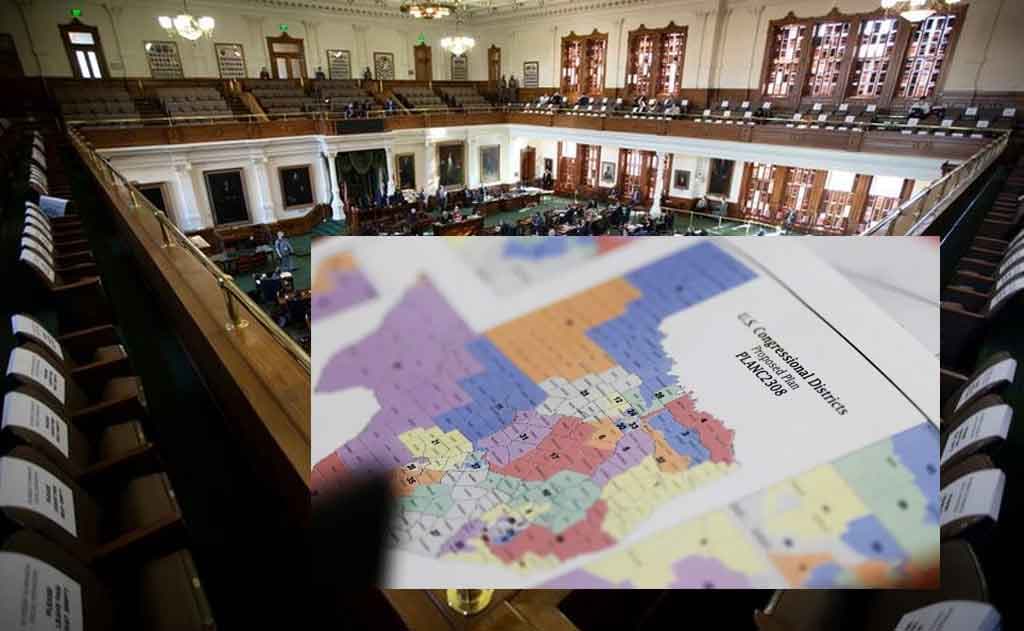
On August 12, 2025, the Texas Senate passed a controversial congressional redistricting map in a 19-2 vote along party lines, a move designed to bolster Republican representation by creating five new GOP-leaning districts while eliminating five Democrat-held seats. The decision, part of a rare mid-decade redistricting effort, has sparked heated protests from Democrats, who walked out of the Senate chamber, labeling the process as blatant gerrymandering. As the map awaits approval from the Texas House, where Democrats are stalling proceedings through a quorum break, the Non-Resident Indian (NRI) community and Indian-American voters in Texas are closely watching the implications for their representation. At NRIGlobe.com, we delve into this unfolding political saga and its impact on the Indian diaspora.
A Contentious Vote in the Texas Senate
The Texas Senate’s approval of Senate Bill 4 came after intense debate, driven by a directive from President Donald Trump to redraw congressional boundaries to favor Republicans ahead of the 2026 midterm elections. The vote saw nine of the 11 Senate Democrats exit the chamber in protest, leaving only Senators Judith Zaffirini and Juan “Chuy” Hinojosa, who voted against the measure. The Senate Democratic Caucus condemned the map as a “corrupt process,” arguing, “This mid-decade redistricting isn’t about fair representation—it’s about politicians picking their voters instead of voters choosing their leaders.”
The new map, identical to a draft advanced by a House committee, aims to increase Republican seats from 25 to 30 out of Texas’s 38 congressional districts. It targets Democratic strongholds in urban areas like Austin, Dallas, and Houston, while redrawing South Texas districts to make them more GOP-friendly. For instance, the map merges areas represented by progressive Representatives Greg Casar and Lloyd Doggett into a single District 37, forcing a potential primary clash, and redraws Casar’s District 35 to exclude most of Austin, reducing its Democratic base.
Democratic Resistance and Quorum Break
While the Senate vote moved forward, the Texas House remains paralyzed. Over 50 House Democrats have left the state for cities like Chicago, New York, and Boston, denying the chamber the two-thirds quorum needed to conduct business. This “quorum break,” a tactic rooted in Texas’s constitution, has stalled the map’s progress for over a week. Governor Greg Abbott, a staunch supporter of the redistricting effort, warned on X, “Democrats can run to another state, but they can’t outrun the will of Texans. If there’s no quorum Friday, Special Session #2 will start immediately after Sine Die.”
Republicans have responded aggressively, with House Speaker Dustin Burrows issuing civil arrest warrants and Attorney General Ken Paxton requesting the state Supreme Court to expel absent members. Democrats face $500-a-day fines for their absence, yet they remain defiant, with Houston Senator Carol Alvarado stating, “We stand in solidarity with our House Democrat brothers and sisters.”
Implications for Indian-American Representation
Texas is home to over 500,000 Indian-Americans, a rapidly growing demographic concentrated in urban centers like Houston, Dallas, and Austin. The redistricting plan could significantly impact their political influence, particularly in districts with sizable NRI populations. The map dilutes Democratic-leaning urban districts by merging them with conservative rural areas, potentially reducing the voice of minority communities, including Indian-Americans, who often align with progressive policies.
For example, Houston’s Ninth Congressional District, represented by Democrat Al Green, is combined with the vacant 18th District to form a new majority-Hispanic district that favors Republicans. Similarly, the redrawing of Austin’s districts could weaken the influence of Indian-American voters who supported Representatives Casar and Doggett. “This is about taking power away from everyday Texans,” said resident Monica Gonzalez during a Senate hearing, a sentiment echoed by many in the NRI community.
Indian-American Congressman Raja Krishnamoorthi, part of the “Samosa Caucus,” has joined colleagues in urging the U.S. Department of Justice to investigate the map for potential Voting Rights Act violations. “These maps target Texans of color, including our vibrant Indian-American community,” Krishnamoorthi said in a statement. The National Democratic Redistricting Committee has also promised swift legal challenges, with president John Bisognano warning, “Millions of Texans will have their voices silenced.”
Community Reactions and NRI Perspectives
The NRI community in Texas is divided yet vocal. Anil Shah, a 50-year-old Houston-based entrepreneur, expressed frustration on X: “Our votes matter, but this map feels like it’s silencing us to favor one party.” Others, like Priya Menon, a 35-year-old Austin tech worker, see the redistricting as a necessary adjustment. “Texas’s population has grown in cities, so redrawing districts makes sense to balance representation,” she said, echoing sentiments from some X users who argue the map corrects outdated boundaries.
However, the majority of NRI voices on X and at public hearings oppose the map, citing its potential to marginalize minority voters. “The new districts affect Democrat seats already in place. It’s a power grab,” posted one user, reflecting the broader sentiment of distrust among progressive NRIs. Community leaders are urging NRIs to engage with advocacy groups like the Indian American Forum for Political Education to amplify their concerns.
Broader Political Context
The redistricting push, initiated at Trump’s urging in July 2025, reflects a national GOP strategy to secure a House majority in 2026. Texas Republicans argue the map reflects the state’s shifting demographics, particularly GOP gains among Hispanic voters in the Rio Grande Valley. Senator Phil King, R-Weatherford, defended the map, stating, “No one has presented data or a compelling case that this map violates any applicable laws.”
Democrats, however, see it as gerrymandering, with critics like Representative Lloyd Doggett warning that it “divides progressives” and undermines fair representation. Democratic governors in California and New York have threatened retaliatory redistricting, signaling a broader national battle over congressional maps.
What’s Next for the Redistricting Map
The map’s fate hinges on the Texas House, where the Democratic quorum break has stalled progress. With the special session ending on August 19, Governor Abbott has vowed to call successive sessions until the map passes. Legal challenges are imminent, with groups like the House Majority PAC and former President Barack Obama raising funds to fight the map in court.
For NRIs, the outcome will shape their political influence in Texas, a state critical to their economic and cultural contributions. “We need fair districts that reflect our diversity,” says Arjun Patel, a Dallas-based community organizer. “NRIs are a growing force, and our voices must be heard.”
How NRIs Can Respond
To navigate this political shift, NRIs can take action:
- Engage with Advocacy Groups: Join organizations like the Indian American Forum or HAF to advocate for fair redistricting.
- Stay Informed: Follow updates on NRIGlobe.com for the latest on Texas redistricting and its impact on Indian-Americans.
- Participate in Hearings: Attend public forums or submit testimony to voice concerns about the map’s effects.
- Support Legal Challenges: Contribute to organizations like the National Democratic Redistricting Committee fighting gerrymandering.
- Vote and Mobilize: Encourage NRI communities to register and vote in 2026 to counter the map’s potential impact.
Conclusion: A Critical Moment for NRI Representation
The Texas Senate’s approval of the GOP-favored redistricting map marks a pivotal moment for Indian-American voters and the broader NRI community. As the map threatens to dilute minority representation, NRIs are rallying to protect their political voice. At NRIGlobe.com, we stand with the diaspora, providing resources and updates to empower NRIs in this fight for fair representation. As the battle moves to the Texas House and likely the courts,
Related NRI Globe Coverage
- Texas Democrats Flee State to Block GOP Map, Face Bribery Charges and Expulsion Threat
- Global EV Adoption Map 2026: Implications for NRIs and the Indian Diaspora
- Texas Rep. Nicole Collier Locked in House Chamber Amid Redistricting Standoff
- Abbott’s Redistricting Plan Ignites Fierce Political Battle in Texas
- Texas Republicans Advance Redistricting Plan Targeting Democratic Districts: A Battle Over Congressional Maps
- Senate Committee Advances PELOSI Act: Implications for NRIs on Congressional Stock Trading Ban
- American Hero Scott Ruskan Saves 165 Lives in Texas Flash Floods: A Coast Guard Story of Bravery
- FEMA Budget Cuts Leave Texas Reeling: The Devastating Impact on Central Texas Flood
Fresh from NRI Globe
- YouTuber Nandu's World (Rama Nandana) UK Visa & Job Fraud Case: Full Details + Key Lessons for NRIs (2026)
- Dussehra / Vijayadashami 2026 Events Country-Wise — Global NRI Directory (Ram Lila, Ravana Dahan, Durga Puja Pandals, Ayudha Puja Venues + Booking)
- Diwali 2026 Events Country-Wise — Global NRI Directory (White House, Leicester, London Trafalgar, Toronto, Auckland, Sydney Parramasala, Fiji, Mauritius, Trinidad, South Africa and More)
- Diwali / Deepavali 2026 Country-Wise NRI Celebrations — Complete Global Guide (USA, UK, Canada, Australia, Fiji, Mauritius, Trinidad, South Africa, UAE and 30+ Countries)