
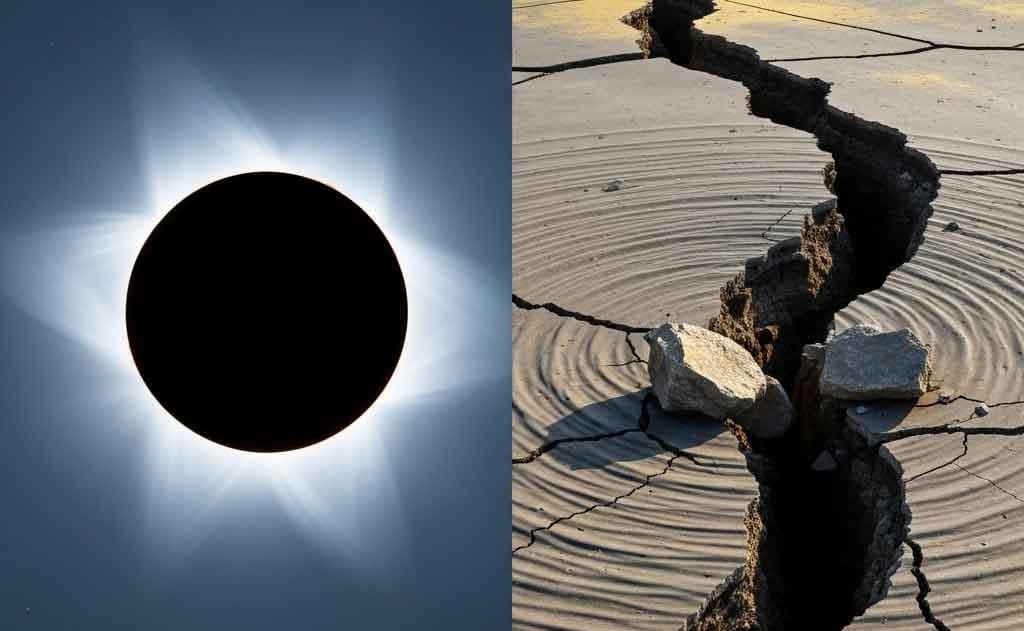
A Celestial Tale Begins
In the small village of Umbra, nestled in the foothills of a restless mountain range, the air buzzed with anticipation. The year was 2025, and a total solar eclipse was set to cast its shadow over the village for the first time in centuries. The elders spoke of ancient legends, whispering that when the moon cloaks the sun, the Earth itself trembles in response. Young Aisha, a curious geologist with a passion for unraveling mysteries, listened intently. Could there be truth to these tales? Did the cosmic dance of a solar eclipse truly stir the ground beneath their feet? Her quest for answers would lead her deep into the science and stories connecting solar eclipses and earthquakes.
The Cosmic Connection: Setting the Stage
A solar eclipse occurs when the moon passes between the Earth and the sun, temporarily casting a shadow that blocks sunlight. This celestial event, awe-inspiring and rare, has captivated humans for millennia, often imbued with spiritual or ominous significance. Earthquakes, on the other hand, are the sudden release of energy in the Earth's crust, caused by tectonic plates shifting along faults. At first glance, these phenomena seem unrelated—one a predictable astronomical event, the other a chaotic geological process. Yet, whispers of a connection have persisted across cultures and scientific inquiries, prompting researchers like Aisha to dig deeper.
The hypothesis hinges on gravitational forces. The sun and moon exert tidal forces on Earth, much like they do on the oceans, causing subtle deformations in the planet's crust. During a solar eclipse, the sun, moon, and Earth align in a rare configuration called syzygy, potentially amplifying these forces. Could this alignment trigger earthquakes, especially in regions already primed for seismic activity? Aisha's journey through historical records, scientific studies, and local folklore would reveal a complex and fascinating story.
Historical Whispers: Eclipses and Earthquakes in the Past
Aisha began her exploration in Umbra's dusty library, poring over ancient manuscripts. She found accounts from civilizations worldwide linking eclipses to earthly upheavals. In 365 CE, the Mediterranean island of Crete was rocked by a devastating earthquake shortly after a solar eclipse, leveling cities and triggering tsunamis. In 1133, a solar eclipse over England was followed by tremors that rattled medieval chroniclers. These stories, while compelling, were anecdotal, and Aisha knew correlation didn't equal causation. Still, the patterns intrigued her.
Modern data offered more clarity. Aisha discovered studies analyzing seismic activity around eclipse events. A 2018 paper in Geophysical Research Letters examined global earthquake records during solar eclipses from 1900 to 2015. The researchers found no statistically significant increase in earthquakes during or immediately after eclipses. However, they noted a slight uptick in small-magnitude quakes in tectonically active regions, suggesting that tidal forces might nudge faults already on the brink of slipping.
The Science of Tides and Tremors
To understand the potential link, Aisha delved into the physics of tidal forces. The moon's gravitational pull causes Earth's crust to flex by a few centimeters daily, a phenomenon called Earth tides. During a solar eclipse, the combined gravitational pull of the sun and moon in alignment could enhance these tides, creating slightly stronger stresses in the crust. For most faults, this stress is negligible compared to the massive forces driving tectonic activity. But in "critically stressed" faults—those already close to failure—the extra nudge might be enough to trigger a quake.
Aisha visualized this as a tightrope walker carrying a heavy load. The walker (the fault) is stable but strained. A gentle breeze (the eclipse's tidal forces) might not topple them, but if they're already wobbling, it could push them over the edge. Studies estimate that tidal stresses during an eclipse are small, about 0.01% of the stress needed for a typical earthquake. Yet, in rare cases, this tiny push could matter.
A Modern Case Study: The 2017 Eclipse
Aisha's research led her to a recent event: the August 21, 2017, total solar eclipse that swept across the United States. Seismologists had monitored earthquake activity along the eclipse's path, particularly in the seismically active Cascadia Subduction Zone. While no major quakes occurred, a 2020 study in Seismological Research Letters reported a cluster of microearthquakes (magnitude less than 2.0) in the hours following the eclipse. These tiny tremors, often imperceptible to humans, suggested that the eclipse's tidal forces might have subtly influenced fault behavior.
Aisha imagined the Earth as a sleeping giant, stirred ever so slightly by the moon's shadow. The 2017 data hinted at a connection, but the effect was small and localized. She wondered if Umbra, situated near a fault line, might experience something similar during the upcoming eclipse.
Cultural Echoes and Modern Myths
Back in Umbra, the village buzzed with stories. Elders recounted how their ancestors would beat drums during eclipses to "steady the Earth." Aisha smiled, recognizing the blend of fear and reverence in these traditions. Similar beliefs echoed globally: in ancient China, eclipses were thought to anger dragons that shook the ground; in India, some texts linked eclipses to seismic unrest. These myths, while not scientific, reflected humanity's attempt to make sense of nature's mysteries.
Aisha also stumbled upon modern pseudoscience claiming eclipses directly cause catastrophic quakes. She dismissed these as exaggerations, noting that large earthquakes, like the 2011 Tohoku quake in Japan, showed no clear link to eclipses. The science was clear: while tidal forces might play a minor role, they were not the primary driver of seismic activity.
The Eclipse Arrives
On the day of the eclipse, Umbra gathered to watch the sky darken. Aisha set up a portable seismometer near the village's fault line, her heart racing with anticipation. As the moon eclipsed the sun, plunging the village into an eerie twilight, she monitored the device. The ground remained still, but the data later revealed a faint tremor, too small to feel, just minutes after totality.
Aisha's findings mirrored the scientific consensus: solar eclipses might slightly increase the likelihood of small quakes in tectonically active areas, but they don't cause major earthquakes. The tidal forces are simply too weak to overcome the complex dynamics of plate tectonics. Yet, the stories and subtle seismic signals kept the mystery alive, a reminder of how interconnected the cosmos and Earth can feel.
Conclusion: A Dance of Wonder
Aisha shared her findings with the village, blending science with their cherished tales. The elders nodded, satisfied that their legends held a kernel of truth, even if the connection was subtle. For Aisha, the journey revealed the beauty of exploring nature's mysteries, where science and storytelling dance together like the sun and moon in the sky.
The relationship between solar eclipses and earthquakes remains a tantalizing puzzle. While the evidence suggests only a minor influence, the alignment of celestial and terrestrial forces continues to inspire awe and curiosity. As Aisha looked to the stars, she knew the Earth would keep trembling, and the heavens would keep dancing, each in their own time.
Related NRI Globe Coverage
- President Trump Claims He Averted Nuclear War Between India and Pakistan
- Total Solar Eclipse 2027 – 6 Minutes of Darkness You Can’t Miss
- Solar Eclipse Hoax Debunked: The Truth About August 2, 2027
- Jeff Bezos and Lauren Sanchez: Age Gap, Relationship Timeline, and Rumors Explained
- YouTuber Nandu's World (Rama Nandana) UK Visa & Job Fraud Case: Full Details + Key Lessons for NRIs (2026)
- US Crime News 2026 — Top Trend Categories NRIs Are Watching (Organized Retail Theft, Auto Theft, Cybercrime, Hate Crimes, Fentanyl, AI-Enabled Fraud)
- US Crime & Safety This Week — September 17-21, 2026 (NRI Family Guide, FBI Alerts, H-1B/Immigration Scams, Tech Support Fraud, Emergency Resources)
- Japan's Centenarian Population Surpasses 100,000 for the First Time in History
Fresh from NRI Globe
- Dussehra / Vijayadashami 2026 Events Country-Wise — Global NRI Directory (Ram Lila, Ravana Dahan, Durga Puja Pandals, Ayudha Puja Venues + Booking)
- Diwali 2026 Events Country-Wise — Global NRI Directory (White House, Leicester, London Trafalgar, Toronto, Auckland, Sydney Parramasala, Fiji, Mauritius, Trinidad, South Africa and More)
- Diwali / Deepavali 2026 Country-Wise NRI Celebrations — Complete Global Guide (USA, UK, Canada, Australia, Fiji, Mauritius, Trinidad, South Africa, UAE and 30+ Countries)
- Dussehra / Vijayadashami 2026 Country-Wise NRI Celebrations — USA, UK, Canada, Australia, New Zealand, UAE, Singapore, Germany, Netherlands and More