
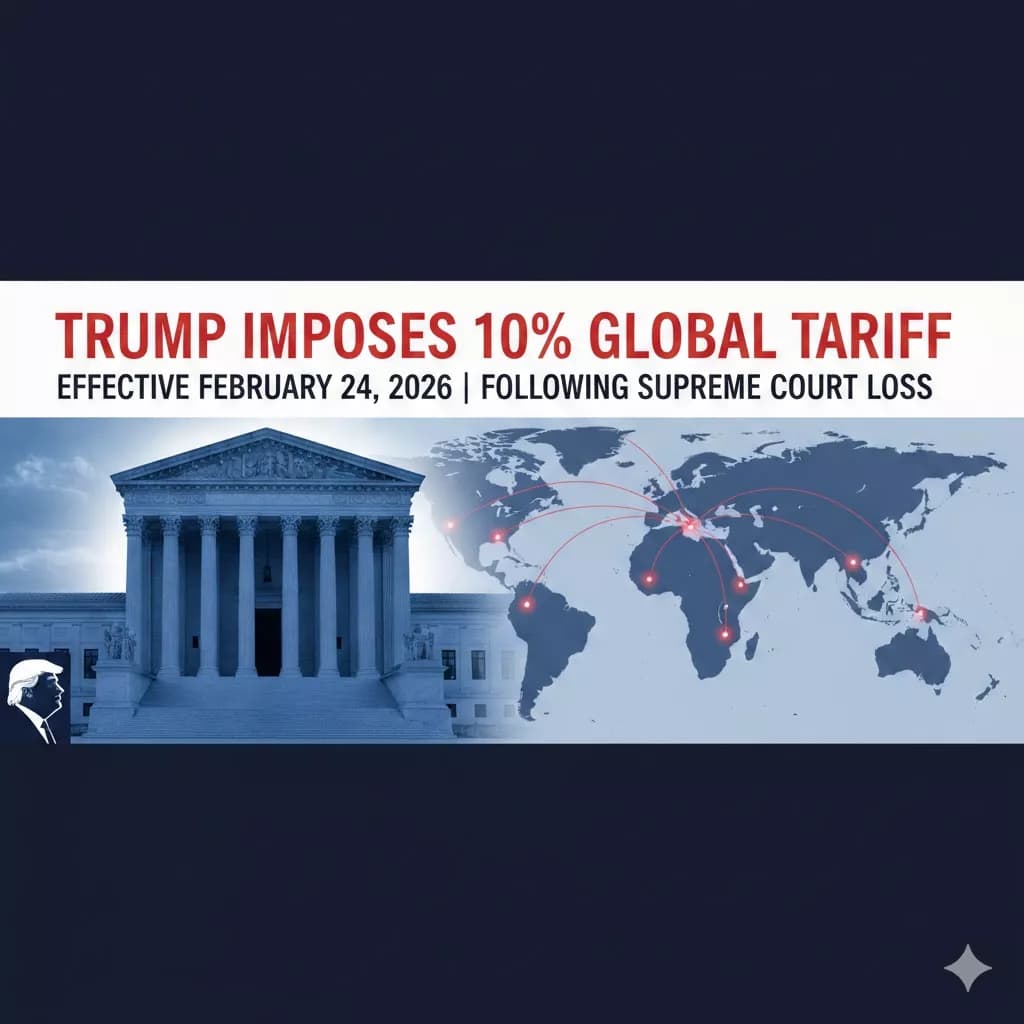
Just hours after the US Supreme Court blocked President Donald Trump's earlier emergency tariffs in a 6-3 ruling, he signed a new proclamation imposing a 10% worldwide import duty on most goods entering the United States. This temporary measure, invoked under Section 122 of the Trade Act of 1974, aims to address US balance-of-payments issues and rebalance global trade.
For Non-Resident Indians (NRIs) living in the US, Canada, UK, Australia, Gulf countries, and elsewhere, this development could influence daily costs, family remittances, investments, and India-US economic ties. Here's a breakdown tailored for the global Indian diaspora.
Key Details of the New Tariff
- Effective Date: Starts at 12:01 a.m. EST on February 24, 2026.
- Duration: Limited to 150 days (about 5 months), unless extended by Congress – making it a short-term policy tool.
- Scope: A flat 10% ad valorem surcharge on imports from all countries, added on top of existing normal (MFN) tariffs.
- Exemptions (important for NRI households and businesses):
- Critical minerals, metals, energy products, and fertilizers not produced enough domestically in the US.
- Key agricultural items like beef, oranges, tomatoes – and potentially some staples relevant to Indian groceries.
- Pharmaceuticals and ingredients (a relief for NRIs relying on generic drugs or sending medicines home).
- Certain electronics, passenger vehicles, light trucks, buses, aerospace products, and parts.
- Informational materials (books, publications), donations, and personal baggage.
- Goods already under separate tariffs (may remain unaffected in some cases).
- Possible protections for partners under deals like USMCA; India-specific arrangements from recent talks could soften impacts.
Background: From Supreme Court Setback to Quick Pivot
The Supreme Court's February 20, 2026, decision invalidated Trump's prior broad tariffs under the International Emergency Economic Powers Act (IEEPA), calling them an overreach of presidential authority. Trump labeled the ruling "deeply disappointing" and accused some justices of foreign influence.
He immediately shifted to Section 122 powers, signing the order from the Oval Office and sharing updates on Truth Social. Officials like Treasury Secretary Scott Bessent noted this – plus potential future use of Sections 301 (unfair practices) and 232 (national security) – could keep tariff revenue levels similar in 2026.
How This Could Impact NRIs
- Higher Costs for Indian Goods in the US: NRIs in the US may see price increases on non-exempt imports like textiles, spices, certain electronics, or specialty foods (e.g., basmati rice, dals, snacks). Indian grocery stores in areas like New Jersey, California, or Texas could pass on costs, affecting family budgets and authenticity of home-cooked meals.
- Remittances and Family Support: While the tariff targets goods (not services or remittances directly), any slowdown in India-US trade could indirectly pressure the rupee or Indian economy, influencing how much NRIs send home or invest back in India.
- Investments and Stocks: NRI investors in Indian IT, pharma, or export-oriented sectors (textiles, gems, auto parts) should watch for volatility. Exemptions for pharmaceuticals and some tech/electronics could limit damage, but broader uncertainty might affect portfolio returns. Many NRIs park money in US stocks too – potential inflation from tariffs could influence Fed policy and markets.
- Business Owners and Entrepreneurs: Indian-American business owners (e.g., in retail, import-export, or tech) face fresh uncertainty. Those importing from India may need to adjust pricing or sourcing. On the positive side, recent US-India frameworks reduced some prior duties, and this 10% level is lower than earlier reciprocal threats (e.g., 25-50%).
- Travel and Gifting: NRIs planning trips to India or sending gifts/packages might face minor added costs on non-exempt items, though personal baggage exemptions help.
- Global Ripple Effects: For NRIs in other countries, retaliatory measures from trading partners could affect jobs or supply chains – though India's strong ties and exemptions may cushion blows.
What NRIs Should Do Next
- Monitor official US Customs and Border Protection updates for exact exemption lists.
- Check with Indian exporters or US-based Indian stores for price adjustments starting late February.
- Review personal investments – consult NRI-focused financial advisors on diversifying amid trade shifts.
- Stay tuned for Congress's role after 150 days or any India-US negotiations.
This move highlights ongoing US protectionism under Trump, but exemptions and the temporary nature offer some breathing room for the diaspora. For the latest NRI-specific angles, follow trusted sources like White House announcements or NRI community forums. Stay connected – NriGlobe will keep updating on how global events affect Indian families abroad!
Latest NRI News & Global Updates:
Health, Wellness & Lifestyle for NRIs
https://nriglobe.com/lifestyle/
Latest NRI News & Global Updates
https://nriglobe.com/news/
Business & Finance News for NRIs
https://nriglobe.com/business/
Investment Guides for NRIs
https://nriglobe.com/investment/
Jobs & Career Opportunities for NRIs
https://nriglobe.com/jobs/
Related NRI Globe Coverage
- Trump Imposes Up-to-100% Tariffs on Foreign-Made Drones (Effective Sep 3, 2026) — DJI, Chinese Suppliers Hit Hard
- Trump Postpones India Tariff, Imposes 35% Tariff on Canada: Trade Deal Progress Falls Short
- $5,000 Trump Dividend Proposal — Complete Details, Feasibility & NRI Impact Analysis (Nov 2026 Midterms)
- Women Accounted for 98% of US Job Gains in August 2026 — What It Means for the Economy & NRIs
- Trump No Tax on Tips: Boost for Indian-Americans
- Trump Hormuz Blockade: Impact on Indian Families
- Trump Attacks Supreme Court After Tariff Loss
- Trump Immigration Crackdown 2026: Minnesota Shooting Fallout – Impact on USA
Fresh from NRI Globe
- YouTuber Nandu's World (Rama Nandana) UK Visa & Job Fraud Case: Full Details + Key Lessons for NRIs (2026)
- Dussehra / Vijayadashami 2026 Events Country-Wise — Global NRI Directory (Ram Lila, Ravana Dahan, Durga Puja Pandals, Ayudha Puja Venues + Booking)
- Diwali 2026 Events Country-Wise — Global NRI Directory (White House, Leicester, London Trafalgar, Toronto, Auckland, Sydney Parramasala, Fiji, Mauritius, Trinidad, South Africa and More)
- Diwali / Deepavali 2026 Country-Wise NRI Celebrations — Complete Global Guide (USA, UK, Canada, Australia, Fiji, Mauritius, Trinidad, South Africa, UAE and 30+ Countries)