
By [Your Name], September 7, 2025, for NRIGlobe.com
On September 6, 2025, President Donald Trump intensified his ongoing feud with Chicago’s leadership by posting a provocative meme on Truth Social, depicting military action to combat crime in the city and referencing a so-called "Department of WAR." The post, which aligns with Trump’s repeated threats to deploy the National Guard to Chicago, has ignited fierce opposition from Illinois Governor JB Pritzker and Chicago Mayor Brandon Johnson, who have labeled the move unconstitutional and vowed legal action. The escalating rhetoric has fueled protests across the city, with thousands taking to the streets, and sparked widespread debate on social media, raising fears of a potential constitutional crisis.
Trump’s Threats and the "Department of WAR" Meme
President Trump’s latest salvo came in the form of a meme shared on Truth Social, his preferred social media platform, on September 6, 2025. The meme reportedly depicted military imagery, including tanks and soldiers, with captions suggesting a forceful crackdown on Chicago’s crime rates under the banner of a "Department of WAR." While the exact content of the meme has not been fully disclosed due to its circulation on a platform with limited public access, sources indicate it framed military intervention as a solution to Chicago’s gun violence, which Trump has repeatedly called “out of control.” The reference to a "Department of WAR" appears to be a rhetorical flourish, as no such federal department exists, though it aligns with Trump’s broader narrative of aggressive federal action against crime in Democratic-led cities.
This post follows weeks of Trump signaling his intent to deploy the National Guard to Chicago, a city he has frequently targeted as a symbol of urban crime. On September 2, 2025, Trump told reporters in the Oval Office, “We’re going in,” though he provided no timeline or specifics, adding, “I didn’t say when we’re going in.” He cited a violent Labor Day weekend in Chicago, where 60 people were shot, eight fatally, as justification for federal intervention. Trump has claimed he has an “obligation to protect this country,” arguing that Illinois officials, particularly Governor Pritzker, should request federal assistance.
Local Leadership Pushes Back
Illinois Governor JB Pritzker and Chicago Mayor Brandon Johnson have vehemently opposed Trump’s threats, framing them as an overreach of federal authority and a violation of constitutional norms. At a press conference on September 2, 2025, alongside other Democratic leaders, including Cook County Board President Toni Preckwinkle and Illinois Attorney General Kwame Raoul, Pritzker rejected the idea of federal troops in Chicago, calling Trump’s remarks “unhinged” and a “partisan ploy.” He stated, “No, I will not call the president, asking him to send troops to Chicago. I’ve made that clear already.” Pritzker warned that any federal deployment could inflame tensions and urged residents to remain peaceful to avoid giving Trump a pretext for further action.
Mayor Johnson echoed Pritzker’s concerns, describing the potential National Guard deployment as “uncoordinated, uncalled for, and unsound.” On August 22, 2025, Johnson issued an executive order instructing Chicago police not to cooperate with federal agents or troops if deployed, signaling the city’s intent to resist. Johnson highlighted Chicago’s progress in reducing crime, noting a 30% drop in homicides, a 35% reduction in robberies, and a nearly 40% decrease in shootings over the past year. “We know that our communities are safest when we fully invest in housing, community safety, and education,” he said, arguing that military intervention would undermine these efforts.
Legal experts have pointed to the Insurrection Act as a potential justification cited by the Trump administration for deploying the National Guard, though many argue such a move would be a drastic overreach absent a clear emergency. A recent federal court ruling in California, where Judge Charles Breyer found Trump’s deployment of troops in Los Angeles to be a violation of the 1878 Posse Comitatus Act, has bolstered local leaders’ arguments. The ruling, which prohibits federal troops from performing law enforcement functions like arrests or crowd control, could set a precedent for challenging any Chicago deployment.
Protests Erupt in Chicago
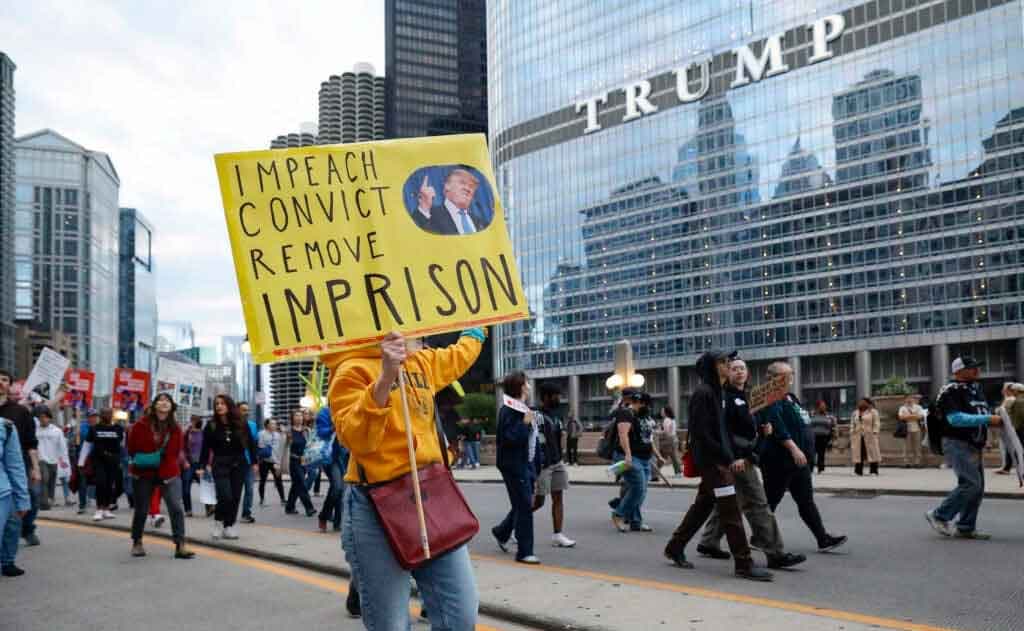
Trump’s September 6 meme and ongoing threats have galvanized Chicago residents, with thousands taking to the streets in protests across the city. Demonstrators, organized by community groups and supported by local veterans’ organizations, have rallied against what they see as an authoritarian move. On September 2, 2025, a group of military veterans gathered at Federal Plaza in Chicago, urging National Guard members to refuse participation in what they called an “illegal deployment.” Protest organizers have emphasized peaceful demonstrations, heeding Pritzker and Johnson’s warnings that violence could provide Trump with an excuse to escalate federal intervention.
Social media reactions, particularly on X, reflect deep divisions. Some users, like @pr0ud_americans, have supported Trump’s stance, arguing that Chicago’s crime rates justify federal action and criticizing Pritzker’s resistance. Others, including @AnthonyMKreis and @namwella1961, have condemned the threats as authoritarian and unconstitutional, with @HeartlandSignal quoting Pritzker’s sharp rebuke of Trump’s “mental faculties” and fitness for office. These polarized sentiments underscore the broader national divide over federal versus state authority.
Constitutional Crisis Looms
The standoff between Trump and Chicago’s leadership has raised concerns about a potential constitutional crisis. The Pentagon’s reported preparations, including authorizing Naval Station Great Lakes as a staging ground for operations targeting undocumented immigrants and crime, suggest that the administration is moving forward despite local opposition. Reports indicate that the Department of Homeland Security (DHS) and Immigration and Customs Enforcement (ICE) may also be involved, potentially expanding the scope of federal action beyond crime to immigration enforcement.
Pritzker has pledged legal action if federal forces overstep their authority, and Johnson’s executive order signals Chicago’s readiness to challenge any deployment in court. The California ruling against Trump’s Los Angeles deployment provides a legal framework for such challenges, though Trump has dismissed the judge as a “radical left judge” and maintained that he has “inherent constitutional authority” to act. Legal scholars predict that any Chicago deployment would quickly lead to lawsuits, potentially reaching federal courts or even the Supreme Court, given the significant questions of presidential power and state sovereignty at stake.
Chicago’s Crime Context
Trump’s focus on Chicago stems from its history of gun violence, which he has exaggerated by calling the city the “MURDER CAPITAL OF THE WORLD!” on Truth Social. However, local data paints a more complex picture. While Chicago experienced a violent Labor Day weekend in 2025, with 60 shootings, overall crime has been trending downward. A CBS News analysis noted a 30% reduction in homicides and significant drops in other violent crimes over the past year, aligning with national trends in many urban areas post-COVID-19. Critics argue that Trump’s rhetoric ignores these improvements and selectively highlights weekend spikes to justify federal intervention.
Chicago Police Superintendent Larry Snelling has also clarified that National Guard members cannot make arrests in the city unless partnered with local or federal law enforcement, further complicating any deployment. Meanwhile, some conservative Illinois lawmakers, such as state Representative Martin McLaughlin, have supported Trump’s plan, citing the success of a similar National Guard deployment in Washington, D.C., where crime reportedly dropped after federal intervention.
Broader Implications
Trump’s threats against Chicago are part of a broader strategy targeting Democratic-led cities, with the president also mentioning Baltimore and New York as potential future targets. His administration has pointed to the D.C. deployment as a model, with White House press secretary Karoline Leavitt stating, “Working with President Trump means safer communities and less crime.” However, local leaders argue that such interventions erode trust between communities and law enforcement, potentially exacerbating tensions rather than resolving them.
The reference to a “Department of WAR” in Trump’s meme, while likely symbolic, has heightened fears of militarization in domestic policy. Governor Pritzker’s warning that Trump may use minor incidents, such as “someone flinging a sandwich at an ICE agent,” to declare an emergency underscores the delicate balance of power at play. As protests continue and legal battles loom, Chicago remains a flashpoint in the ongoing debate over federal authority, urban crime, and constitutional governance.
Conclusion
President Trump’s escalation of threats against Chicago, culminating in his provocative “Department of WAR” meme, has set the stage for a high-stakes confrontation with Illinois and city officials. Governor Pritzker and Mayor Johnson’s resolute opposition, backed by legal precedent and public protests, highlights the deep tensions between federal and local authority. As Chicago braces for potential National Guard deployment, the nation watches closely, with the outcome likely to shape the boundaries of presidential power and the future of urban policy in America.
For updates on this developing story, visit NRIGlobe.com and follow us on social media.
By [Your Name], September 7, 2025, for NRIGlobe.com
On September 6, 2025, President Donald Trump intensified his ongoing feud with Chicago’s leadership by posting a provocative meme on Truth Social, depicting military action to combat crime in the city and referencing a so-called "Department of WAR." The post, which aligns with Trump’s repeated threats to deploy the National Guard to Chicago, has ignited fierce opposition from Illinois Governor JB Pritzker and Chicago Mayor Brandon Johnson, who have labeled the move unconstitutional and vowed legal action. The escalating rhetoric has fueled protests across the city, with thousands taking to the streets, and sparked widespread debate on social media, raising fears of a potential constitutional crisis.
Trump’s Threats and the "Department of WAR" Meme
President Trump’s latest salvo came in the form of a meme shared on Truth Social, his preferred social media platform, on September 6, 2025. The meme reportedly depicted military imagery, including tanks and soldiers, with captions suggesting a forceful crackdown on Chicago’s crime rates under the banner of a "Department of WAR." While the exact content of the meme has not been fully disclosed due to its circulation on a platform with limited public access, sources indicate it framed military intervention as a solution to Chicago’s gun violence, which Trump has repeatedly called “out of control.” The reference to a "Department of WAR" appears to be a rhetorical flourish, as no such federal department exists, though it aligns with Trump’s broader narrative of aggressive federal action against crime in Democratic-led cities.
This post follows weeks of Trump signaling his intent to deploy the National Guard to Chicago, a city he has frequently targeted as a symbol of urban crime. On September 2, 2025, Trump told reporters in the Oval Office, “We’re going in,” though he provided no timeline or specifics, adding, “I didn’t say when we’re going in.” He cited a violent Labor Day weekend in Chicago, where 60 people were shot, eight fatally, as justification for federal intervention. Trump has claimed he has an “obligation to protect this country,” arguing that Illinois officials, particularly Governor Pritzker, should request federal assistance.
Local Leadership Pushes Back
Illinois Governor JB Pritzker and Chicago Mayor Brandon Johnson have vehemently opposed Trump’s threats, framing them as an overreach of federal authority and a violation of constitutional norms. At a press conference on September 2, 2025, alongside other Democratic leaders, including Cook County Board President Toni Preckwinkle and Illinois Attorney General Kwame Raoul, Pritzker rejected the idea of federal troops in Chicago, calling Trump’s remarks “unhinged” and a “partisan ploy.” He stated, “No, I will not call the president, asking him to send troops to Chicago. I’ve made that clear already.” Pritzker warned that any federal deployment could inflame tensions and urged residents to remain peaceful to avoid giving Trump a pretext for further action.
Mayor Johnson echoed Pritzker’s concerns, describing the potential National Guard deployment as “uncoordinated, uncalled for, and unsound.” On August 22, 2025, Johnson issued an executive order instructing Chicago police not to cooperate with federal agents or troops if deployed, signaling the city’s intent to resist. Johnson highlighted Chicago’s progress in reducing crime, noting a 30% drop in homicides, a 35% reduction in robberies, and a nearly 40% decrease in shootings over the past year. “We know that our communities are safest when we fully invest in housing, community safety, and education,” he said, arguing that military intervention would undermine these efforts.
Legal experts have pointed to the Insurrection Act as a potential justification cited by the Trump administration for deploying the National Guard, though many argue such a move would be a drastic overreach absent a clear emergency. A recent federal court ruling in California, where Judge Charles Breyer found Trump’s deployment of troops in Los Angeles to be a violation of the 1878 Posse Comitatus Act, has bolstered local leaders’ arguments. The ruling, which prohibits federal troops from performing law enforcement functions like arrests or crowd control, could set a precedent for challenging any Chicago deployment.
Protests Erupt in Chicago
Trump’s September 6 meme and ongoing threats have galvanized Chicago residents, with thousands taking to the streets in protests across the city. Demonstrators, organized by community groups and supported by local veterans’ organizations, have rallied against what they see as an authoritarian move. On September 2, 2025, a group of military veterans gathered at Federal Plaza in Chicago, urging National Guard members to refuse participation in what they called an “illegal deployment.” Protest organizers have emphasized peaceful demonstrations, heeding Pritzker and Johnson’s warnings that violence could provide Trump with an excuse to escalate federal intervention.
Social media reactions, particularly on X, reflect deep divisions. Some users, like @pr0ud_americans, have supported Trump’s stance, arguing that Chicago’s crime rates justify federal action and criticizing Pritzker’s resistance. Others, including @AnthonyMKreis and @namwella1961, have condemned the threats as authoritarian and unconstitutional, with @HeartlandSignal quoting Pritzker’s sharp rebuke of Trump’s “mental faculties” and fitness for office. These polarized sentiments underscore the broader national divide over federal versus state authority.
Constitutional Crisis Looms
The standoff between Trump and Chicago’s leadership has raised concerns about a potential constitutional crisis. The Pentagon’s reported preparations, including authorizing Naval Station Great Lakes as a staging ground for operations targeting undocumented immigrants and crime, suggest that the administration is moving forward despite local opposition. Reports indicate that the Department of Homeland Security (DHS) and Immigration and Customs Enforcement (ICE) may also be involved, potentially expanding the scope of federal action beyond crime to immigration enforcement.
Pritzker has pledged legal action if federal forces overstep their authority, and Johnson’s executive order signals Chicago’s readiness to challenge any deployment in court. The California ruling against Trump’s Los Angeles deployment provides a legal framework for such challenges, though Trump has dismissed the judge as a “radical left judge” and maintained that he has “inherent constitutional authority” to act. Legal scholars predict that any Chicago deployment would quickly lead to lawsuits, potentially reaching federal courts or even the Supreme Court, given the significant questions of presidential power and state sovereignty at stake.
Chicago’s Crime Context
Trump’s focus on Chicago stems from its history of gun violence, which he has exaggerated by calling the city the “MURDER CAPITAL OF THE WORLD!” on Truth Social. However, local data paints a more complex picture. While Chicago experienced a violent Labor Day weekend in 2025, with 60 shootings, overall crime has been trending downward. A CBS News analysis noted a 30% reduction in homicides and significant drops in other violent crimes over the past year, aligning with national trends in many urban areas post-COVID-19. Critics argue that Trump’s rhetoric ignores these improvements and selectively highlights weekend spikes to justify federal intervention.
Chicago Police Superintendent Larry Snelling has also clarified that National Guard members cannot make arrests in the city unless partnered with local or federal law enforcement, further complicating any deployment. Meanwhile, some conservative Illinois lawmakers, such as state Representative Martin McLaughlin, have supported Trump’s plan, citing the success of a similar National Guard deployment in Washington, D.C., where crime reportedly dropped after federal intervention.
Broader Implications
Trump’s threats against Chicago are part of a broader strategy targeting Democratic-led cities, with the president also mentioning Baltimore and New York as potential future targets. His administration has pointed to the D.C. deployment as a model, with White House press secretary Karoline Leavitt stating, “Working with President Trump means safer communities and less crime.” However, local leaders argue that such interventions erode trust between communities and law enforcement, potentially exacerbating tensions rather than resolving them.
The reference to a “Department of WAR” in Trump’s meme, while likely symbolic, has heightened fears of militarization in domestic policy. Governor Pritzker’s warning that Trump may use minor incidents, such as “someone flinging a sandwich at an ICE agent,” to declare an emergency underscores the delicate balance of power at play. As protests continue and legal battles loom, Chicago remains a flashpoint in the ongoing debate over federal authority, urban crime, and constitutional governance.
Conclusion
President Trump’s escalation of threats against Chicago, culminating in his provocative “Department of WAR” meme, has set the stage for a high-stakes confrontation with Illinois and city officials. Governor Pritzker and Mayor Johnson’s resolute opposition, backed by legal precedent and public protests, highlights the deep tensions between federal and local authority. As Chicago braces for potential National Guard deployment, the nation watches closely, with the outcome likely to shape the boundaries of presidential power and the future of urban policy in America.
For updates on this developing story, visit NRIGlobe.com and follow us on social media.
Related NRI Globe Coverage
- NRI Alert: Iran War Escalates After Trump Warning
- Trump Fires CDC Director Susan Monarez, Sparks Resignations and Protests
- Trump Orders Federal Takeover of D.C. Police, National Guard Deployment Amid Crime Concerns
- Trump Proposes Federal Takeover of Washington, D.C. Amid Crime and Governance Concerns
- Trump Admits Ignorance on U.S. Russian Imports Amid Tariff Threats on India
- Donald Trump Diagnosed with Chronic Venous Insufficiency: White House Addresses Health Concerns
- Trump Diagnosed with Chronic Venous Insufficiency: White House Health Update
- Protests Erupt Outside White House During Netanyahu-Trump Meeting
Fresh from NRI Globe
- YouTuber Nandu's World (Rama Nandana) UK Visa & Job Fraud Case: Full Details + Key Lessons for NRIs (2026)
- Dussehra / Vijayadashami 2026 Events Country-Wise — Global NRI Directory (Ram Lila, Ravana Dahan, Durga Puja Pandals, Ayudha Puja Venues + Booking)
- Diwali 2026 Events Country-Wise — Global NRI Directory (White House, Leicester, London Trafalgar, Toronto, Auckland, Sydney Parramasala, Fiji, Mauritius, Trinidad, South Africa and More)
- Diwali / Deepavali 2026 Country-Wise NRI Celebrations — Complete Global Guide (USA, UK, Canada, Australia, Fiji, Mauritius, Trinidad, South Africa, UAE and 30+ Countries)