
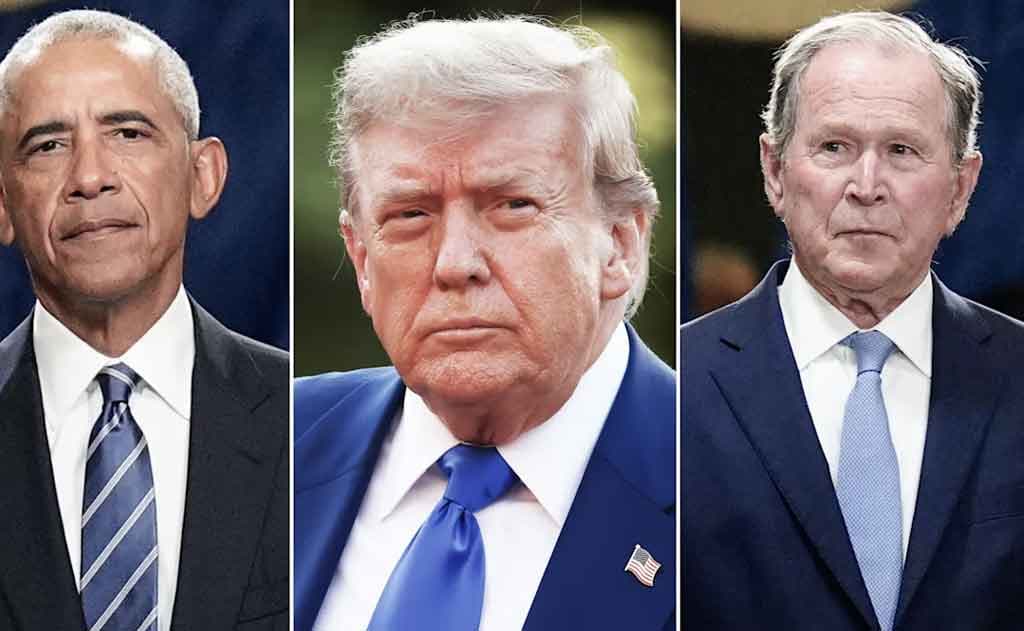
A Departure from Presidential Tradition
On August 10, 2025, President Donald Trump made headlines by relocating the official White House portraits of former Presidents Barack Obama, George W. Bush, and George H.W. Bush to a little-seen stairwell, diverging from the long-standing tradition of showcasing recent presidents in prominent areas like the Grand Foyer. This move, which has stirred debate across the U.S. and among the global Indian diaspora, highlights tensions between Trump and his predecessors while raising questions about the symbolism of such decisions in the nation’s most iconic residence.
Details of the Portrait Relocation
Insiders report that Trump instructed White House staff to move Obama’s portrait to the top of the Grand Staircase, a restricted area primarily used by the presidential family, Secret Service, and select personnel. The portraits of George W. Bush and his father, George H.W. Bush, were also shifted to this secluded stairwell, effectively removing them from public view during White House tours. This follows an earlier instance in April 2025, when Obama’s portrait was replaced in the Grand Foyer with a painting of Trump raising his fist after surviving an assassination attempt in Butler, Pennsylvania. The latest relocation further diminishes the visibility of these former presidents’ legacies.
A Context of Political Friction
The decision comes against a backdrop of strained relationships between Trump and the relocated presidents. Trump’s longstanding feud with Obama, rooted in his promotion of the “birther” conspiracy questioning Obama’s citizenship, has intensified with recent accusations of “treason” tied to alleged 2016 election misconduct. Obama’s office has dismissed these claims as baseless. Similarly, Trump’s ties with the Bush family have been fraught; George H.W. Bush reportedly voted against Trump in 2016, and George W. Bush, who attended Trump’s 2025 inauguration but skipped the subsequent luncheon, has been publicly criticized by Trump as a “failed” leader.
For the Indian-American community, which closely follows U.S. political developments, this move resonates as a potential signal of prioritizing personal agendas over bipartisan respect. The relocation of Obama’s portrait, in particular, carries weight for those who view his presidency as a milestone in diversity and inclusion, values cherished by many in the diaspora.
Symbolic and Cultural Significance
The tradition of displaying presidential portraits in prominent White House locations, formalized by First Lady Jacqueline Kennedy in the 1960s, symbolizes continuity and respect for past leaders. Moving Obama’s portrait—the first Black president’s likeness—to a restricted area, alongside those of the Bushes, has sparked criticism as an attempt to downplay their contributions. For Indian-Americans, who often draw parallels between U.S. and Indian democratic traditions, this act raises questions about how leaders honor their predecessors and the message it sends globally.
Trump’s Influence on White House Aesthetics
Trump’s involvement in White House decor extends beyond this incident. Reports indicate he has overseen changes like paving over the Rose Garden’s lawn, adding gold leaf to the Oval Office, and removing a bust of Martin Luther King Jr. Plans for a $200 million Mar-a-Lago-inspired ballroom have also surfaced. Additionally, Trump demanded the removal of his own portrait from the Colorado State Capitol in March 2025, calling it “distorted” and criticizing the artist, Sarah A. Boardman, who also painted Obama’s portrait for the same venue.
Reactions and Implications
The portrait relocations have drawn mixed reactions. Posts on X reflect polarized views, with some calling the move a “petty” act of disrespect and others defending it as within Trump’s authority. Critics argue it undermines the spirit of unity fostered by the White House Historical Association, which funds these portraits and their unveiling ceremonies. The Indian-American community, often engaged in discussions about leadership and representation, may see this as a reflection of deeper divisions in American politics.
The White House has not commented officially, and representatives for Obama, George W. Bush, and the George H.W. Bush Presidential Library have not responded to inquiries. As this story unfolds, it underscores the power of symbols in shaping narratives of leadership, a topic of interest for NRIs observing U.S. governance.
A Broader Perspective
For the global Indian community, the relocation of these portraits serves as a reminder of the complexities of political legacy and representation. As the White House evolves under Trump’s leadership, the placement of these portraits will likely remain a point of discussion, reflecting broader themes of respect, inclusion, and the enduring impact of history.
Sources: CNN, Yahoo, The Independent, ABC45, CubaHeadlines, India Today, Internewscast, Posts on X
Related NRI Globe Coverage
- Trump Announces $200 Million Golden Ballroom for White House
- Donald Trump Diagnosed with Chronic Venous Insufficiency: White House Addresses Health Concerns
- Trump Diagnosed with Chronic Venous Insufficiency: White House Health Update
- Protests Erupt Outside White House During Netanyahu-Trump Meeting
- India’s PMO Cites “Trust Deficit” in Refusing Talks with White House, Confirms Dainik Jagran
- White House Jumps on TikTok Bandwagon: A Bold Move Amid Security Fears and China Tensions
- Trump Named in Epstein Files, House Subpoenas DOJ for Transparency
- House Recesses Early to Avoid Epstein Vote, Trump Alleges Obama's Treason
Fresh from NRI Globe
- YouTuber Nandu's World (Rama Nandana) UK Visa & Job Fraud Case: Full Details + Key Lessons for NRIs (2026)
- Dussehra / Vijayadashami 2026 Events Country-Wise — Global NRI Directory (Ram Lila, Ravana Dahan, Durga Puja Pandals, Ayudha Puja Venues + Booking)
- Diwali 2026 Events Country-Wise — Global NRI Directory (White House, Leicester, London Trafalgar, Toronto, Auckland, Sydney Parramasala, Fiji, Mauritius, Trinidad, South Africa and More)
- Diwali / Deepavali 2026 Country-Wise NRI Celebrations — Complete Global Guide (USA, UK, Canada, Australia, Fiji, Mauritius, Trinidad, South Africa, UAE and 30+ Countries)