
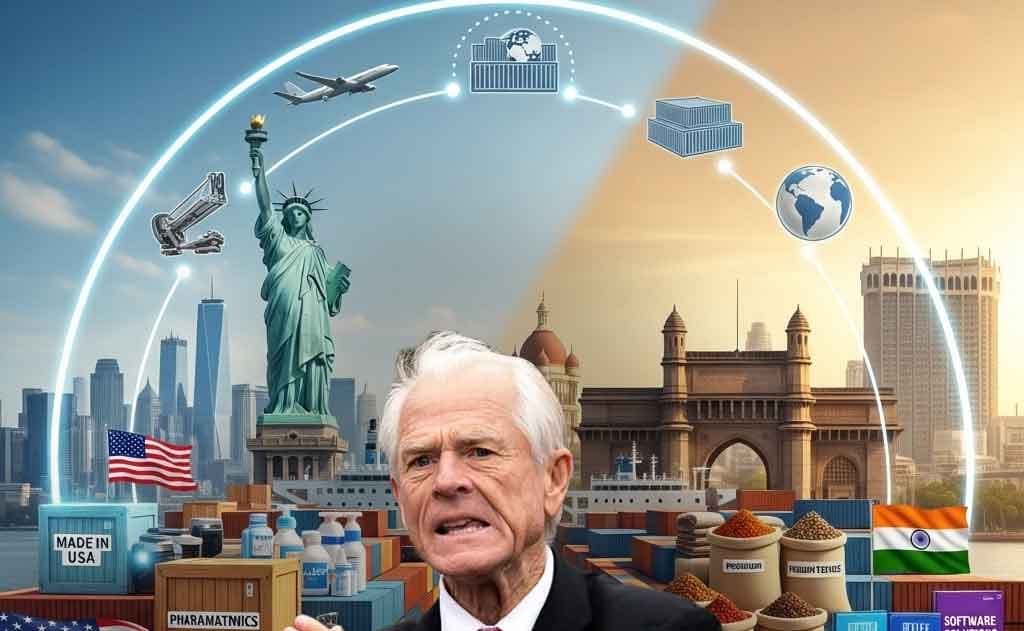
Washington, DC, September 2, 2025 – Tensions between the United States and India have reached a new high following remarks by White House Trade Adviser Peter Navarro, who expressed frustration over India’s growing ties with Russia and China. Navarro’s comments, made during a press interaction on Monday, come amid a deepening trade dispute sparked by the Trump administration’s imposition of 50% tariffs on Indian goods, a move that has strained bilateral relations and pushed India closer to its BRICS allies.
“It was a shame to see Modi getting in bed with the authoritarian leaders of Russia and China,” Navarro said, referring to Indian Prime Minister Narendra Modi’s recent meetings with Russian President Vladimir Putin and Chinese President Xi Jinping at the Shanghai Cooperation Organisation (SCO) summit in Tianjin, China. “I’m not sure what he’s thinking. We hope he comes around to seeing that he needs to be with us, Europe, and Ukraine, not Russia.”
Navarro’s remarks, reported by Free Press Journal, reflect a rare admission of faltering US diplomacy in its efforts to isolate India from its traditional ally, Russia, and regional rival, China. The trade adviser’s frustration stems from India’s continued purchase of discounted Russian crude oil, which the Trump administration claims is funding Russia’s war in Ukraine. Navarro has repeatedly labeled the Russia-Ukraine conflict “Modi’s war,” arguing that India’s oil imports—now accounting for 35-40% of its crude supply, up from less than 2% before 2022—are enabling Moscow’s military efforts.
The Trump administration’s decision to impose a 50% tariff on Indian goods, including a 25% penalty specifically tied to India’s Russian oil purchases, has drawn sharp criticism from New Delhi. Indian officials, including External Affairs Minister S. Jaishankar, have called the tariffs “unfair, unjustified, and unreasonable,” pointing out that China, the largest importer of Russian oil, faces no similar penalties. India has also defended its energy purchases, emphasizing the need to secure affordable oil for its 1.4 billion citizens and maintain economic stability.
Navarro’s latest comments targeted Modi’s participation in the SCO summit, where the Indian leader was seen engaging warmly with Putin and Xi. The summit, hosted by China, highlighted the strengthening ties among BRICS nations (Brazil, Russia, India, China, and South Africa) as a counterweight to Western influence. Navarro accused India of “strategic freeloading” and claimed that its high tariffs and non-tariff barriers harm American workers and businesses while indirectly supporting Russia’s war efforts. He also controversially referenced India’s caste system, alleging that “Brahmins are profiteering at the expense of the Indian people” through the oil trade, a remark that has sparked backlash for its cultural insensitivity.
The tariffs, which affect over 55% of India’s exports to the US—its largest trading partner—are already causing significant disruptions. Labor-intensive sectors like textiles and jewelry are bearing the brunt, with exporters warning of factory closures and job losses. India’s trade minister, Piyush Goyal, responded defiantly, stating that India “will neither bow down nor ever appear weak” in the face of US pressure.
Critics of the Trump administration’s approach, including Democrats on the House Foreign Affairs Committee, argue that singling out India while sparing China and the European Union, which also trade heavily with Russia, is inconsistent and counterproductive. “It’s almost like it’s not about Ukraine at all,” the committee stated on X, suggesting that the tariffs may be more about domestic political posturing than geopolitical strategy.
Analysts speculate that the trade spat is pushing India closer to China and Russia, undermining years of US efforts to cultivate India as a strategic partner against China’s rising influence. Modi’s first visit to China in seven years, coupled with plans to increase India-Russia trade to $100 billion by 2030, signals New Delhi’s intent to diversify its geopolitical alignments. Some reports also suggest that personal grievances, including Modi’s refusal to endorse Trump’s claim of brokering peace between India and Pakistan, may have contributed to the deteriorating US-India relationship.
Despite the tensions, there are indications that both sides are open to dialogue. US Treasury Secretary Scott Bessent, adopting a more conciliatory tone, expressed confidence that the US and India would “eventually come together” to resolve the dispute. However, Navarro’s hardline stance and the administration’s refusal to back down suggest that a resolution may be elusive without significant concessions from New Delhi.
As the US-India trade war escalates, the global community watches closely. India’s potential role as a mediator in the Russia-Ukraine conflict, as suggested by Navarro’s earlier comment that “the road to peace runs through New Delhi,” remains a point of contention. For now, the rift between Washington and New Delhi underscores the challenges of balancing economic interests, geopolitical alliances, and global stability in an increasingly multipolar world.
Disclaimer: This story is based on reports from various sources, including Free Press Journal, The Independent, and The Indian Express, and reflects the latest developments as of September 2, 2025.
Related NRI Globe Coverage
- Trump’s Repeated Calls to PM Modi Go Unanswered Amid Escalating U.S.-India Trade Tensions
- Modi’s China Visit for SCO Summit: A Step Toward Easing India-China Tensions
- Israel Attacks Lebanon: Airstrikes Escalate Tensions in Nabatieh
- Iran-Israel Tensions Escalate: Is Ayatollah Ali Khamenei Dead? Unraveling the Rumors
- UK Visa Changes for Indians 2026: GBM, ILR & Trade Deal Guide
- France News This Week: April 2026 – Diplomatic Tensions, Rising Fuel Costs, and a Touch of National Heritage
- NRIs in Gulf Countries: Essential Safety Tips Amid Escalating Middle East Tensions (March 2026 Update)
- Breaking: US Fires Cruise Missiles from Syria at Targets in Iran Amid Heightened Tensions
Fresh from NRI Globe
- YouTuber Nandu's World (Rama Nandana) UK Visa & Job Fraud Case: Full Details + Key Lessons for NRIs (2026)
- Dussehra / Vijayadashami 2026 Events Country-Wise — Global NRI Directory (Ram Lila, Ravana Dahan, Durga Puja Pandals, Ayudha Puja Venues + Booking)
- Diwali 2026 Events Country-Wise — Global NRI Directory (White House, Leicester, London Trafalgar, Toronto, Auckland, Sydney Parramasala, Fiji, Mauritius, Trinidad, South Africa and More)
- Diwali / Deepavali 2026 Country-Wise NRI Celebrations — Complete Global Guide (USA, UK, Canada, Australia, Fiji, Mauritius, Trinidad, South Africa, UAE and 30+ Countries)