
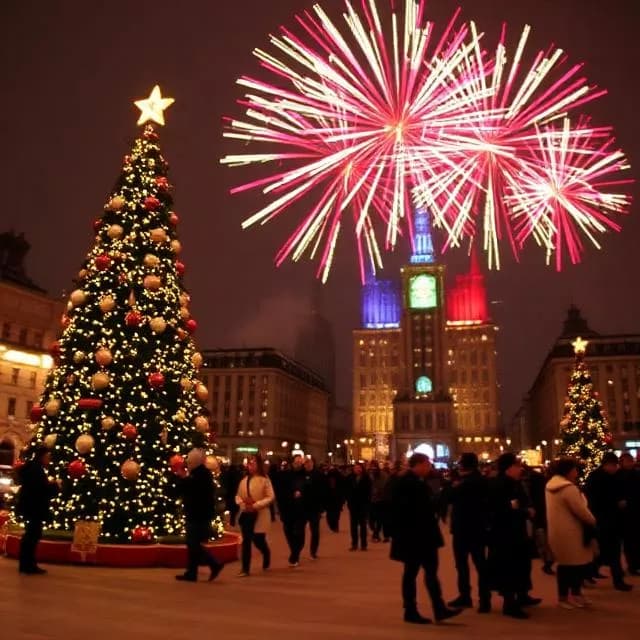
When the World Celebrates New Year: Time Zones, Traditions
As the final days of December 2025 draw to a close, billions of people across the planet prepare to welcome 2026. But unlike a single, synchronized moment, the arrival of the New Year is a majestic, rolling spectacle that unfolds over nearly 26 hours. Thanks to Earth's rotation, the division of the world into time zones, and the zigzagging International Date Line (IDL), midnight sweeps westward in a continuous wave of fireworks, cheers, and cultural rituals.
From the remote Pacific islands that greet the first dawn of 2026 to the last quiet territories still lingering in 2025, this phenomenon transforms New Year's Eve into a truly global, 24-hour-plus celebration. For the NRIs (Non-Resident Indians), global diaspora communities, and anyone fascinated by cultural diversity, understanding this journey offers a deeper appreciation of how humanity marks renewal, hope, and fresh beginnings.
In this comprehensive guide (over 3000 words), we explore:
- The science and history behind the staggered timeline
- Which places celebrate first and last in 2026
- Iconic traditions and superstitions from every continent
- Alternative New Year celebrations rooted in ancient calendars
- The deeper cultural, spiritual, and symbolic meanings behind these rituals
Whether you're planning a family gathering, traveling abroad, or simply curious about global customs, this exploration celebrates the beautiful ways we all say goodbye to the old and hello to the new.
The Science of Time: Why New Year Doesn't Arrive Everywhere at Once
Earth spins from west to east, completing one full rotation every 24 hours. To manage this, humanity divided the planet into 24 primary time zones, each roughly 15 degrees of longitude wide, centered on the Prime Meridian (0° longitude) in Greenwich, London.
However, the key to the rolling New Year lies in the International Date Line — an imaginary line running roughly along the 180° longitude meridian in the Pacific Ocean. Crossing it from east to west adds a day; from west to east subtracts one. Established at the International Meridian Conference in 1884 to standardize time for railroads, shipping, and global communication, the IDL zigzags to avoid splitting countries or islands awkwardly.
In 1995, Kiribati deliberately adjusted its time zones and bent the IDL eastward so all its islands share the same date — making it the first nation to enter each new day. Samoa made a similar shift in 2011, skipping December 30 to align economically with Australia and New Zealand, jumping from one of the last to one of the first.
Today, with 38 different local times in use (including half-hour and quarter-hour offsets), it takes about 26 hours for January 1, 2026, to cover every inhabited place on Earth.
The Global Journey: First to Last in 2026
The New Year wave begins in the Pacific and travels westward:
First to Celebrate – The Pacific Pioneers (UTC+14) The absolute first inhabited place is Kiritimati (Christmas Island) in Kiribati's Line Islands. This remote atoll, with its pristine beaches and small population, sees midnight hours before anywhere else. Community gatherings, traditional music, feasting, and warm Pacific hospitality mark the moment. Shortly after, Samoa, Tonga, and parts of eastern Russia join in. New Zealand's major cities like Auckland follow with one of the world's most spectacular fireworks shows over the Harbour Bridge and Opera House — often the first major broadcast seen globally.
The Early Wave – Asia Awakens As the hours progress, Japan, South Korea, China, and the Philippines light up with temple bells, dragon dances, and urban countdowns. In Tokyo, massive crowds gather at shrines to ring in the year with hatsumode (first shrine visit) preparations.
Europe & Africa Join the Party Midnight reaches London, Paris, Berlin, and Moscow with street parties, champagne toasts, and historic fireworks over landmarks like the Eiffel Tower or Red Square. In many African nations, community bonfires and drumming ceremonies blend modern celebrations with ancestral traditions.
The Americas & the Final Stretch New York City's iconic Times Square ball drop draws millions (virtually and in person), while Rio de Janeiro's Copacabana Beach hosts one of the largest beach parties on Earth. The wave concludes in the far Pacific.
Last to Celebrate – The Quiet End The final inhabited place is American Samoa (UTC-11), where midnight arrives nearly 25–26 hours after Kiribati's first cheers. Nearby uninhabited U.S. territories like Baker Island and Howland Island (UTC-12) bring up the rear — the very last specks on Earth to welcome 2026.
This staggering timeline reminds us that time is both universal and deeply local — a perfect metaphor for global unity in diversity.
Spectacular Traditions: A Continent-by-Continent Tour
New Year's Eve customs vary wildly, often blending ancient symbolism with modern festivity. Here are some of the most beloved:
Europe
- Spain & Portugal: Eat 12 grapes at midnight (one per clock chime) for luck each month. New red underwear is worn for passion and prosperity.
- Denmark: Leap off furniture at midnight to "jump into the new year." Friends smash plates against doors — the more shards, the more luck.
- Scotland (Hogmanay): Fire festivals, torchlight processions, and first-footing — the first visitor after midnight should be a dark-haired man bearing gifts (whisky, coal, shortbread) for prosperity.
- Greece: Smash a pomegranate on the doorstep; scattered seeds mean abundance.
- Ireland: Open all doors and windows at midnight to let the old year out and the new in. Knock bread on walls to ward off evil.
Asia
- Japan: Eat toshi-koshi soba (long buckwheat noodles) for longevity. Watch the 108 bell rings at temples to cleanse 108 earthly desires.
- Philippines: Display round fruits (for money) and jump at midnight to grow taller. Wear polka dots for prosperity.
- South Korea: Traditional games, ancestral rites, and eating tteokguk (rice cake soup) — each bowl adds a year to your age.
- China (pre-Lunar preparations): Even on Gregorian New Year, cleaning and red decorations ward off evil.
Americas
- United States (South): Eat Hoppin' John (black-eyed peas, rice, pork) and collard greens (money) for prosperity.
- Brazil: Wear white for peace, jump over seven ocean waves (one wish each), and offer flowers to Iemanjá (sea goddess).
- Mexico & Latin America: Similar grape-eating tradition, plus carrying an empty suitcase around the block for travel luck.
- Canada: Polar bear plunges in icy waters for renewal.
Africa & Middle East
- South Africa: Braais (barbecues), fireworks, and community gatherings.
- Morocco: Family feasts, cakes, dancing, and laughter at home or in clubs.
Oceania
- Australia: Massive fireworks in Sydney, beach parties, and summer vibes.
Superstitions for Luck in 2026 Common global beliefs include:
- Loud noises (fireworks, bells) scare away evil spirits.
- Avoid cleaning/washing clothes on Jan 1 — it "washes away" luck.
- In some Asian cultures, first visitor determines the year's tone.
- Honey-sweetened foods for sweetness; lentils/round foods for money; no debt/lending on Jan 1.
Beyond January 1: Alternative New Years Around the World
The Gregorian calendar is dominant, but many cultures follow ancient systems:
- Chinese/Lunar New Year (Jan 29–Feb 17, 2026 range): Dragon dances, red envelopes (hongbao), family reunions, firecrackers.
- Nowruz (March 20–21, 2026): Persian/Iranian spring festival — Haft-Seen table (7 symbolic items), cleaning, bonfire jumping.
- Hindu Regional New Years (March–April): Ugadi/Gudi Padwa (spring renewal, neem-jaggery for life's flavors), Vishu (Kerala mirror ritual).
- Rosh Hashanah (Sept/Oct): Jewish reflection, shofar blowing, apples & honey for sweetness.
- Songkran (Thailand, mid-April): Massive water fights for purification.
- Islamic New Year (Hijri): Quiet reflection on Prophet's migration.
These celebrations highlight humanity's diverse ways of measuring time — lunar, solar, lunisolar — often tied to seasons, harvests, and spirituality.
Conclusion: A World United by Hope
Whether you're on Kiritimati watching the first sunrise of 2026, in Times Square amid confetti, or quietly reflecting at home, the New Year reminds us of our shared humanity. Time zones may delay midnight, but they cannot divide the universal desire for health, love, prosperity, peace, and renewal.
As midnight circles the globe, traditions — from grape-eating to pomegranate-smashing, water-splashing to bell-ringing — connect us across borders and beliefs. In 2026, may your celebrations be joyful, your intentions clear, and your year filled with light.
Related NRI Globe Coverage
- New Year Celebrations 2026: How the World and Indian Diaspora Welcomed the New Year
- Hindu New Year vs English New Year: Why Hindus Celebrate Time Differently
- 25 Magical New Year Traditions Around the World That Will Inspire
- How NRIs Celebrated New Year 2026 Worldwide: Vibrant Traditions
- New Year’s Day 2026 Celebrations Around the World: A Time Zone Guide for the Global Indian Diaspora
- English New Year Parties vs Hindu New Year Rituals: What Do We Lose & Gain?
- New Year Celebrations Around the World: Fireworks, Faith & Festivities
- YouTuber Nandu's World (Rama Nandana) UK Visa & Job Fraud Case: Full Details + Key Lessons for NRIs (2026)
Fresh from NRI Globe
- Dussehra / Vijayadashami 2026 Events Country-Wise — Global NRI Directory (Ram Lila, Ravana Dahan, Durga Puja Pandals, Ayudha Puja Venues + Booking)
- Diwali 2026 Events Country-Wise — Global NRI Directory (White House, Leicester, London Trafalgar, Toronto, Auckland, Sydney Parramasala, Fiji, Mauritius, Trinidad, South Africa and More)
- Diwali / Deepavali 2026 Country-Wise NRI Celebrations — Complete Global Guide (USA, UK, Canada, Australia, Fiji, Mauritius, Trinidad, South Africa, UAE and 30+ Countries)
- Dussehra / Vijayadashami 2026 Country-Wise NRI Celebrations — USA, UK, Canada, Australia, New Zealand, UAE, Singapore, Germany, Netherlands and More