
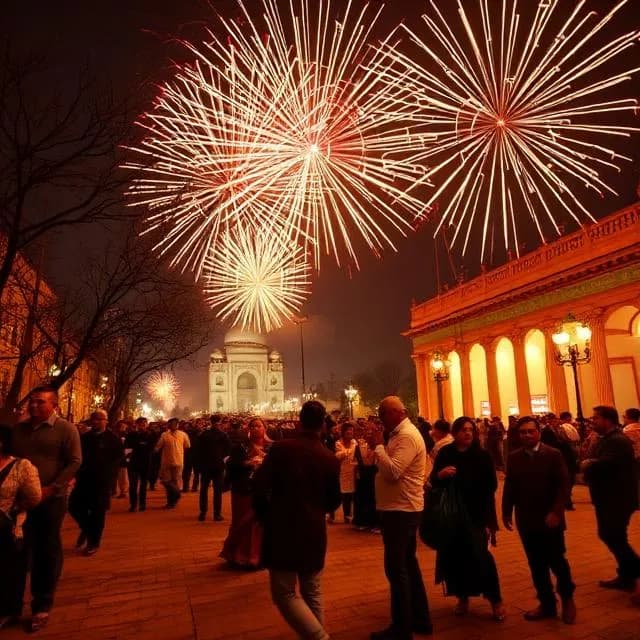
Why NRIs Celebrate January 1: The Colonial History Behind India's New Year
Understanding the Calendar Shift That Connected India to Global Timekeeping
A Question Every NRI Has Encountered
If you've ever tried explaining Indian festivals to colleagues abroad, you've faced this moment: "Wait, you have multiple New Years?"
It's true. India never had a single January 1-style New Year. Yet today, most Indians—whether in Mumbai, Toronto, or London—celebrate January 1 alongside (or sometimes instead of) traditional regional New Years like Ugadi, Gudi Padwa, or Vishu.
For NRIs navigating life between cultures, understanding this shift matters. It's not just history—it's part of how India integrated into the global calendar system we all use today.
India's Original Calendar Landscape
Before British rule, India operated on sophisticated regional calendar systems, each rooted in astronomy and local traditions:
Major Calendar Systems:
- Luni-solar Panchangams (most of North and Central India)
- Solar calendars (Tamil Nadu, Kerala, Bengal, Odisha)
- Regional New Years aligned with agricultural cycles and cosmic events
These weren't primitive systems—they were scientifically advanced, tracking planetary movements, lunar phases, and seasonal transitions with remarkable precision.
For NRIs whose grandparents still consult Panchangams for auspicious dates, this astronomical heritage is part of your family history.
How the British Gregorian Calendar Entered India
The East India Company Era (1757–1858)
When the British East India Company established control, they faced a practical administrative challenge: coordinating governance across regions using hundreds of different calendars.
Their solution? Introduce the Gregorian calendar—already standard across Europe—for:
- Trade and commerce documentation
- Military scheduling
- Company administrative records
Initially, this affected only British operations. Indian society continued using traditional calendars for daily life.
The British Raj Makes It Official (1858–1947)
Once India came under direct British Crown rule, the Gregorian calendar became institutionalized across:
Key Areas of Implementation:
- Government offices and civil administration
- Courts and legal systems
- Railways and postal services (critical for a connected India)
- Tax collection and financial year calculations
- English-medium schools and universities
January 1 became the official reset point for fiscal years, academic terms, salary cycles, and government planning.
For families whose ancestors worked in colonial administration, railways, or British companies—this is when the dual calendar reality began.
The Education Factor: How January 1 Became "Normal"
The most lasting impact came through education.
British-run schools systematically:
- Used only the Gregorian calendar in all textbooks
- Taught history through European chronological frameworks
- Presented January 1 as the standard New Year
Generations of Indians educated in this system grew up mentally synchronized with the Gregorian calendar—even while their families celebrated traditional festivals at home.
This is the experience many NRI parents and grandparents had: One calendar at school and work, another at home and temple.
What Happened to Indigenous Calendars?
Not Banned—But Bureaucratically Sidelined
Indian calendars weren't outlawed. They were simply excluded from:
- Official government use
- Modern education systems
- Public and professional life
Over time, a hierarchy emerged:
- Gregorian calendar = official, modern, professional
- Traditional calendars = religious, cultural, personal
This separation is why many NRIs today can tell you their birthday according to the Gregorian calendar instantly, but need to ask their parents for their traditional calendar birth date.
Infrastructure and Standardization
British infrastructure projects accelerated this shift:
Railways needed:
- Unified scheduling across thousands of kilometers
- Standard dates for timetables
- Synchronized operations
Telegraph systems required:
- Common dating protocols
- International compatibility
The Gregorian calendar fit modern infrastructure perfectly. Regional calendars, fluid and locally rooted, didn't.
After Independence: India's Practical Choice
Why Independent India Kept January 1 (1947 Onward)
When India gained independence, the new government faced nation-building priorities. They chose administrative continuity, retaining:
- The Gregorian calendar for governance
- English as an associate official language
- Existing bureaucratic systems
This wasn't cultural surrender—it was pragmatic nation-building. India needed to function internally while integrating with the global economy.
However, this decision meant the Gregorian calendar remained India's official system, while traditional calendars continued in cultural and religious spheres.
The NRI Experience: Living Between Two Calendars
Why This History Matters for NRIs
Understanding this colonial calendar shift helps explain the dual identity many NRIs navigate:
You celebrate both:
- January 1 with colleagues and friends (global integration)
- Ugadi/Gudi Padwa/Vishu with family (cultural roots)
You explain both:
- Why Diwali "moves" every year on the Gregorian calendar
- Why Indian festivals aren't "fixed" dates like Christmas
You balance both:
- Professional life synchronized with the Gregorian calendar
- Personal and spiritual life connected to traditional timekeeping
This isn't confusion—it's bicultural fluency.
Modern India: Dual Calendar Reality
Today, India operates seamlessly on parallel systems:
| Calendar System | Primary Usage |
|---|---|
| Gregorian Calendar | Government, business, international coordination |
| Traditional Calendars | Festivals, religious observances, cultural identity |
For NRIs, this means:
- January 1 is a practical, global New Year
- Traditional New Years maintain cultural and spiritual significance
- Both can coexist without contradiction
Cultural Revival: The New Generation
Interestingly, younger Indians—both in India and abroad—are increasingly interested in traditional calendars:
Recent Trends:
- Digital Panchang apps making traditional calendars accessible
- Increased academic research into Indian astronomical systems
- Social media celebrating regional New Years
- NRI families teaching children about traditional timekeeping
Technology is helping preserve what colonialism tried to standardize away.
The Global Perspective: Why January 1 Still Makes Sense
Here's the pragmatic reality for NRIs: The Gregorian calendar is the global standard for:
- International business coordination
- Academic calendars worldwide
- Aviation and global logistics
- Digital platforms and technology systems
Using January 1 doesn't erase Indian identity—it enables global participation.
The key is maintaining awareness of both systems, not choosing one over the other.
What NRIs Can Do
For yourself:
- Learn your birth date in your family's traditional calendar
- Understand the astronomical basis of Indian festivals
- Explore digital Panchang resources
For your children:
- Teach them about both calendar systems
- Explain why Indian festivals "move" on the Gregorian calendar
- Connect them to the scientific sophistication of traditional Indian astronomy
In your community:
- Support cultural organizations celebrating regional New Years
- Share knowledge about traditional timekeeping systems
- Help bridge understanding between cultures
The Bottom Line
January 1 became India's default New Year through British colonial administration—not through Indian choice or tradition. Independent India retained it for practical, global integration reasons.
For NRIs, this history explains why:
- You naturally use the Gregorian calendar professionally
- Your family still celebrates traditional New Years
- You can honor both without contradiction
Understanding this history doesn't require rejecting January 1. It simply means recognizing that India's relationship with time has always been richer and more complex than any single calendar can capture.
Related NRI Globe Coverage
- Hindu New Year vs English New Year: Why Hindus Celebrate Time Differently
- Flu & COVID-19 Cases Rise Again in the US: January 2026 Update – NRI Focus – January 22, 2026
- Latest US News January 2026: Top Developments So Far – January 22, 2026
- New Year Celebrations 2026: How the World and Indian Diaspora Welcomed the New Year
- Wolf Supermoon January 3, 2026: The First Full Moon of the Year – A Spectacular Start for NRIs Worldwide
- English New Year Parties vs Hindu New Year Rituals: What Do We Lose & Gain?
- The Indian National Flag: History, Design and the Meaning of Every Element
- New Year 2026 Global Celebrations: Complete NRI Guide by City and Country
Fresh from NRI Globe
- YouTuber Nandu's World (Rama Nandana) UK Visa & Job Fraud Case: Full Details + Key Lessons for NRIs (2026)
- Dussehra / Vijayadashami 2026 Events Country-Wise — Global NRI Directory (Ram Lila, Ravana Dahan, Durga Puja Pandals, Ayudha Puja Venues + Booking)
- Diwali 2026 Events Country-Wise — Global NRI Directory (White House, Leicester, London Trafalgar, Toronto, Auckland, Sydney Parramasala, Fiji, Mauritius, Trinidad, South Africa and More)
- Diwali / Deepavali 2026 Country-Wise NRI Celebrations — Complete Global Guide (USA, UK, Canada, Australia, Fiji, Mauritius, Trinidad, South Africa, UAE and 30+ Countries)