
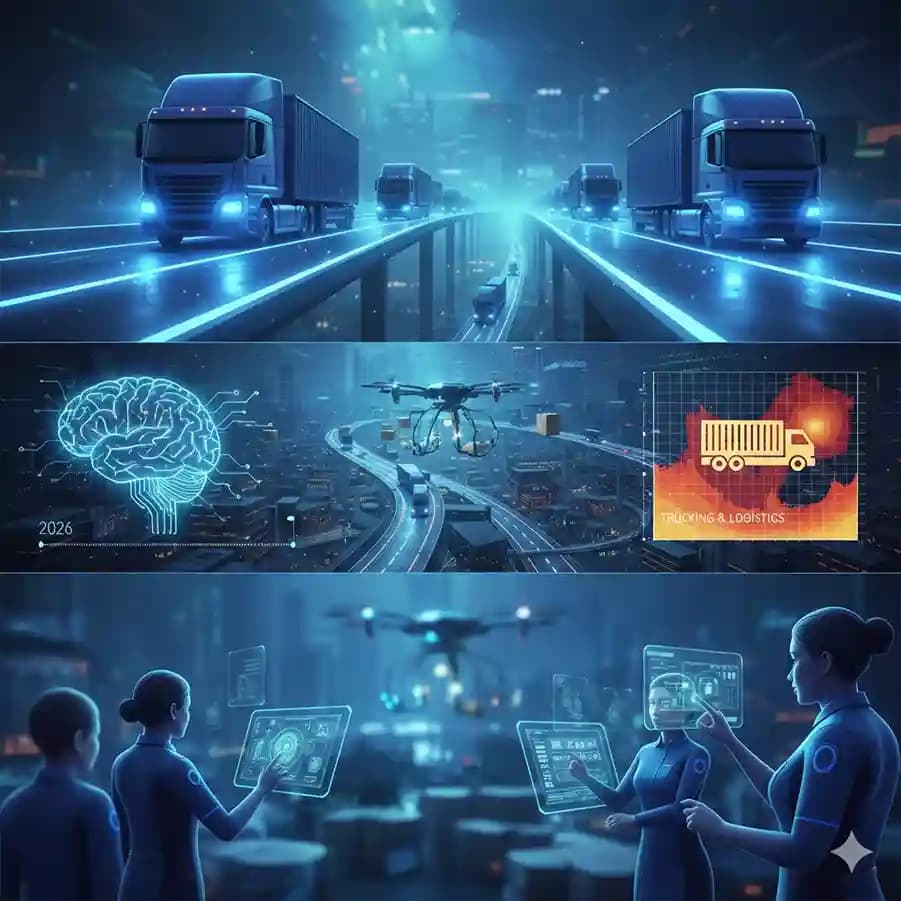
Trucking moves most US freight. AI software and self-driving trucks now change how loads move and who handles them. For workers, carriers, and investors alike, understanding the mechanics behind these shifts matters more than reacting to headline announcements.
TL;DR
- AI platforms claim large productivity gains in freight matching and routing.
- Autonomous truck developers have logged thousands of driverless miles on specific corridors.
- Analysts project uneven job effects, with long-haul roles facing higher exposure.
- Retraining programs and union agreements offer one path for affected workers.
- Companies report cost reductions but must address transition support.
The Recent Market Reaction to AI Logistics Tools
Public companies in trucking and freight brokerage saw sharp share price moves after a small firm announced productivity claims for its platform. Investors reacted to the possibility that fewer staff could handle larger volumes.
Market moves of this kind reflect forward-looking concerns rather than confirmed long-term outcomes. Historical patterns show that initial adoption often produces mixed results across firms of different sizes. Freight brokerage, in particular, is a sector where margins are thin and the perceived threat of platform-based disintermediation has surfaced repeatedly over the past decade — yet human brokers have continued to add value through relationship management and exception handling that software handles poorly.
Transportation researchers and industry analysts generally caution that headline productivity figures from vendors tend to reflect best-case deployments rather than sector-wide averages. Independent assessments, including data tracked by the Bureau of Labor Statistics Employment Projections, suggest that technology-driven efficiency gains in freight have historically been uneven — benefiting large carriers first while smaller operators take longer to see measurable returns. That gap matters when evaluating how quickly any single platform's claims might translate into broad industry change. For NRI-owned trucking businesses or investors monitoring the sector from abroad, this unevenness is especially relevant: capital allocation decisions based on vendor-supplied figures alone carry meaningful risk.
Software Automation in Freight Operations
Route planning, load matching, and billing now use machine learning models. These systems reduce empty miles and speed up paperwork. Carriers report lower fuel use and fewer missed appointments when the tools integrate with existing dispatch software. The underlying logic is straightforward — algorithms can evaluate far more lane combinations and rate variables simultaneously than a human dispatcher working a phone and a spreadsheet.
Smaller brokers face pressure because larger platforms can replicate some coordination tasks. The change does not eliminate the need for human judgment on exceptions such as weather delays or special handling. What it does shift is the ratio of routine to complex work that any given employee handles in a day, which over time changes the skill profile that employers prioritize when hiring.
Measured Effects on Daily Work
Dispatchers spend less time on repetitive phone calls. Some firms reassign those staff to customer problem-solving roles. Others reduce headcount through attrition rather than layoffs. The distinction matters for how communities experience the change: attrition-based reductions are less visible in local unemployment data but can still hollow out a workforce over several years.
The pace of change inside individual companies depends heavily on fleet size, existing software infrastructure, and management appetite for risk. Firms that integrate AI tools gradually — piloting on a single lane or terminal before rolling out more broadly — tend to report smoother transitions and fewer operational disruptions than those that attempt rapid, company-wide deployments. Smaller carriers operating under tighter cash constraints may also find that the upfront integration costs of sophisticated AI dispatch platforms create a barrier that slows adoption relative to what industry forecasts imply.
Autonomous Trucks on US Roads
Several developers operate driverless trucks on limited routes in the southern and southwestern states. Miles driven without a safety driver in the cab have increased steadily on approved corridors. The technology relies on a combination of lidar, radar, camera arrays, and high-definition mapping — each of which must perform reliably across varying light conditions, road surface quality, and traffic density before regulators permit broader deployment.
Current operations focus on highway segments between distribution centers. Urban and last-mile segments still require human drivers for the foreseeable period. The handoff point — where an autonomous truck completes a highway leg and a local driver takes over for urban delivery — has become a logistical category of its own, sometimes called a transfer hub model.
| Developer | Reported Miles (driverless) | Primary Corridors | Status |
|---|---|---|---|
| Aurora | 250000+ | Texas to Arizona | Expanded testing |
| Gatik | Commercial runs | Texas, Arkansas, Arizona | Active deliveries |
| Kodiak | Multiple trucks | Highway routes | Planning expansion |
Regulatory oversight for autonomous commercial vehicles falls partly under the Federal Motor Carrier Safety Administration, which continues to update guidance as driverless operations expand. Carriers and developers must comply with FMCSA reporting requirements, and any significant safety incident on an approved corridor can trigger reviews that slow further expansion. That regulatory layer adds uncertainty to timelines that developers publish publicly. It also means that the competitive landscape among autonomous truck developers remains fluid — a company leading on miles today may face a regulatory pause that allows rivals to close the gap.
Effects on Different Roles
Long-haul drivers see the clearest exposure because highway autonomy targets those distances first. Local and specialized drivers remain in demand because routes involve more variables — narrow streets, time-window deliveries, customer-site requirements, and real-time judgment calls that current systems are not equipped to handle reliably.
Office roles such as load planners and customer service agents also face partial automation. Workers who combine domain knowledge with basic data skills retain an advantage. A load planner who understands both the regulatory constraints on hours-of-service and how to query a routing platform's output, for example, occupies a position that is harder to automate than either skill alone.
Specialized endorsements — hazardous materials, oversized loads, temperature-controlled freight — add a layer of complexity that current AI systems handle poorly. Drivers who hold multiple endorsements and understand the regulatory requirements behind them are less substitutable than those operating standard dry-van lanes on predictable routes. This is a concrete, actionable distinction: the credential itself signals a level of compliance knowledge that software cannot yet replicate end-to-end.
Logistics and Warehouse Changes
Inside warehouses, robots handle repetitive picking and sorting. Labor hours per package have declined in automated facilities, yet overall shipment volumes continue to rise. The relationship between automation and total employment in this segment is therefore not a simple subtraction — it depends heavily on whether demand growth outpaces the efficiency gains that robots deliver.
Supply chain software now predicts delays with greater accuracy. Firms use these forecasts to adjust staffing rather than to eliminate positions outright. Predictive tools draw on carrier performance data, weather feeds, port congestion metrics, and historical lane reliability — combining inputs that would take a human analyst significant time to synthesize manually.
The net employment picture inside large fulfillment centers remains contested. Some operators have added net headcount even after deploying robotics, because volume growth outpaced the efficiency gains. Others have held staffing flat while processing significantly more units — a dynamic that BLS employment projections data can help contextualize over longer time horizons. For workers considering whether to pursue warehouse roles as a career path, understanding which type of facility they are entering is a meaningful part of that decision.
Comparative Impacts Across Regions
Rural terminals with older driver demographics show slower adoption rates. Urban logistics hubs invest earlier because labor costs and turnover are higher. The cost calculus differs substantially: in a high-turnover urban market, the break-even point for an AI dispatch tool arrives sooner than in a rural terminal where experienced staff stay for decades and institutional knowledge is a genuine competitive asset.
States with strong workforce programs report more successful transitions when automation arrives. Programs that combine classroom training with on-the-job hours produce better retention. The structure of those programs — whether they are funded through state workforce boards, employer consortia, or federal grants — affects how accessible they are to workers who cannot afford to step away from income-generating shifts for extended periods.
Geography also shapes which corridors attract autonomous truck pilots first. The relatively flat, dry terrain of Texas, Arizona, and neighboring states offers more predictable operating conditions than mountainous or high-precipitation regions. Workers in those southern corridors may therefore encounter competitive pressure from autonomous systems sooner than peers in other parts of the country. For NRI families with relatives employed in long-haul trucking along those specific corridors, this geographic dimension is worth factoring into longer-term financial planning conversations.
Preparation Steps for Workers
Drivers can add endorsements for hazardous materials or obtain commercial drone certifications. Office staff benefit from short courses in data visualization and basic scripting. Neither path requires a four-year degree, and both can be pursued incrementally alongside full-time work — an important consideration for workers who cannot afford a gap in income.
Many community colleges now offer logistics certificates that include AI tool modules. Completion rates improve when employers cover tuition. Some carriers have begun structuring tuition reimbursement as a retention tool, tying benefit eligibility to a continued service period after course completion — a model that benefits both the employer and the worker who might otherwise struggle to self-fund training.
Workforce boards in several states have begun partnering directly with carriers to co-design training curricula. When the curriculum reflects actual tools in use at local employers, workers gain skills that transfer immediately rather than remaining theoretical. Checking with local workforce boards — a step outlined in the Next Steps section below — is a practical starting point for identifying which programs carry employer backing in your area. Union contracts at some large carriers also include provisions for retraining funds, making it worth reviewing any collective bargaining agreement that applies to your employment before seeking outside programs.
Next steps
Review current job functions against publicly available AI tool demos. Identify two skills that complement automation rather than compete with it. Contact local workforce boards for subsidized training options before major changes occur at your employer.
Sources
- Bureau of Labor Statistics Employment Projections
- Federal Motor Carrier Safety Administration Reports
Related NRI Globe Coverage
- AI's Impact on H-1B Tech Jobs in 2026 — What Indian Tech Workers in USA Need to Know
- AI Impact on Indian IT Services and NRI Tech Professionals 2026: The Augmentation-Not-Replacement Framework
- AI Becoming Too Expensive: Companies Scale Back in June 2026 — What It Means for Indian Tech Workers and H-1B Visas
- OpenAI Reshapes ChatGPT as an All-in-One Superapp: How Coding, Canva, and Booking Integrations Affect Indian IT Professionals
- Trump Administration Considers Government Equity Stakes in US AI Companies: Implications for Indian Tech Talent and NRI Entrepreneurs
- SpaceX IPO and Big-Tech Compute Deals: How Elon Musk’s Moves Affect Indian Talent in the US
- Uber Cuts 23% of HR & People Division Jobs: Efficiency Drive or AI Shadow?
- AI’s Impact on Indian Tech Careers: What NRIs Should Know (2026)
Fresh from NRI Globe
- YouTuber Nandu's World (Rama Nandana) UK Visa & Job Fraud Case: Full Details + Key Lessons for NRIs (2026)
- Dussehra / Vijayadashami 2026 Events Country-Wise — Global NRI Directory (Ram Lila, Ravana Dahan, Durga Puja Pandals, Ayudha Puja Venues + Booking)
- Diwali 2026 Events Country-Wise — Global NRI Directory (White House, Leicester, London Trafalgar, Toronto, Auckland, Sydney Parramasala, Fiji, Mauritius, Trinidad, South Africa and More)
- Diwali / Deepavali 2026 Country-Wise NRI Celebrations — Complete Global Guide (USA, UK, Canada, Australia, Fiji, Mauritius, Trinidad, South Africa, UAE and 30+ Countries)