
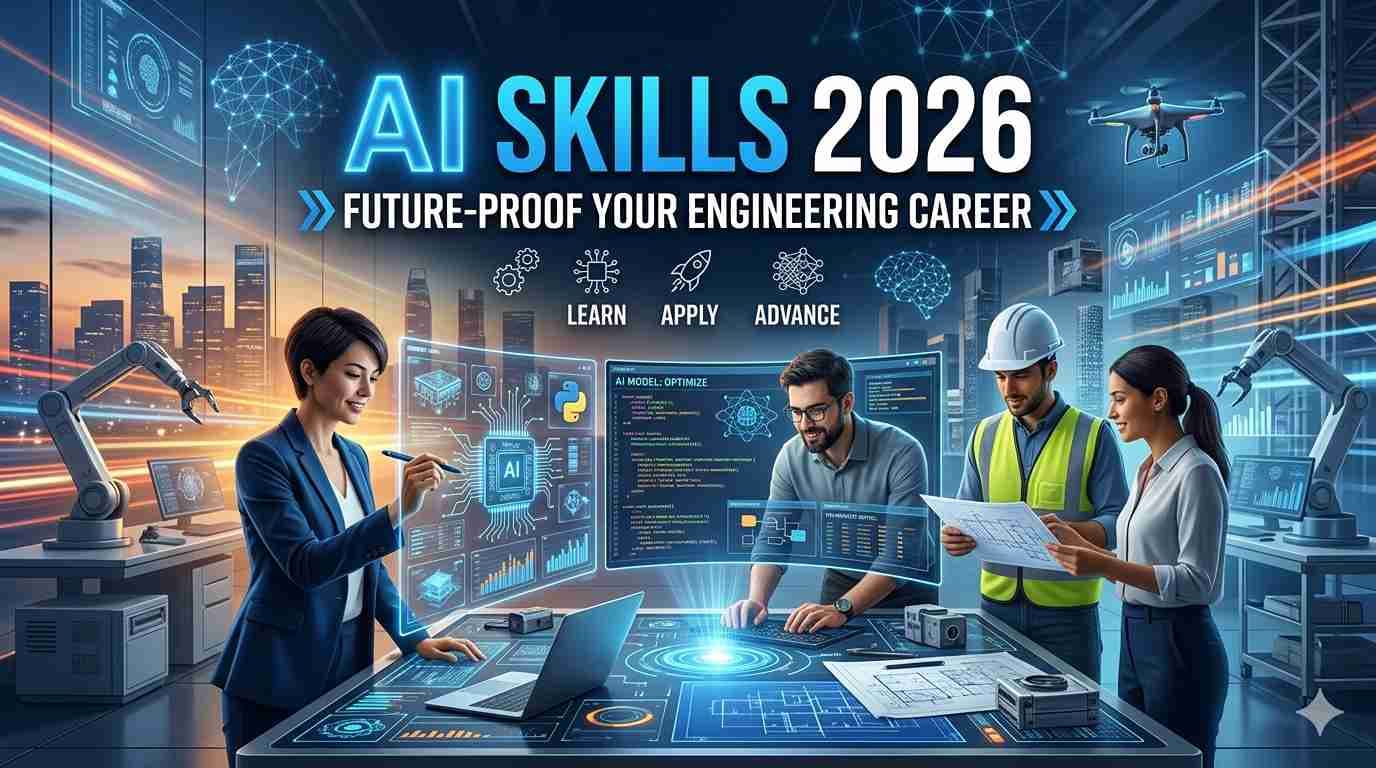
With AI reshaping software engineering faster than expected, Indian engineers — whether in India, on H-1B visas in the US, or working remotely as NRIs — face a clear choice: adapt or risk falling behind.
Anthropic CEO Dario Amodei’s recent prediction that “coding is going away first, then all of software engineering” has sparked intense discussion. While AI won’t eliminate jobs overnight, it is dramatically changing what employers value. Big Tech companies are prioritizing AI skills in H-1B hiring, with over 80% of new labor condition applications from Amazon, Meta, Google, Microsoft, and Apple tied to AI-related roles.
India is projected to need nearly one million additional AI-skilled professionals by the end of 2026. For Indian talent, this represents a massive opportunity to move up the value chain from traditional coding to high-impact AI roles.
Here are the top AI skills every Indian engineer needs in 2026 to stay competitive, boost H-1B chances, command higher salaries, and thrive in the AI era.
1. Python Proficiency + Advanced Programming Fundamentals
Python remains the undisputed king of AI development. Master it beyond basics — focus on async programming, type hints with Pydantic, environment management, and production-grade code.
Strong fundamentals in data structures, algorithms, and system design are still non-negotiable. These help you evaluate and optimize AI-generated code effectively, especially as tools like Grok, Claude, and Cursor handle routine coding.
2. Machine Learning and Deep Learning
Core understanding of supervised/unsupervised learning, neural networks, and frameworks like PyTorch and TensorFlow is essential.
In 2026, employers seek engineers who can not only train models but deploy them at scale. Specialize in areas like reinforcement learning and recommendation systems, which are heavily in demand at Big Tech.
3. Generative AI and Large Language Models (LLMs)
This is the hottest skill right now. Learn to work with models like Grok, Claude, GPT variants, and Gemini.
Key sub-skills:
- Prompt engineering (evolving into context engineering and structured output)
- Retrieval-Augmented Generation (RAG)
- LLM fine-tuning (LoRA, RLHF techniques)
- Building AI agents and multi-step workflows
Tools like Grok 4.3’s vision-to-code capabilities make rapid prototyping faster than ever.
4. MLOps and AI System Integration
Moving models from notebook to production is where real value lies.
Master MLOps tools (Docker, Kubernetes, MLflow), vector databases (Pinecone, Weaviate), monitoring, and scalable deployment. Understand how to integrate LLMs via APIs, handle context windows, and build reliable end-to-end AI systems.
Full-stack fundamentals (backend, APIs, databases) combined with AI integration are highly valued for “end-to-end product ownership.”
5. AI-Assisted Development and Agentic Tools
Learn to leverage AI coding tools as a superpower:
- Cursor, Claude Code, GitHub Copilot, Aider
- Multimodal capabilities (uploading screenshots to generate UI/code)
- Agentic workflows for automation
The shift is from writing every line of code to architecting, reviewing, and orchestrating AI outputs. Engineers who master this productivity multiplier will stand out.
6. Data Engineering for AI + Cloud Platforms
High-quality data powers AI success. Skills in data pipelines, SQL, big data tools, and cloud platforms (AWS, Azure, GCP) with AI services are critical.
Edge AI, on-device AI, and responsible AI (ethics, bias mitigation) are emerging differentiators.
Bonus: Human-Centric Skills That AI Can’t Replace
- Systems thinking and architecture
- Problem-solving at a high level
- Communication and cross-functional collaboration
- Ethical AI considerations
These “soft” skills become premium as AI handles technical execution.
Why These Skills Matter for NRIs and H-1B Holders
Big Tech’s H-1B focus has shifted toward AI talent. Senior roles in machine learning, AI research, and MLOps enjoy better lottery odds under wage-weighted preferences. Many NRIs are also exploring opportunities back in India’s booming AI ecosystem or building global products remotely.
Upskilling in these areas can help you:
- Secure or strengthen H-1B sponsorship
- Transition into higher-paying AI engineer or ML roles
- Launch side projects or startups using tools like Grok for fast prototyping
How to Start Building These Skills in 2026
- Practice daily with free tools: Grok, Claude, Cursor
- Build real projects: RAG applications, AI agents, or clone apps from screenshots
- Contribute to open source or create portfolios showcasing AI-augmented work
- Pursue targeted certifications or micro-credentials in MLOps and Generative AI
The message is clear: AI is not replacing engineers — it’s amplifying those who learn to work with it.
What’s your plan for 2026? Which AI skill are you prioritizing first? Are you an NRI or H-1B holder already using these tools? Share your experiences, upskilling tips, or concerns in the comments below.
NriGlobe will continue tracking AI trends, H-1B updates, and strategies to help the global Indian community thrive in the AI-driven future.
Continue reading — NRI Globe pillar guide: H-1B Complete Guide for Indians 2026
Related NRI Globe Coverage
- Top AI Skills to Learn in 2026 for Indian Professionals
- Is AI Replacing Software Engineers in 2026? Impact on Jobs, Skills & Future for NRIs
- Best Courses and Skills for OPT and CPT Success in the USA
- AI Data Center Cooling Methods Explained — Air vs Direct-to-Chip Liquid vs Immersion (2026 Rack Density Guide)
- Generative AI Terminology 2026 — Complete Glossary From Beginner to Advanced (LLM, RAG, Agents, LangGraph, MCP, Enterprise AI)
- How Much Electricity Does AI Use for One Prompt? The Real 2026 Numbers (ChatGPT, Gemini, Agentic AI)
- How Much Water Does AI Use for One Prompt? The Real 2026 Numbers Explained
- Best AI Tools for NRIs in 2026 — ChatGPT, Claude, Gemini, Perplexity, Notion AI and Practical Uses for Immigration, Family and Productivity
Fresh from NRI Globe
- YouTuber Nandu's World (Rama Nandana) UK Visa & Job Fraud Case: Full Details + Key Lessons for NRIs (2026)
- Dussehra / Vijayadashami 2026 Events Country-Wise — Global NRI Directory (Ram Lila, Ravana Dahan, Durga Puja Pandals, Ayudha Puja Venues + Booking)
- Diwali 2026 Events Country-Wise — Global NRI Directory (White House, Leicester, London Trafalgar, Toronto, Auckland, Sydney Parramasala, Fiji, Mauritius, Trinidad, South Africa and More)
- Diwali / Deepavali 2026 Country-Wise NRI Celebrations — Complete Global Guide (USA, UK, Canada, Australia, Fiji, Mauritius, Trinidad, South Africa, UAE and 30+ Countries)