
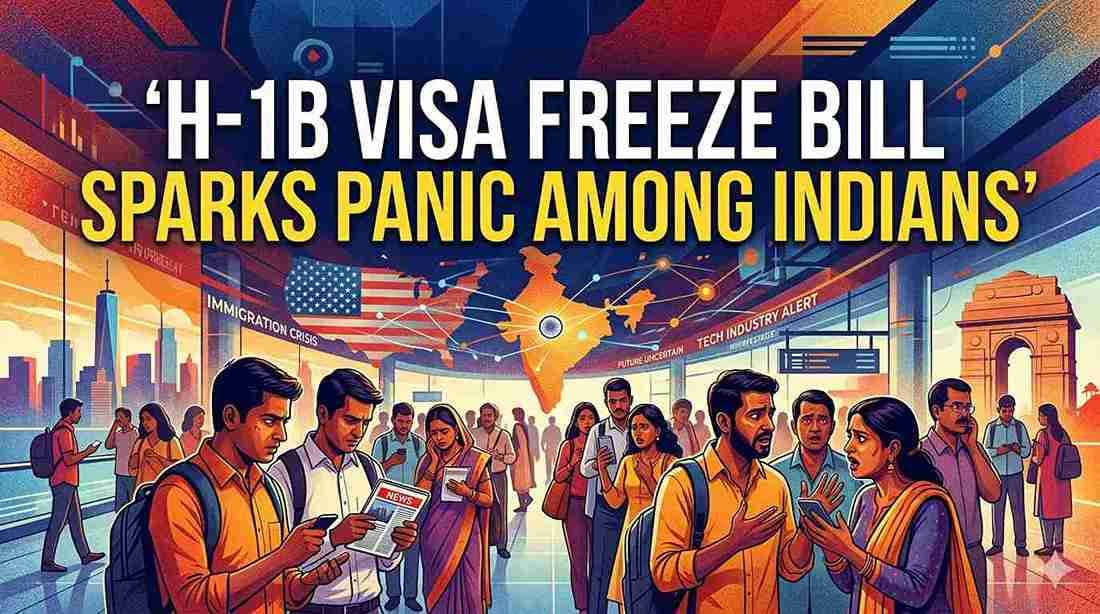
In September 2025 the Trump administration reportedly announced a proclamation imposing a $100,000 fee on H-1B petitions filed for foreign workers, triggering major backlash from tech employers, industry associations and Indian professional communities. This guide walks through the reported rule as understood publicly, employer responses, litigation status and practical NRI action items.
Important: This is a rapidly evolving policy area with multiple legal challenges. Always verify current rules with a qualified US immigration attorney and USCIS/DOL/DOS official sources before making decisions based on this article.
What the Fee Rule Reportedly Does
The September 19, 2025 proclamation reportedly aimed to impose a $100,000 payment on new H-1B petitions for workers outside the United States, effective for petitions filed after a stated cutoff date (widely reported as September 21, 2025). The stated rationale from the administration referenced protecting American workers and reshaping the H-1B programme.
Key questions that emerged in the days after the announcement:
- Scope: Does the fee apply to all H-1B petitions or only new petitions for workers currently outside the US?
- Existing H-1B holders: Are current H-1B workers in the US affected on transfers, extensions or amendments?
- Cap-exempt employers: Are universities, government research organisations and non-profits exempt (as under the base H-1B cap rules)?
- Effective date: Which petitions specifically fall within the new rule?
- Legal authority: Does the executive branch have authority to impose this fee without Congressional action?
USCIS and DHS have reportedly issued clarifying guidance on some of these questions since the announcement, but interpretations, court orders and administrative guidance have continued to evolve. Refer to USCIS.gov and your immigration attorney for the current text.
Litigation and Legal Challenges
Multiple lawsuits were reportedly filed in the weeks following the proclamation by:
- Industry associations (technology, higher education, healthcare)
- State attorneys general
- Civil-liberties organisations
- Individual employers and affected workers
Core legal arguments include claims that the executive branch lacks authority to impose the fee without Congressional action, that the rule violates the Administrative Procedure Act (APA) for lack of notice-and-comment rulemaking, and that it discriminates against certain nationality groups (a disproportionate number of H-1B holders are Indian nationals).
Status of these cases changes rapidly. Court injunctions, stays and appeals can shift the effective status of the rule. Verify current litigation state with an attorney.
How US Employers Have Reportedly Responded
- Some hyperscalers reportedly announced they would absorb the fee for critical roles rather than pass it to candidates.
- Consulting firms (TCS, Infosys, HCL, Wipro, Cognizant, Deloitte, Accenture) reportedly reduced new H-1B petition volumes and shifted more work to their India delivery centres or nearshore locations.
- Smaller employers reportedly pulled back on H-1B sponsorship for new hires, preferring US citizens, green-card holders or L-1 intra-company transfers where feasible.
- Universities and research institutions (traditionally cap-exempt) reportedly continued sponsoring at similar rates, though transfer-in petitions from cap-subject employers faced complications.
Who Is Most Affected
- New H-1B petitions for workers currently outside the US filed after the effective date
- Employers without deep pockets to absorb the fee
- Indian workers on OPT / STEM-OPT whose employers were relying on the H-1B lottery for a bridge to long-term work status
- Consulting-services employees where sponsorship economics were already tight
- Graduate students weighing US vs Canada / UK / Australia offers
Practical Steps for Affected Indian Professionals
- Consult a qualified US immigration attorney before making any move. This is not optional advice — the rule interacts with H-1B, L-1, O-1, EB-1/2/3, F-1, OPT, STEM-OPT and adjustment-of-status in complex ways.
- Confirm your current status carefully. If you are already in H-1B status in the US, understand what triggers — if any — the new fee applies to (transfers, extensions, amendments, cap-subject re-entry, consular processing).
- Employer conversations. If you are pending a petition, ask HR / mobility for a written statement on how the employer plans to handle the new fee.
- Financial buffer. Maintain 6-12 months of essential expenses in case of extended processing delays or employer sponsorship changes.
- Alternate country planning. Canada, UK, Australia, Germany, Ireland, Netherlands and Singapore all offer viable talent pathways for Indian professionals. See our companion guide: Best Countries for Indian Immigrants Beyond USA 2026.
- Documentation. Keep pay stubs, performance reviews, project write-ups and RSU vest schedules organised and personal-copy-accessible.
- Track official sources. USCIS.gov, DHS.gov and the Federal Register for definitive text. Media summaries can be misleading.
Fact-Check & Sourcing Notes
NRI Globe cross-references publicly reported information from major outlets and the USCIS/DHS/Federal Register. Because of the volume of executive-branch immigration activity and ongoing litigation:
- Specific fee amounts, effective dates and exemption lists should always be verified via the USCIS official pages or a licensed immigration attorney.
- Court orders can pause, narrow or overturn portions of the rule. Check the current status.
- Country-of-origin effects vary. India is disproportionately affected because Indian nationals represent the majority of new H-1B petitions in recent years.
Broader Impact on the Indian Diaspora and Indian Tech Sector
- H-1B volume declines from Indian consulting firms shift work back to India (Bengaluru, Hyderabad, Pune, Chennai) — boosting Global Capability Centres (GCCs) and India-side hiring.
- Master's programme demand for STEM courses in the USA reportedly softened at some universities as prospective students weigh Canada, UK, Germany and Australia alternatives.
- Startups and mid-stage tech firms face harder hiring economics without the flexibility to absorb the fee.
- Green-card queues for EB-2 / EB-3 India continue to be affected by baseline backlog dynamics; per-country caps remain a structural constraint.
Frequently Asked Questions
Is the $100,000 H-1B fee currently in effect?
The proclamation was announced September 19, 2025 and reportedly took effect for petitions filed after a stated cutoff date. However, litigation and administrative guidance have continued to evolve. Verify the current effective status with a qualified US immigration attorney and USCIS.gov before making decisions.
Does the fee apply to H-1B extensions or transfers for workers already in the US?
This is one of the most-asked questions. Interpretations have varied. Consult a qualified US immigration attorney for your specific case.
Are cap-exempt employers (universities, research institutions) affected?
Historically cap-exempt employers face a different H-1B regime. Whether the new fee rule applies to them (or extends specific carve-outs) has been a live question. Verify current guidance.
Should Indian tech workers leave the US preemptively?
Not on the basis of media summaries alone. Consult a qualified immigration attorney. Individual circumstances (current status, employer, pending petitions, family members' status) matter significantly.
How does this affect F-1 STEM-OPT holders?
STEM-OPT is a distinct programme from H-1B. However, most STEM-OPT holders rely on the H-1B lottery for a long-term work pathway. If employer sponsorship dynamics shift, STEM-OPT holders may face different post-graduation trajectories. Consult an attorney.
Related NRI Globe Coverage
- Best Countries for Indian Immigrants Beyond USA 2026
- Trump Rejects AI Slowdown — H-1B Impact
- Oracle Layoffs September 2026
- Oracle's 6 AM Layoff Emails — Lessons for NRIs
- Latest Business & NRI News
Disclaimer: This article summarises publicly reported information as of 2026. Specific fee amounts, effective dates, exemptions and litigation status can change rapidly. This is not legal advice. Consult a qualified US immigration attorney and USCIS.gov / DHS.gov / Federal Register for authoritative current information. NRI Globe provides journalism and general information only.