
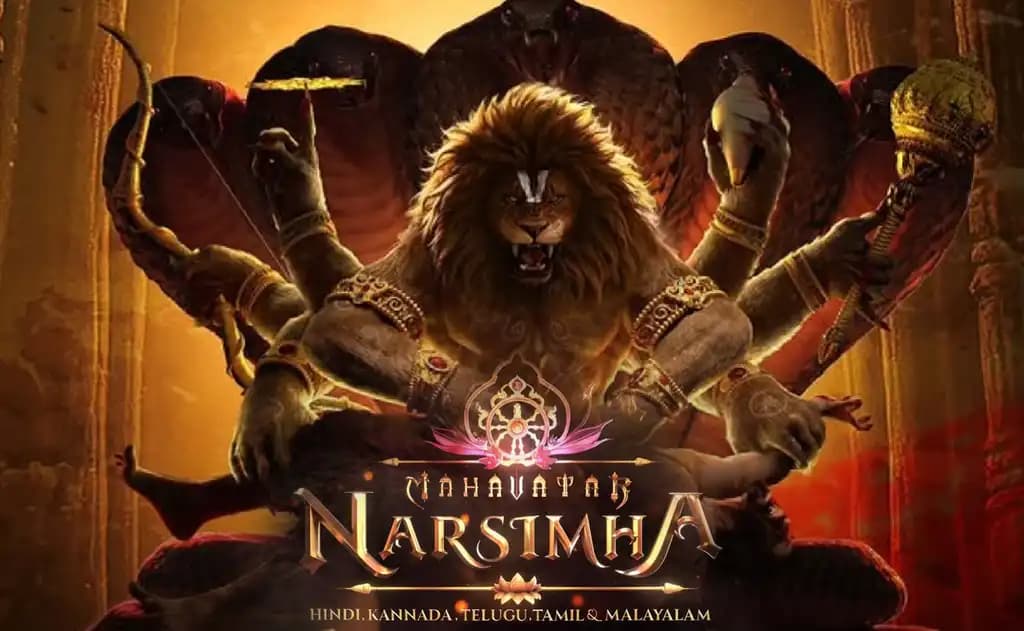
Indian animation crossed a visible threshold with the release of Mahavatar Narsimha. Families in multiple languages turned out in numbers that exceeded prior benchmarks for the format. The film drew attention not only from domestic audiences but also from diaspora communities who had long waited for an Indian animated theatrical release capable of holding screens beyond a single weekend.
TL;DR
- India net collections reached an estimated ₹44.5 crore in the first week.
- Overseas markets contributed roughly ₹2.25 crore in the same period.
- Hindi version accounted for the largest share of domestic earnings.
- Worldwide gross crossed ₹80 crore within nine days.
- Performance varied across dubbed versions in five languages.
Opening Week Collections in India
According to figures reported by box office trackers including Sacnilk, day-one net stood at approximately ₹2.29 crore across all versions. These early estimates are drawn from aggregated reports and may be subject to revision as official statements emerge. In the context of Indian animated releases, a day-one figure of this scale is meaningful because the format has historically struggled to attract the kind of opening-day footfall that live-action films generate almost automatically.
Subsequent days showed steady increases. Day two reached ₹4.7 crore and day three climbed to ₹9.5 crore. The first three days together produced between ₹15.85 crore and ₹19 crore net inside India. That weekend trajectory suggested the film was benefiting from family group bookings rather than relying solely on solo or couple audiences, a pattern that tends to produce stronger Sunday numbers relative to Friday.
Weekday momentum continued. Day four added between ₹3.6 crore and ₹6.1 crore. Day five delivered ₹7.7 crore. By the end of day seven the India net total stood at an estimated ₹44.5 crore, according to tracker data cited by the Times of India entertainment desk. Maintaining daily figures above ₹3 crore on weekdays is a threshold that most Indian animated titles have historically failed to clear, making the mid-week performance one of the more closely watched aspects of the run.
Daily Breakdown Table
| Day | India Net (₹ crore) | Worldwide Gross (₹ crore) |
|---|---|---|
| 1 | 2.29 | 2.29 |
| 2 | 4.70 | 7.5 |
| 3 | 9.50 | 20 |
| 4 | 3.6–6.1 | 16–22 |
| 5 | 7.70 | 29.35–29.55 |
| 6 | 7.5–7.7 | 37 |
| 7 | 7.70 | 44.5 |
| 8 | 7.7–12 | 52.45 |
| 9 | 15.40 | 67.85 |
Language Performance Split
Hindi contributed the largest portion, roughly 60 percent of the nine-day India net. Telugu followed with consistent daily additions in Andhra Pradesh and Telangana. Kannada registered noticeable traction inside Karnataka. Tamil and Malayalam versions added smaller but steady increments in their core territories.
The multi-language release strategy reflects a broader industry shift toward treating animated mythological content as genuinely pan-Indian rather than targeting a single regional market. Each dubbed version carried its own promotional push, with regional social channels amplifying trailers in the weeks before release. For diaspora audiences, the availability of familiar language tracks was a meaningful factor in driving group outings and family bookings. An NRI family settled in, say, the United Kingdom with roots in Tamil Nadu is far more likely to organize a cinema outing when a Tamil-dubbed print is available locally than when only a Hindi version screens. The multi-language strategy therefore has a direct commercial logic that extends well beyond domestic territory boundaries.
It is also worth understanding what a language split of this kind signals about production investment. Dubbing into five languages requires additional studio time, voice talent, and quality-control passes. The fact that the producers committed to that expenditure before release suggests a level of confidence in the pan-Indian appeal of the source material that earlier animated projects had not demonstrated.
Overseas Markets and Diaspora Turnout
Reports suggest the film opened simultaneously in India and several major overseas markets, including territories with large South Asian diaspora populations such as the United States, Canada, United Kingdom, Australia, and parts of the Gulf region. The precise list of release territories and the full range of dubbed language availability had not been officially confirmed in full detail at the time of writing; readers should verify current listings through local theater platforms or the sources cited below.
North American collections approached ₹1 crore by day nine. UAE and GCC territories added approximately ₹0.5 crore. United Kingdom and Australia together contributed another ₹0.5 crore. Remaining markets including Singapore, Malaysia, and South Africa supplied the balance.
For NRI families, the simultaneous release window meant that viewing the film on opening weekend was a shared cultural moment rather than a delayed experience. Trade observers noted that diaspora word-of-mouth on social platforms contributed to sustained curiosity in markets where Indian animated titles had previously struggled to hold screens beyond a single weekend. The Gulf region, in particular, has a dense concentration of South Asian families with children of school age, and the mythological subject matter carries strong household recognition across generations. That combination of demographics and cultural familiarity tends to produce higher per-screen averages than a general-audience animated release would achieve in the same territory.
For NRI viewers who follow Indian box office data closely, the overseas contribution also carries a secondary significance. A healthy overseas gross strengthens the case for distributors in those markets to secure wider screen counts for future Indian animated releases, gradually building the kind of infrastructure that currently exists for live-action Indian films in diaspora hubs.
Comparative Context for Indian Animation
Previous Indian animated titles rarely sustained momentum beyond opening weekends. Mahavatar Narsimha maintained daily collections above ₹7 crore through the second week, according to tracker data reported by Sacnilk. This pattern differs from earlier releases that saw sharp drops after day three. The difference points to stronger word-of-mouth among family viewers and repeat visits in key cities.
To understand why this matters, it helps to consider how animated films are typically evaluated by exhibitors. A film that drops steeply after its opening weekend signals weak audience satisfaction or limited repeat-viewing appeal, prompting multiplexes to reassign screens quickly. A film that holds its numbers — or even grows them, as the day-nine figure of ₹15.40 crore India net suggests — gives exhibitors a commercial reason to maintain or expand the screen count. That dynamic is familiar in the context of global animated franchises but has been largely absent from the Indian animated theatrical space until now.
The sustained run also gave exhibitors confidence to hold screens rather than replacing the film with incoming live-action titles. That kind of exhibitor support has historically been difficult for Indian animation to secure, making the second-week performance commercially significant beyond the raw numbers.
Production and Marketing Elements
Hombale Films brought prior experience from live-action successes into the animated space. Marketing focused on mythological themes that already hold recognition among diaspora households. Trailers circulated on major streaming platforms and regional social channels. Cultural events in several cities hosted early screenings that helped seed interest.
The mythological source material gave the marketing team a ready-made visual language. Imagery tied to the Narsimha avatar carries immediate recognition across age groups and regional backgrounds, reducing the need to build awareness from scratch. That recognition likely lowered the barrier for parents deciding whether to bring younger children, a demographic that drives repeat visits and strong weekend multipliers. Parents who grew up hearing stories associated with this avatar were, in effect, pre-sold on the subject matter before a single trailer was released, giving the marketing campaign a head start that a wholly original animated property would not have enjoyed.
The production approach also appears to have balanced visual ambition with budget discipline. Animated features require significant upfront investment in rigging, rendering, and voice production, and the returns are rarely guaranteed. The fact that the film reached profitability within its first fortnight, as trade reports suggest, indicates that the production team calibrated the scope of the project against realistic revenue projections rather than chasing a budget scale the market could not yet support.
Implications for Future Projects
Producers now have a clearer data point on viable budgets for mythological animation. Trade reports suggest the production outlay was in a range that allowed for measurable profit within the first fortnight, though the precise budget figure had not been formally disclosed by the producers at the time of writing. Readers seeking confirmed figures should monitor official statements from Hombale Films directly.
Digital release windows and potential sequels are already under discussion in trade circles, as reported by the Times of India entertainment desk. The nine-day worldwide gross of approximately ₹83 crore provides a reference line for similar projects aimed at both domestic and overseas Indian audiences. For studios evaluating whether mythological animation can sustain a theatrical run rather than defaulting to a short window before streaming, this release offers the most concrete evidence yet that the audience exists and will return across multiple weekends.
The broader implication for the Indian animation sector is that production quality, combined with culturally resonant subject matter and a genuine multi-language release, can close much of the gap with live-action family films. Investors and co-production partners who had previously treated animated mythological content as a niche category may reassess that assumption in light of these results. For NRI investors or producers with ties to the Indian entertainment industry, the performance data now available from this release provides a more grounded basis for evaluating future animated projects than was possible before. The overseas contribution, while modest relative to the domestic total, also demonstrates that diaspora markets are a viable secondary revenue stream rather than an afterthought.
Streaming platforms operating in the Indian market will also be watching these numbers carefully. A film that performs this strongly in theatres typically commands a stronger licensing fee when the digital window opens, and the multi-language availability makes it attractive for platforms seeking to serve regional-language subscribers alongside Hindi-dominant audiences.
Next steps
Track weekly updates from official trackers. Check local theater listings for extended runs in your city. Share viewing plans with family groups planning weekend outings.
Sources
Related NRI Globe Coverage
- Hollywood This Week — September 17-21, 2026 New Movie Releases, Box Office Update and Where to Watch (NRI Family Guide)
- September 2026 Box Office Projections — Practical Magic 2 Leads ($35-45M), Resident Evil ($30-40M), NRI Multiplex Outlook
- Why NRIs Rejected Yash's Toxic Movie — Overseas Box Office Crash Explained
- NRI Box Office Trends 2025–2026: How Indian Cinema Is Performing With the Diaspora
- Telugu Cinema Going Global: The NRI Box-Office Story
- Bollywood Box Office Guide for NRIs 2026: Opening Weekends, USA-UK-UAE Performance & Diaspora Audience Tracker
- Biker vs Rakasa Box Office Collection: Sangeeth Shobhan’s Horror Comedy Takes Early Lead Over Sharwanand’s Motocross Drama – NRI Reactions Pour In
- Wuthering Heights Leads Global Box Office
Fresh from NRI Globe
- YouTuber Nandu's World (Rama Nandana) UK Visa & Job Fraud Case: Full Details + Key Lessons for NRIs (2026)
- Dussehra / Vijayadashami 2026 Events Country-Wise — Global NRI Directory (Ram Lila, Ravana Dahan, Durga Puja Pandals, Ayudha Puja Venues + Booking)
- Diwali 2026 Events Country-Wise — Global NRI Directory (White House, Leicester, London Trafalgar, Toronto, Auckland, Sydney Parramasala, Fiji, Mauritius, Trinidad, South Africa and More)
- Diwali / Deepavali 2026 Country-Wise NRI Celebrations — Complete Global Guide (USA, UK, Canada, Australia, Fiji, Mauritius, Trinidad, South Africa, UAE and 30+ Countries)