
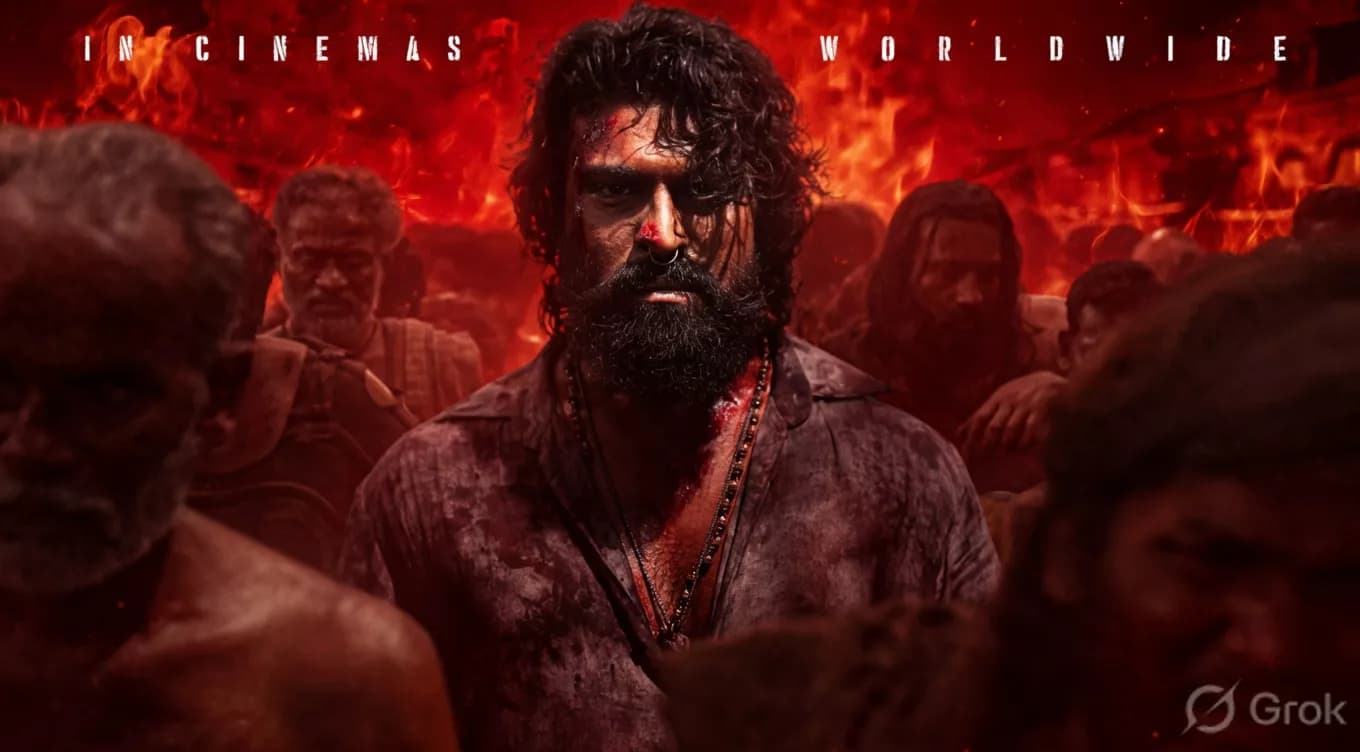
Peddi (2026), directed by Buchi Babu Sana and starring Ram Charan in the title role, released worldwide on June 4, 2026. Marketed as a 1980s rural Andhra Pradesh sports action drama, the film positions a villager-turned-athlete as the central figure who rallies his community through cricket and wrestling to challenge a powerful rival.
From a commercial standpoint, the project leverages a major star's physical transformation, A.R. Rahman's score, high-production sports sequences, and a mass-appeal underdog formula. Early theatrical indicators — including strong advance bookings and premium-format screenings in North America — suggest it is engineered for opening-week collections across Telugu markets and overseas territories with significant NRI audiences.
However, a closer examination of the sports narrative shows repeated prioritisation of dramatic convenience over logical consistency. This review analyses the film through a commercial sports-story lens — focusing on execution, market positioning, and the specific areas where the story logic falters.
Note: This is a critical review reflecting the analysis and opinion of NRIGlobe. Box-office figures and budget are based on reported trade indicators and may change. It contains light, spoiler-aware discussion of the film's structure.
Commercial Positioning and Target Audience
Peddi operates as a star-driven commercial sports entertainer. Ram Charan's portrayal emphasises physical commitment, body transformation, and intense interval-block sequences. The blend of wrestling (pehlwan elements) and cricket aims to broaden appeal beyond pure cricket fans to mass family audiences.
For NRIs — particularly Telugu diaspora communities in the US, UK, Canada, Australia, and the Gulf — the film offers a familiar rural-underdog sports template with cultural nostalgia. Theatrical runs in premium large formats (IMAX, Dolby Cinema, 4DX) in select overseas locations provide the intended big-screen experience, with post-theatrical OTT availability expected on major platforms within the usual window for Telugu big-budget releases.
The production carries a reported ₹300 crore budget and deploys standard commercial tools — song interludes, mass-hero elevation moments, and a sports climax designed for theatrical applause. These elements function adequately for audiences seeking spectacle over strict realism.
Story Framework (Spoiler-Light)
The narrative establishes the protagonist as a homeless labourer in 1980s rural Andhra Pradesh who channels community pride into sports. Cricket and wrestling serve as vehicles for unity against a dominant rival faction. The first half focuses on origin struggles and skill acquisition, while the second half escalates into competitive confrontations and resolution through athletic victory.
Early reactions have noted the interval block's intensity and Ram Charan's physical presence; commercially, these sections deliver the expected high points. The romantic thread involving Janhvi Kapoor registers as largely peripheral to the core sports conflict.
Where the Sports Narrative Strains Logic
Despite strong visual execution and star power, several sequences undermine narrative coherence when viewed through a logical sports-story framework. The most prominent examples:
1. Accelerated Dual-Sport Mastery
The protagonist moves from manual labourer to competitive-level cricketer and wrestler within a compressed timeline. In a 1980s rural setting with limited coaching infrastructure, nutrition science, and recovery resources, achieving elite proficiency in two physically distinct disciplines simultaneously defies documented athletic-development timelines.
2. Physics-Defying Cricket and Wrestling Action
Several batting, fielding, and grappling sequences feature ball trajectories, dive recoveries, and pinning manoeuvres that exceed realistic biomechanical and equipment limits of the era. They generate commercial theatrical energy but detach from observable athletic physics and safety parameters.
3. Blatant Sabotage with Delayed Consequences
The rival camp repeatedly employs visible cheating (equipment interference, external pressure). In a structured sports contest — even in the depicted period — such actions would typically trigger earlier intervention by umpires, organisers, or community oversight. The plot delays consequences until dramatically convenient.
4. Instant Village-Wide Mobilisation
An entire rural community, spanning age groups and traditional social structures of 1980s Andhra Pradesh, rapidly aligns behind complex sports strategies after minimal motivation. Real-world community sports initiatives of that era usually faced sustained logistical, financial, and social friction before achieving cohesion.
5. Romantic Subplot as Commercial Filler
The Janhvi Kapoor track contributes minimal advancement to the protagonist's sporting journey or the central rivalry. It primarily serves song placement and star-pairing requirements rather than integrating with the sports conflict or character growth.
6. Unrealistic Injury Recovery and Endurance
Characters exhibit rapid recovery and sustained high performance following injuries or extreme training loads, ignoring period-appropriate medical understanding and general human physiological limits during prolonged competition.
7. Sports Victory as Complete Socio-Political Resolution
The climactic athletic outcome single-handedly dismantles entrenched power imbalances with the rival faction. In practice, such victories rarely produce lasting structural change without accompanying administrative, legal, or economic measures — elements largely absent from the resolution.
8. Training Montage Ignoring Era Constraints
The transformation and skill montages imply access to progressive-overload methods, specialised recovery, and consistent high-level opposition that were not realistically available to a rural labourer in 1980s Andhra Pradesh.
Collectively, these illustrate a pattern where commercial dramatic requirements override internal story logic.
Performances and Technical Execution
Ram Charan delivers a physically committed central performance, particularly in the body-transformation and intense action segments. Supporting cast members, including Jagapathi Babu's antagonist portrayal, function within the commercial archetype framework.
A.R. Rahman's score and select tracks provide energetic elevation during the sports and mass sequences. Real-location cricket work adds visual authenticity to certain passages, and the action choreography and production design support the intended theatrical scale — even when narrative logic does not.
Verdict for Commercial Audiences and NRIs
Peddi functions as a standard commercial sports drama engineered for mass theatrical consumption. It delivers on star-driven spectacle, interval impact, and sports-visual energy. Audiences prioritising big-screen entertainment, physical performance, and familiar underdog formulas will likely find sufficient value during the opening weeks.
Viewers seeking tighter narrative logic, realistic sports progression, or integrated subplots may find the highlighted illogical scenes disruptive. The film does not attempt a grounded or documentary-style sports story; it operates within established commercial Telugu cinema conventions.
For NRIs: the current theatrical window in premium formats offers the designed experience, and Telugu-speaking diaspora audiences may appreciate the rural Andhra setting and the sports-as-pride motif. Those preferring logically consistent storytelling should approach with tempered expectations regarding plot coherence.
Overall commercial assessment: strong opening potential driven by star power and sports spectacle; sustainability will depend on word-of-mouth once audiences process the logical gaps. The film prioritises theatrical highs over narrative rigour.
Frequently Asked Questions (FAQ)
Is Peddi worth watching in theatres?
For spectacle, star power, and big-screen sports energy — yes, especially in premium formats. If you prioritise tight, realistic storytelling, temper your expectations on plot logic.
Who is in Peddi and who directed it?
Peddi stars Ram Charan and Janhvi Kapoor, is directed by Buchi Babu Sana, with music by A.R. Rahman.
When will Peddi be available on OTT?
Post-theatrical OTT release is expected on a major platform within the usual window for Telugu big-budget films. The exact platform and date depend on the digital-rights deal.
Is Peddi a realistic sports film?
No — it is a commercial mass entertainer. As this review details, several sports sequences prioritise dramatic impact over realism.
Related Reading on NRIGlobe
- Peddi Release: Ram Charan's Sports Drama & NRI Opening (June 4)
- Telugu Cinema Going Global: The NRI Box-Office Story
- How NRIs Can Watch New Telugu & Indian Movies in the USA
- Best OTT Platforms for Indian Content in the USA (2026)