
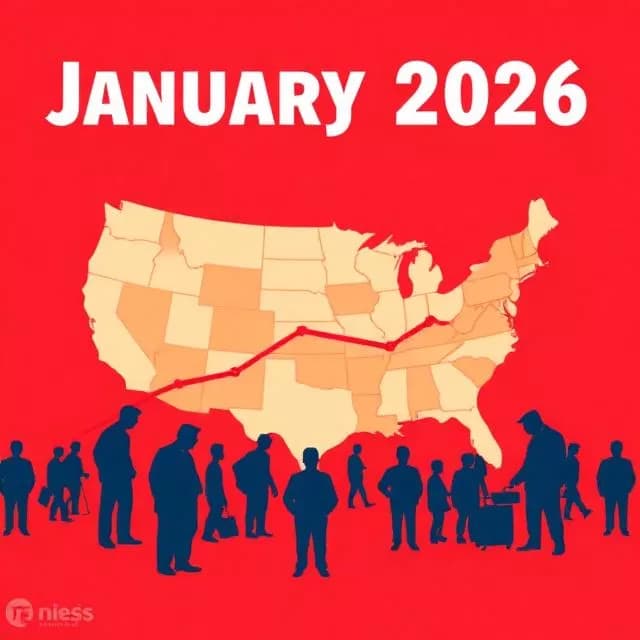
January 2026 US Layoffs Surge as Unemployment Holds at 4.4%
NRIGlobe Business Desk February 2, 2026 – Hyderabad, India (US-Focused Coverage for Global NRIs)
January 2026 marked a tough start for the US job market, with major corporations announcing significant layoffs driven by cost-cutting, AI adoption, automation, and efficiency restructuring. Over 60,000 jobs were flagged for elimination in the month alone, continuing the trend from 2025's heavy downsizing. While the overall unemployment rate held steady at 4.4% (per December 2025 BLS data, with January figures due February 6), the labor market feels more challenging for white-collar and corporate professionals amid selective hiring.
For Non-Resident Indians (NRIs) in the US—especially in tech, logistics, finance, and manufacturing hubs like California, Texas, New York, and the Midwest—these cuts raise concerns about job security, H-1B visa stability, green card backlogs, and career transitions. Many NRIs in affected sectors are exploring upskilling in AI, pivoting to resilient industries like healthcare, or leveraging severance for entrepreneurship.
Key Private-Sector Layoff Announcements in January 2026
- Amazon: Slashing ~16,000 corporate roles globally (heavily US-impacted), the second major round in three months, aiming to trim bureaucracy and boost AI investment. This follows 14,000 cuts in late 2025, targeting up to 30,000 corporate positions overall.
- UPS: Plans to eliminate up to 30,000 operational jobs throughout 2026, mainly via voluntary buyouts and attrition, due to declining Amazon package volumes and cost controls.
- Dow Inc.: Cutting ~4,500 positions as part of its "Transform to Outperform" strategy, emphasizing AI, automation, and streamlined operations.
- Nike: Eliminating ~775 roles at US distribution centers to accelerate supply chain automation.
- Other Notable Moves: Pinterest (reduction affecting <15% of workforce), Mastercard (ongoing headcount adjustments), Citi (continued reductions), Angi (~350 jobs), and smaller cuts at T-Mobile and others. WARN notices from over 100 companies signal broader impacts in manufacturing, logistics, tech, healthcare, retail, finance, and hospitality.
These announcements reflect a broader "efficiency era" where companies prioritize profitability, AI integration, and post-pandemic adjustments over expansive headcount.
Unemployment & Labor Market Status
- The US Bureau of Labor Statistics (BLS) reported a 4.4% unemployment rate for December 2025 (released January 2026), with non-farm payrolls adding only 50,000 jobs—below expectations and signaling cooling but stable conditions.
- Advance estimates (e.g., Chicago Fed) suggest the rate will hold around 4.35–4.4% for January 2026.
- Hiring remains selective: Growth in healthcare, manufacturing, and professional services favors experienced talent, while entry-level and certain corporate roles face pressure. Long-term unemployment metrics have risen in some areas, and consumer confidence in job availability has dipped.
- The labor market shows a "low-hire, low-fire" equilibrium—fewer openings but also lower voluntary quits—making job searches longer for displaced workers.
Federal Jobs & Workforce Developments
No massive new federal layoffs were announced in January 2026, but the Trump administration's efficiency initiatives (including the Department of Government Efficiency) continued aggressive reductions from 2025.
- Office of Personnel Management (OPM) data: Net loss of ~220,000 federal civilian employees from January to November 2025 (over 320,000 separations vs. limited hires), shrinking the workforce by nearly 10%.
- Hardest-hit agencies: Defense (~61,000 reductions), Treasury (~31,000+), Agriculture (~21,000+), HHS, VA, and others.
- A partial government shutdown affected several agencies (DHS, DOD, HHS, Education, etc.) in late January due to funding issues, potentially furloughing workers temporarily (essential services continued).
- Broader policies include merit-based hiring, return-to-office mandates, DEI eliminations, and hiring limits (one new hire per four departures).
These changes create uncertainty for federal employees and contractors, many of whom are NRIs in STEM roles.
Implications for Global NRIs in the US
For the Indian diaspora—over 4.5 million strong in the US—these developments highlight risks in tech/logistics-heavy states and opportunities in stable sectors. NRIs often face added challenges like visa dependencies during transitions.
Tips for NRIs:
- Upskill in AI, data analytics, or cybersecurity via platforms like Coursera or LinkedIn Learning.
- Network through professional groups (e.g., TiE, AAPI) and leverage alumni networks.
- Explore internal mobility, severance benefits, or green card/visa consultations.
- Monitor BLS reports (next: February 6 for January data) and company announcements closely.
NRIGlobe will track evolving trends, BLS releases, and NRI-specific impacts. The US economy shows resilience, but structural shifts demand proactive career planning.
Latest NRI News & Global Updates:
Health, Wellness & Lifestyle for NRIs
https://nriglobe.com/lifestyle/
Latest NRI News & Global Updates
https://nriglobe.com/news/
Business & Finance News for NRIs
https://nriglobe.com/business/
Investment Guides for NRIs
https://nriglobe.com/investment/
Jobs & Career Opportunities for NRIs
https://nriglobe.com/jobs/
Continue reading — NRI Globe pillar guide: H-1B Complete Guide for Indians 2026
Related NRI Globe Coverage
- Feb 2026 Software Layoffs Surge Amid AI Adoption
- January 2026 Global Layoffs & NRI Career Impact
- January 2026 Layoffs: Impact on NRIs & Tech Workforce
- Amazon Layoffs January 2026: Impact on AWS & DevOps Jobs
- Microsoft January 2026 Layoffs Rumors Denied: What NRIs in Tech Need to Know Amid AI Boom
- Software & Tech Layoffs in the USA (Week of September 13, 2026) — Uber, Apple, PayPal, Amazon Cuts & NRI Impact
- Uber Layoffs 3,300 Jobs Sept 2026 — NRI Tech Impact + H-1B Playbook
- US Tech Layoffs 2026: NRI Impact, H-1B Action Plan and the Recovery Path
Fresh from NRI Globe
- YouTuber Nandu's World (Rama Nandana) UK Visa & Job Fraud Case: Full Details + Key Lessons for NRIs (2026)
- Dussehra / Vijayadashami 2026 Events Country-Wise — Global NRI Directory (Ram Lila, Ravana Dahan, Durga Puja Pandals, Ayudha Puja Venues + Booking)
- Diwali 2026 Events Country-Wise — Global NRI Directory (White House, Leicester, London Trafalgar, Toronto, Auckland, Sydney Parramasala, Fiji, Mauritius, Trinidad, South Africa and More)
- Diwali / Deepavali 2026 Country-Wise NRI Celebrations — Complete Global Guide (USA, UK, Canada, Australia, Fiji, Mauritius, Trinidad, South Africa, UAE and 30+ Countries)