
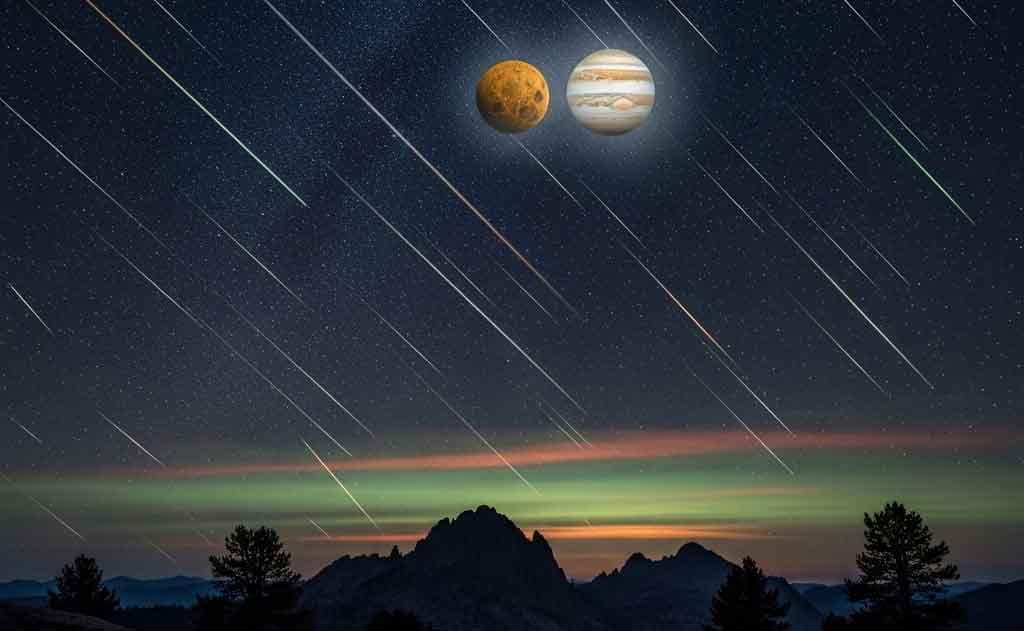
On the evenings of June 8 and 9, 2026, Venus and Jupiter — the two brightest planets in our night sky — will appear remarkably close together in what astronomers and skywatchers are calling the "Cosmic Kiss." The planets will be separated by just about 1.6 to 2 degrees (roughly the width of your pinky finger held at arm's length). This rare and beautiful planetary conjunction is one of the best of the year and will be visible to the naked eye from most parts of the world where NRIs live. Here is a complete, practical guide for Indian families living abroad on how to watch this stunning celestial event.
What exactly is the Cosmic Kiss?
The "Cosmic Kiss" refers to the close alignment of Venus — the brightest planet, often called the Evening Star — and Jupiter, the second brightest, in the western sky after sunset. On June 8 and especially June 9, they will appear side-by-side low on the western horizon. The pair will remain visible for about 1.5 to 2.5 hours after sunset before setting. No special equipment is needed, though binoculars will enhance the view.
This is a purely visual treat caused by the planets' orbits lining up from Earth's perspective. It has no astrological significance but offers a wonderful opportunity for families to step outside and enjoy the night sky together.
Best time to watch (June 8 and 9, 2026)
General rule: Look 30 to 60 minutes after local sunset in the western or west-northwestern sky. The planets will be relatively low, so you need a clear horizon without tall buildings or trees blocking the view.
Viewing times by country (approximate, June 9)
- US East Coast (New York, New Jersey, Florida): sunset around 8:20 PM; best viewing 8:50 PM - 10:30 PM; look west.
- US West Coast / Central (California, Texas): sunset around 8:00 PM; best viewing 8:30 PM - 10:00 PM; look west.
- Canada (Toronto, Vancouver): sunset around 8:45 PM; best viewing 9:15 PM - 10:45 PM; look west.
- UK and Ireland: sunset around 9:20 PM; best viewing 9:50 PM - 11:00 PM; look west / northwest.
- UAE and Middle East: sunset around 7:00 PM; best viewing 7:30 PM - 9:00 PM; look west.
- Australia (Sydney, Melbourne): sunset around 5:00 PM; best viewing 5:30 PM - 7:00 PM; look west.
- Singapore and Southeast Asia: sunset around 7:10 PM; best viewing 7:40 PM - 9:00 PM; look west.
Tip: Use your phone's compass or any astronomy app to locate the western direction accurately.
Best free apps and tools for NRIs
These apps will show you exactly where to look and give precise timing for your city:
- Stellarium (free on Android, iOS and Web) — best overall. Search "Venus" or "Jupiter" and it shows the real-time position.
- SkyView or SkySafari — excellent for beginners. Point your phone at the sky and identify objects in real time.
- NASA App or EarthSky website — daily sky guides and alerts.
- TimeandDate.com — check exact sunset time for your city.
How to watch if it is cloudy or you are in a big city
Many NRIs live in cities with heavy light pollution. Here are easy alternatives:
- Drive to a darker location. Even 30-45 minutes outside the city can make a big difference.
- Use binoculars or a small telescope. Makes the planets appear much brighter and clearer.
- Watch live streams and videos. YouTube channels like EarthSky, NASA, and local astronomy clubs often stream planetary events. Search "Venus Jupiter conjunction June 2026 live" for real-time coverage.
- Take photos. Use your phone's Night mode or a DSLR on a tripod. Venus will appear very bright and white, while Jupiter will look slightly yellowish.
Safety and practical tips for families
- Never look directly at the Sun while waiting for the planets to appear.
- Choose a spot with a clear western view — a rooftop, park or beach works well.
- Bring blankets or chairs — the planets stay visible for a couple of hours.
- Involve kids. This is a great way to introduce astronomy and Indian scientific heritage (ancient Indian astronomers like Aryabhata studied planetary movements extensively).
- Check the weather forecast the same day. Clear skies are essential.
Why this Cosmic Kiss matters for NRIs
For many Indian families abroad, events like this offer a beautiful way to connect with nature and pass on cultural curiosity about the cosmos. India has a rich tradition of sky-watching, from ancient observatories to modern ISRO missions. Watching the Cosmic Kiss together can become a memorable family moment. Whether you are in New York, London, Dubai, Sydney or Toronto, this is one of the easiest and most rewarding astronomical events to witness in 2026.
Final word
The Cosmic Kiss of Venus and Jupiter on June 8-9, 2026, is a rare and beautiful sight that requires no ticket or subscription — just step outside and look west after sunset. Mark your calendar, download Stellarium, and enjoy this celestial moment with your family. If the sky is clear where you are, you are in for a treat.
Did you manage to spot the Cosmic Kiss? Share your photos or experience in the comments — we would love to hear from NRIs across the world.
Related NRI Globe Coverage
- YouTuber Nandu's World (Rama Nandana) UK Visa & Job Fraud Case: Full Details + Key Lessons for NRIs (2026)
- US Crime News 2026 — Top Trend Categories NRIs Are Watching (Organized Retail Theft, Auto Theft, Cybercrime, Hate Crimes, Fentanyl, AI-Enabled Fraud)
- US Crime & Safety This Week — September 17-21, 2026 (NRI Family Guide, FBI Alerts, H-1B/Immigration Scams, Tech Support Fraud, Emergency Resources)
- Japan's Centenarian Population Surpasses 100,000 for the First Time in History
- Major US News This Week (September 14-15, 2026): Supreme Court Blocks Trump Mail Voting Rules, AI Debate Explodes, Space Weapons Confirmed
- How AI Is Changing NRI Life 2026 — Visas, Jobs, Money, Family and the New Frauds
- $5,000 Trump Dividend Proposal — Complete Details, Feasibility & NRI Impact Analysis (Nov 2026 Midterms)
- Trump Urges Support for AI Data Centers on Fox News — US-China Race, Stocks, Local Opposition (NRI Perspective)
Fresh from NRI Globe
- Dussehra / Vijayadashami 2026 Events Country-Wise — Global NRI Directory (Ram Lila, Ravana Dahan, Durga Puja Pandals, Ayudha Puja Venues + Booking)
- Diwali 2026 Events Country-Wise — Global NRI Directory (White House, Leicester, London Trafalgar, Toronto, Auckland, Sydney Parramasala, Fiji, Mauritius, Trinidad, South Africa and More)
- Diwali / Deepavali 2026 Country-Wise NRI Celebrations — Complete Global Guide (USA, UK, Canada, Australia, Fiji, Mauritius, Trinidad, South Africa, UAE and 30+ Countries)
- Dussehra / Vijayadashami 2026 Country-Wise NRI Celebrations — USA, UK, Canada, Australia, New Zealand, UAE, Singapore, Germany, Netherlands and More