
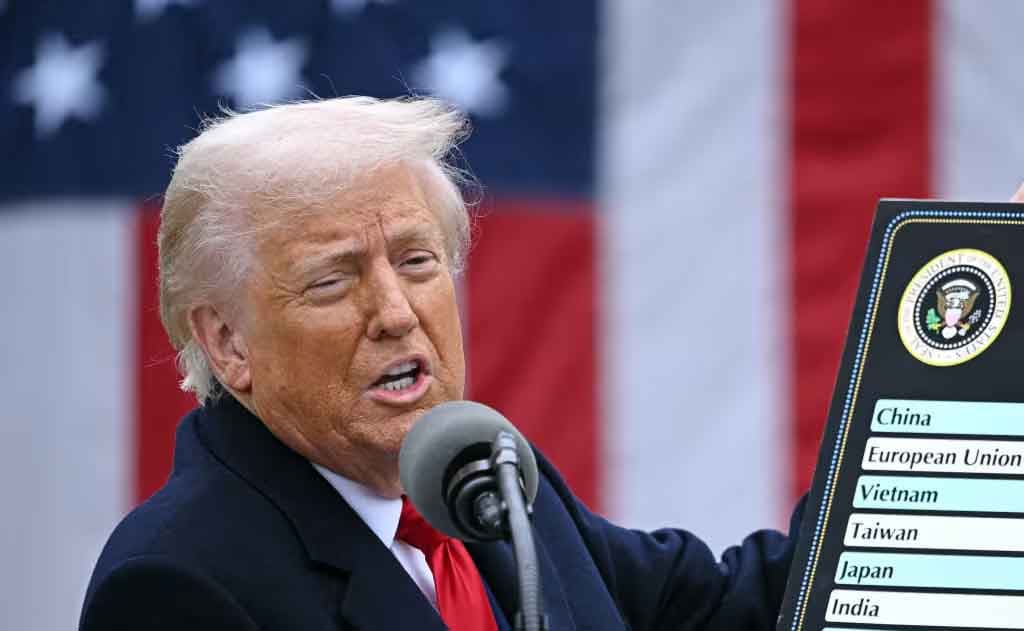
In a dramatic turn of events that has sent shockwaves through global markets and U.S. political circles, the U.S. Court of Appeals for the Federal Circuit delivered a landmark 7-4 ruling on August 29, 2025, declaring most of President Donald Trump’s sweeping global tariffs illegal. The decision, which labels the tariffs an unconstitutional overreach under the International Emergency Economic Powers Act (IEEPA), marks a significant setback to Trump’s cornerstone economic policy, raising questions about the limits of presidential power and the future of U.S. trade strategy. With Trump vowing to take the fight to the Supreme Court, this ruling promises to keep the nation—and the world—on edge.
A Bold Policy Meets a Legal Roadblock
President Trump’s tariffs, introduced as part of his “America First” agenda, were a defining feature of his second term. On April 2, 2025, dubbed “Liberation Day,” Trump invoked the IEEPA to impose a universal 10% tariff on nearly all U.S. trading partners, with additional “reciprocal” tariffs as high as 50% on countries like India and 145% on China. Further, in February 2025, Trump introduced “trafficking tariffs” targeting Canada, Mexico, and China, citing drug smuggling and illegal immigration as national emergencies. These levies aimed to reshape global trade, boost domestic manufacturing, and generate billions in revenue. But the bold strategy hit a legal wall when the Federal Circuit ruled that the IEEPA, a 1977 law designed for sanctions and embargoes, does not grant the president the authority to impose such sweeping tariffs.
The court’s majority, composed of one Republican and six Democratic appointees, argued that tariffs are a “core Congressional power” under the Constitution, and the IEEPA’s language does not explicitly allow the president to impose duties or taxes. The judges leaned on the major questions doctrine, a legal principle requiring clear congressional authorization for actions with significant economic impact, to assert that Trump’s tariffs were “unheralded” and “transformative” without legislative backing. The ruling specifically invalidated the “reciprocal” and “trafficking” tariffs, sparing other duties like those on steel and aluminum imposed under different statutes, such as Section 232 of the Trade Act of 1974.
The Legal Battle’s Origins
The case, V.O.S. Selections, Inc. v. United States, began with lawsuits from small businesses and 12 Democratic-led states, including California and Oregon, challenging Trump’s tariffs. The plaintiffs argued that the trade deficits and drug trafficking issues cited by Trump did not constitute an “unusual and extraordinary threat” under the IEEPA, and the tariffs lacked a direct link to the declared emergencies. On May 28, 2025, the U.S. Court of International Trade (CIT) first ruled against the tariffs, declaring them an overreach and enjoining their enforcement. The Trump administration appealed to the Federal Circuit, which temporarily stayed the CIT’s ruling, allowing tariffs to remain in place pending further review.
The Federal Circuit’s August 29 decision upheld the CIT’s findings, stating, “The statute bestows significant authority on the President to undertake a number of actions in response to a declared national emergency, but none of these actions explicitly include the power to impose tariffs, duties, or the like, or the power to tax.” The court emphasized that Congress has historically used clear language in other statutes, like the Trade Act of 1974, to delegate tariff authority, and the absence of such language in the IEEPA was telling.
Dissent and Defiance
The ruling wasn’t unanimous. Four dissenting judges, including Obama appointees Richard Taranto and Raymond Chen, and George W. Bush appointees Kimberly Moore and Sharon Prost, argued that the IEEPA’s broad language allows the president to regulate imports, including through tariffs, during national emergencies. Judge Taranto wrote, “IEEPA embodies an eyes-open congressional grant of broad emergency authority in this foreign-affairs realm,” suggesting that Trump’s actions were within legal bounds.
President Trump, never one to back down, took to Truth Social to blast the decision as the work of a “Highly Partisan Appeals Court,” accusing it of threatening to “destroy the United States of America.” He vowed to appeal to the Supreme Court, where three of the nine justices are his appointees, expressing confidence in a favorable outcome. White House spokesman Kush Desai defended the tariffs, stating, “President Trump lawfully exercised the tariff powers granted to him by Congress to defend our national and economic security from foreign threats.” The administration has until October 14, 2025, to file its appeal, as the court delayed enforcement of the ruling to allow time for further legal action.
Reactions and Economic Implications
The ruling sparked a range of reactions. Critics of Trump’s trade policies, including California Governor Gavin Newsom and New York Attorney General Letitia James, celebrated it as a check on executive overreach. Newsom called it “a major victory for the rule of law,” while James noted that the tariffs were a “massive tax hike” that could have fueled inflation and job losses. Representative Richard Neal, the top Democrat on the House Ways and Means Committee, echoed this sentiment, stating, “No president—Trump or anyone else—can invent powers they do not have.”
On the economic front, the decision could ease inflationary pressures, as tariffs have driven up consumer prices, with some estimates suggesting a $4,711 increase in car prices due to auto-related duties. Global markets rallied briefly after the ruling, but analysts warn of short-term volatility as trade partners reassess agreements struck under the threat of Trump’s tariffs. Treasury Secretary Scott Bessent cautioned that suspending the tariffs could disrupt ongoing trade negotiations with the EU, Japan, and South Korea, potentially leading to “diplomatic embarrassment” and retaliation from other nations.
However, the ruling doesn’t spell the end of Trump’s tariff ambitions. Alternative legal tools, such as Section 122 of the Trade Act of 1974, which allows 15% tariffs for 150 days, or Section 301, used in Trump’s first-term trade war with China, could be employed to maintain some levies. Trade adviser Peter Navarro signaled this intent, stating, “You can assume, even if we lose, we will do it another way.”
A Global Trade War in Limbo
Trump’s tariffs have reshaped global trade, straining alliances and escalating tensions with adversaries like China, where tariffs peaked at 145%. The ruling casts doubt on trade deals with countries like Britain, Japan, and Indonesia, which were negotiated under the shadow of IEEPA tariffs. For India, a key U.S. trade partner, the decision could impact exports worth $66 billion, particularly in pharmaceuticals and automotive sectors, as Trump had labeled India a “tariff king” and threatened 50% duties.
The case now heads toward a likely Supreme Court showdown, with oral arguments possibly scheduled after the justices’ September 29, 2025, conference. Legal scholars are divided on the outcome, with some citing the Court’s conservative majority as favorable to Trump, while others argue that the major questions doctrine and constitutional limits on executive power could uphold the Federal Circuit’s ruling. Jeffrey Schwab of the Liberty Justice Center, representing business plaintiffs, called the decision a “powerful reaffirmation” of constitutional principles, protecting American businesses and consumers from “uncertainty and harm.”
What’s Next?
As the legal battle moves forward, the implications are profound. If the Supreme Court upholds the ruling, billions in tariff revenues could be refunded to importers, potentially weakening Trump’s leverage in trade negotiations. However, a reversal could embolden future presidents to wield emergency powers more broadly, raising concerns about unchecked executive authority. For now, the tariffs remain in effect, leaving businesses, consumers, and global markets in a state of uncertainty.
At NRIGlobe, we’ll continue to track this evolving story, bringing you the latest on how it impacts trade, economics, and U.S.-India relations. Stay tuned for updates on this high-stakes legal and economic drama.
Disclaimer: The information is based on court rulings and public statements as of August 30, 2025. Legal outcomes may change pending further appeals. For more insights on global trade and policy, visit NRIGlobe.com.
© 2025 NRIGlobe. All rights reserved.
Related NRI Globe Coverage
- Trump's Tariffs and Trade Wars in 2026: How They Affect NRI Families
- How Trump's 2026 Tariffs & Greenland Row Affect India
- Federal Judge Temporarily BLOCKS Trump's Deployment of Oregon National Guard to Portland
- Trump’s Repeated Calls to PM Modi Go Unanswered Amid Escalating U.S.-India Trade Tensions
- Trump’s Tariffs: Revenue Surge, Rising Costs, and What It Means for NRIs
- The Ripple Effect of Trump’s Tariffs on NRIs: Direct and Indirect Impacts
- Chris Sununu Slams Trump’s Tariffs on India as Threat to U.S. Manufacturers
- Trump's EU Trade Deal: Win or Short-Term Fix?
Fresh from NRI Globe
- YouTuber Nandu's World (Rama Nandana) UK Visa & Job Fraud Case: Full Details + Key Lessons for NRIs (2026)
- Dussehra / Vijayadashami 2026 Events Country-Wise — Global NRI Directory (Ram Lila, Ravana Dahan, Durga Puja Pandals, Ayudha Puja Venues + Booking)
- Diwali 2026 Events Country-Wise — Global NRI Directory (White House, Leicester, London Trafalgar, Toronto, Auckland, Sydney Parramasala, Fiji, Mauritius, Trinidad, South Africa and More)
- Diwali / Deepavali 2026 Country-Wise NRI Celebrations — Complete Global Guide (USA, UK, Canada, Australia, Fiji, Mauritius, Trinidad, South Africa, UAE and 30+ Countries)