

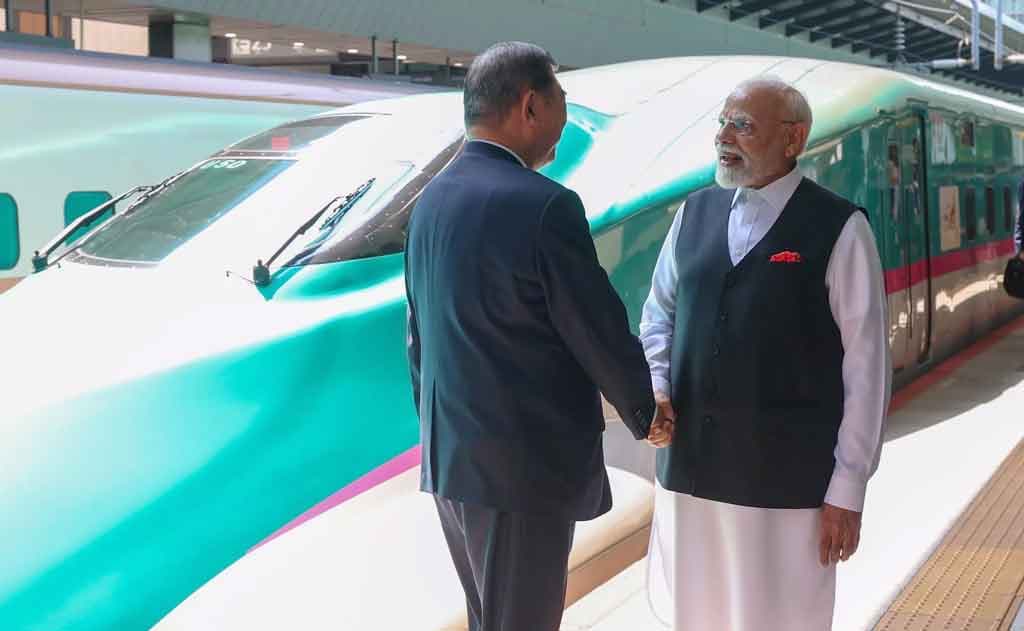
Tokyo, August 30, 2025 – In a powerful symbol of deepening ties between India and Japan, Prime Minister Narendra Modi and his Japanese counterpart, Shigeru Ishiba, embarked on a high-speed bullet train journey from Tokyo to Sendai during the 15th India-Japan Annual Summit. The ride, aboard Japan’s iconic Shinkansen, underscored the growing collaboration between the two nations in high-speed rail, advanced technologies, semiconductors, defense, artificial intelligence (AI), green energy, and economic partnerships. This event, part of Modi’s two-day visit to Japan on August 29-30, 2025, highlighted the strengthening of the Special Strategic and Global Partnership amid evolving regional and global dynamics.
A Symbolic Journey on the Shinkansen
On the morning of August 30, 2025, Modi and Ishiba boarded the Shinkansen, Japan’s world-renowned bullet train, for a journey to Sendai in Miyagi Prefecture. The ride was more than a diplomatic gesture; it was a vivid demonstration of Japan’s technological prowess and India’s ambition to integrate cutting-edge infrastructure into its development journey. During the trip, Modi received a detailed briefing on the ALFA-X Shinkansen, Japan’s fastest train, from the chairman of East Japan Railway Company (JR East). The ALFA-X, a prototype for the next-generation E10 Shinkansen, is designed to reach speeds of up to 400 km/h, a significant upgrade from the earlier E5 model initially planned for India.
Before the journey, Modi met with Indian locomotive pilots undergoing training at JR East, a testament to the people-to-people collaboration driving India’s Mumbai-Ahmedabad High-Speed Rail (MAHSR) project. This 508-km corridor, a flagship initiative supported by Japanese funding and technology, aims to reduce travel time between the two cities to just over two hours by 2028. The interaction with the trainees highlighted the skill-sharing aspect of the partnership, ensuring that India’s bullet train network will be operated by a skilled domestic workforce.
Japanese Prime Minister Ishiba shared glimpses of the journey on social media platform X, posting, “To Sendai with Prime Minister Modi. Continuing from last night, I will join you from inside the car.” The post, accompanied by images of the two leaders aboard the train, captured the camaraderie and shared vision driving India-Japan ties.
High-Speed Rail: A Cornerstone of Collaboration
The bullet train ride spotlighted the Mumbai-Ahmedabad High-Speed Rail project, a cornerstone of India-Japan infrastructure cooperation. Launched in 2017 with a soft loan from Japan covering 80% of the project’s cost (estimated at ₹1.65 lakh crore, with potential increases to ₹2 lakh crore), the corridor is a bold step toward modernizing India’s rail network. Japan, the pioneer of high-speed rail, has committed to donating two Shinkansen trains (E5 and E3 models) by 2026, with plans to introduce the advanced E10 Shinkansen simultaneously in India and Japan by 2030. This marks a shift from earlier plans to transfer the older E5 model, reflecting India’s push for cutting-edge technology.
During the summit, Modi and Ishiba discussed expanding India’s bullet train network beyond the Mumbai-Ahmedabad line, exploring potential routes to connect other major cities. The E10 Shinkansen project is expected to be integrated into a broader transport and mobility framework, with manufacturing in India to cater to domestic needs and potential exports to third countries. This collaboration not only strengthens infrastructure but also positions India as a hub for high-speed rail technology in the Global South.
Economic Ties: A New Investment Horizon
The summit underscored the robust economic partnership between India and Japan, with Japan announcing a decade-long investment plan of ¥10 trillion (approximately $68 billion) in India. This ambitious target builds on the success of the previous goal of ¥5 trillion, achieved ahead of schedule in 2025. The new investment plan, highlighted in a joint statement, focuses on sectors such as semiconductors, AI, clean energy, and critical minerals, aiming to bolster economic security and resilient supply chains.
Speaking at the India-Japan Economic Forum in Tokyo on August 29, Modi emphasized India’s economic potential, stating, “In India, capital doesn’t just grow, it multiplies.” He highlighted Japan’s significant investments, noting that Japanese companies have poured over $40 billion into India, with $13 billion invested in the last two years alone. Modi pitched India as a “springboard” for accessing the Global South, citing its political stability, transparent policies, and rapid economic growth. According to the Japan Bank for International Cooperation (JBIC) Survey 2024, India remains the top promising country for Japanese investment over the next three years, with a vote share of 58.7%.
The leaders also signed 11 documents, including a joint vision for the next decade titled “India-Japan Joint Vision for the Next Decade: Eight Directions to Steer the Special Strategic and Global Partnership.” This vision emphasizes cooperation in security, defense, clean energy, technology, and space, reflecting shared values of democracy and the rule of law.
Technology and Innovation: Semiconductors and AI
A key highlight of the visit was the focus on advanced technologies, particularly semiconductors and AI. On August 30, Modi and Ishiba visited the Tokyo Electron Factory in Sendai, a leading Japanese chipmaker, signaling the priority placed on semiconductor cooperation. Japan’s expertise in chip manufacturing aligns with India’s growing tech talent pool, creating opportunities for joint ventures and innovation. The leaders also toured a semiconductor wafer fabrication plant operated by Powerchip Semiconductor Manufacturing Corporation (PSMC) in partnership with Japanese stakeholders, underscoring the push for economic security in critical technologies.
The summit also saw progress in space collaboration, with the Indian Space Research Organisation (ISRO) and Japan’s JAXA advancing their Lunar Polar Exploration Mission (LUPEX), linked to India’s Chandrayaan-5 program. This project could open doors for Indian startups to leverage Japanese technology, fostering innovation in space exploration.
Defense and Security: A Strategic Alignment
Amid regional challenges, including China’s growing influence and U.S. tariffs, Modi and Ishiba reaffirmed their commitment to a free and open Indo-Pacific. The leaders upgraded the 2008 Joint Declaration on Security Cooperation, signing new agreements to enhance defense collaboration. Discussions included potential cooperation between the Indian Navy and Japan’s Maritime Self-Defense Force on ship maintenance, as well as technology transfers between India’s DRDO and Japan’s ATLA.