
Pillar guide · Last updated September 3, 2026 · Reviewed against USCIS + Department of Labor current rules.
The H-1B visa is the single most-used route for Indian professionals into the United States, and no other visa category comes close in demand from Indians specifically — of the roughly 85,000 H-1B cap-subject visas issued each year, Indian nationals typically receive between 65% and 75%. If you are working in India and thinking about US tech, or already in the US on OPT and planning to convert, or an H-1B holder navigating a layoff or an extension question, this pillar is your one-stop reference.
This complete guide covers what the H-1B is and who qualifies, the annual cap and lottery mechanics, the beneficiary-centric registration change, the full timeline from March registration to October start, prevailing-wage and LCA requirements, initial duration and extensions past six years, the H-4 dependent visa and H-4 EAD for spouses, portability rules for changing employers, the 60-day grace period after a layoff, the pending policy changes in 2026 (the $100,000 fee proposal and RIN 1615-AD22 grace-period elimination), realistic costs and timelines, common denial and RFE patterns, the Green Card pathway from H-1B, and the alternatives worth knowing when H-1B is not the right fit.
Everything below reflects rules as of September 3, 2026. Immigration law changes; we update this pillar monthly and note the last-review date at the top.
What Is the H-1B Visa?
The H-1B is a US non-immigrant visa category that allows a US employer to temporarily employ a foreign worker in a "specialty occupation." Two things define it and cause most of the confusion:
- It is employer-sponsored. The employer files the petition; the visa is tied to that employment. You cannot "get an H-1B" on your own — you have to be hired first.
- It is dual-intent. Unlike tourist or student visas, the H-1B allows the holder to pursue permanent residence (Green Card) without prejudicing the H-1B status. This dual-intent quality is why the H-1B is the standard on-ramp to a Green Card for most Indian professionals.
Legally, the H-1B category is defined at 8 U.S.C. §1101(a)(15)(H)(i)(b) and implemented in 8 CFR 214.2(h). The Department of Labor administers the Labor Condition Application (LCA) and prevailing-wage requirements; USCIS adjudicates the petition itself.
Who Qualifies — The "Specialty Occupation" Standard
An H-1B position must be a "specialty occupation," which USCIS interprets to mean a role that requires the theoretical and practical application of a body of highly-specialised knowledge, and requires the attainment of a bachelor's degree or higher in a specific specialty (or its equivalent) as a minimum for entry.
Four independent criteria — any one must be satisfied:
- A bachelor's or higher degree, or its equivalent, is normally the minimum entry requirement for the position.
- The degree requirement is common to the industry in parallel positions among similar organisations, or the role is so complex that it can be performed only by an individual with a degree.
- The employer normally requires a degree or its equivalent for the position.
- The nature of the specific duties is so specialised and complex that the knowledge required is usually associated with the attainment of a bachelor's or higher degree.
In practice for Indian applicants: software engineer, data scientist, financial analyst, mechanical engineer, biomedical researcher, and physician roles routinely qualify. Generic "IT consultant" or "business analyst" roles at staffing companies get RFE'd (Request for Evidence) more heavily because the specialty-occupation link is weaker.
The degree connection matters. USCIS increasingly wants to see the applicant's degree in a field that plausibly maps to the job. A B.Tech in Mechanical Engineering applying for a Data Scientist role will typically need to establish the connection via coursework, prior experience, or equivalent-degree evaluation.
The Annual Cap — 65,000 + 20,000
Congress caps H-1B new petitions at 85,000 per fiscal year:
- 65,000 regular cap for all qualifying applicants.
- 20,000 master's cap reserved for applicants with a US master's or higher degree from an accredited institution.
The US fiscal year runs October to September. Cap-subject H-1B petitions are filed against the next fiscal year's cap — so the FY 2027 cap year begins registration in March 2026 for October 1, 2026 start dates.
Because demand vastly exceeds supply (roughly 400,000+ registrations for 85,000 slots in recent years), USCIS runs a random lottery every March to select who is invited to file a petition.
Cap-Exempt Employers — Universities, Non-Profits, Government Research
Cap-exempt employers are not subject to the 85,000 limit and can sponsor H-1B applicants any time of year. The three categories are:
- Institutions of higher education (universities and colleges).
- Non-profit organisations affiliated with such institutions (typically research institutes, teaching hospitals).
- Non-profit and governmental research organisations.
For Indian applicants who miss the lottery multiple times, joining a cap-exempt employer (an academic medical centre, a university research lab) is a legitimate and increasingly common route to obtaining H-1B status without the lottery bottleneck. The cap-exempt status attaches to the employer, so switching to a cap-subject employer later would trigger the cap.
The Lottery — Beneficiary-Centric Selection
Since FY 2025, USCIS has operated a beneficiary-centric registration system. This changed the game.
Under the old employer-centric system, a single applicant could be registered by multiple employers (particularly consulting/staffing firms), which inflated registrations and gave a mathematical edge to workers with multiple sponsors — a pattern that led to widespread abuse.
The beneficiary-centric change means each unique passport-holder receives one chance in the lottery, regardless of how many employers register them. If selected, the beneficiary can then choose which employer files the petition on their behalf. This dramatically reduced the total registrations (from ~800,000+ in earlier years to a much smaller pool once duplicates were eliminated) and produced a fairer selection distribution.
The lottery itself is random. There is no wage-tiering in the current selection (the wage-based selection rule proposed in prior administrations was set aside; be alert to potential future changes). Every registered beneficiary has an equal random-selection probability.
The Full Timeline — Registration to Start Date
| Stage | Typical timing | Details |
|---|---|---|
| 1. Registration window | Early March | Employer submits online registration for each intended beneficiary. Fee: registration fee (currently $215 per beneficiary per USCIS April 2024 fee rule). |
| 2. Initial selection notification | Late March / early April | USCIS notifies selected registrations. Second-round selections may follow later if the cap isn't reached from initial pool. |
| 3. Petition filing window | April – June (typically 90 days from selection) | Employer files the full I-129 petition + supporting evidence at USCIS. Filing fees + attorney costs due here (see costs section below). |
| 4. USCIS adjudication | 2-6 months regular; 15 business days with premium processing ($2,805 fee) | USCIS may issue an RFE (Request for Evidence) — common on specialty-occupation, wage level, and beneficiary-qualification grounds. |
| 5. Approval | By early October (goal) | H-1B status begins October 1 for the fiscal year, or on the approval-notice start date if later. If applicant is inside the US on F-1 OPT, the "cap-gap" rule extends their OPT until October 1. |
| 6. Visa stamping (if outside US) | 1-6 weeks depending on consulate | Applicant attends visa interview at a US consulate (Mumbai, Chennai, Hyderabad, Kolkata, or Delhi are the Indian consulates that handle H-1B). Dropbox eligibility (bypass in-person interview) applies to prior H-1B holders under certain conditions. |
| 7. US entry + start work | October 1 onward | Can enter US up to 10 days before the H-1B start date. Employment begins on start date. |
For applicants inside the US on OPT, the "cap-gap" rule automatically extends F-1 OPT and stay to October 1 of the year the H-1B was approved. Missed selections don't get this extension — travel + status planning matters.
Prevailing Wage + the LCA
Before filing the H-1B petition, the employer must file a Labor Condition Application (LCA) with the US Department of Labor certifying four things:
- The H-1B worker will be paid at least the prevailing wage for the position and geographic area (or the actual wage paid to similar US workers at the employer, whichever is higher).
- Employment will not adversely affect the working conditions of similarly employed US workers.
- There is no strike, lockout, or work stoppage at the intended employment site.
- Notice of the LCA filing has been posted at the worksite (or delivered to the bargaining representative if unionised).
Prevailing wages come in four "levels" based on the Occupational Employment Statistics wage data:
- Level I — Entry: beginning positions requiring basic knowledge of the occupation.
- Level II — Qualified: some experience, exercises judgement.
- Level III — Experienced: full command of occupation, may supervise.
- Level IV — Fully competent: significant experience, sophisticated judgement, may lead teams.
The wage level named on the LCA is scrutinised. Filing a senior engineer role at Level I (to underpay) is a common trigger for USCIS RFEs and denials — the wage level must match the actual duties + years of experience required.
Duration and Extensions — 3 + 3 = 6, Beyond via Green Card Progression
The H-1B is granted for an initial period of up to 3 years, extendable in 3-year increments up to a total of 6 years. Beyond 6 years, extensions are available if:
- A PERM labor certification or I-140 petition has been pending for at least 365 days at the time of the H-1B extension filing (AC21 §106(a)), granting 1-year extensions beyond 6 years.
- An approved I-140 petition exists but the applicant's priority date is not current for Green Card final-action (AC21 §104(c)), granting 3-year extensions beyond 6 years.
The vast majority of Indian H-1B holders exhaust the initial 6 years and rely on I-140-approved 3-year extensions while they wait for their EB-2 or EB-3 priority date to become current. Given the current Indian EB-2/EB-3 backlogs (measured in years for EB-3 and decades for EB-2), these post-6-year extensions become the default.
H-4 Visas and H-4 EAD for Spouses
The H-4 visa allows the H-1B holder's spouse and unmarried children under 21 to accompany them to the US. H-4 status generally does not permit work — with one significant exception.
The H-4 EAD (Employment Authorisation Document) allows H-4 spouses to work in the US, but only if:
- The H-1B principal has an approved I-140 immigrant petition, or
- The H-1B principal has been granted extensions beyond the initial 6-year limit under AC21 §106(a) (365-day PERM/I-140 rule).
H-4 EAD is a game-changer for many Indian families in the US — it converts a stay-at-home spouse into a working professional and roughly doubles household income. It has also been repeatedly threatened with elimination by successive administrations. As of September 2026, H-4 EAD remains available under the criteria above. The proposed elimination (RIN 1615-AD14) has been shelved through multiple administrations but remains a policy risk.
H-1B Portability — Changing Employers
The AC21 Act (§105) allows an H-1B holder to change employers on receipt (not approval) of the new employer's I-129 petition. This is called "H-1B portability" and it means an Indian H-1B professional can accept a job offer, have the new employer file the transfer, and begin work at the new job the day USCIS receives the petition — without waiting for approval.
Portability is why the H-1B is a working professional's visa, not an indentured one. If the new petition is later denied, the applicant loses that job but does not lose their H-1B status entirely — they can typically return to the prior employer or pivot again.
Layoff Scenarios — The 60-Day Grace Period
Under 8 CFR 214.1(l)(2), an H-1B holder whose employment ends before their I-94 expires is generally considered to maintain status for up to 60 consecutive calendar days, or until the I-94 expires, whichever is shorter.
What the 60 days can be used for:
- File a new H-1B transfer petition with a new employer (portability).
- File a change of status to H-4, F-1, B-2, O-1, or another category.
- Depart the US and re-enter later on a valid visa.
Critical 2026 update: DHS submitted a proposed rule in August 2026 titled "Eliminating the Discretionary 60-Day Grace Period" (RIN 1615-AD22) that would remove this protection entirely — meaning workers would fall out of status immediately upon employment ending. As of September 3, 2026 the rule has cleared OMB review but is not yet finalised. The current 60-day protection remains fully in force. We cover this in depth in our USA Visa Grace Period New Rules 2026 guide — that guide is where we will update the moment the proposed rule is published.
Recent 2026 Policy Changes to Track
The $100,000 H-1B Fee Proposal (September 2025)
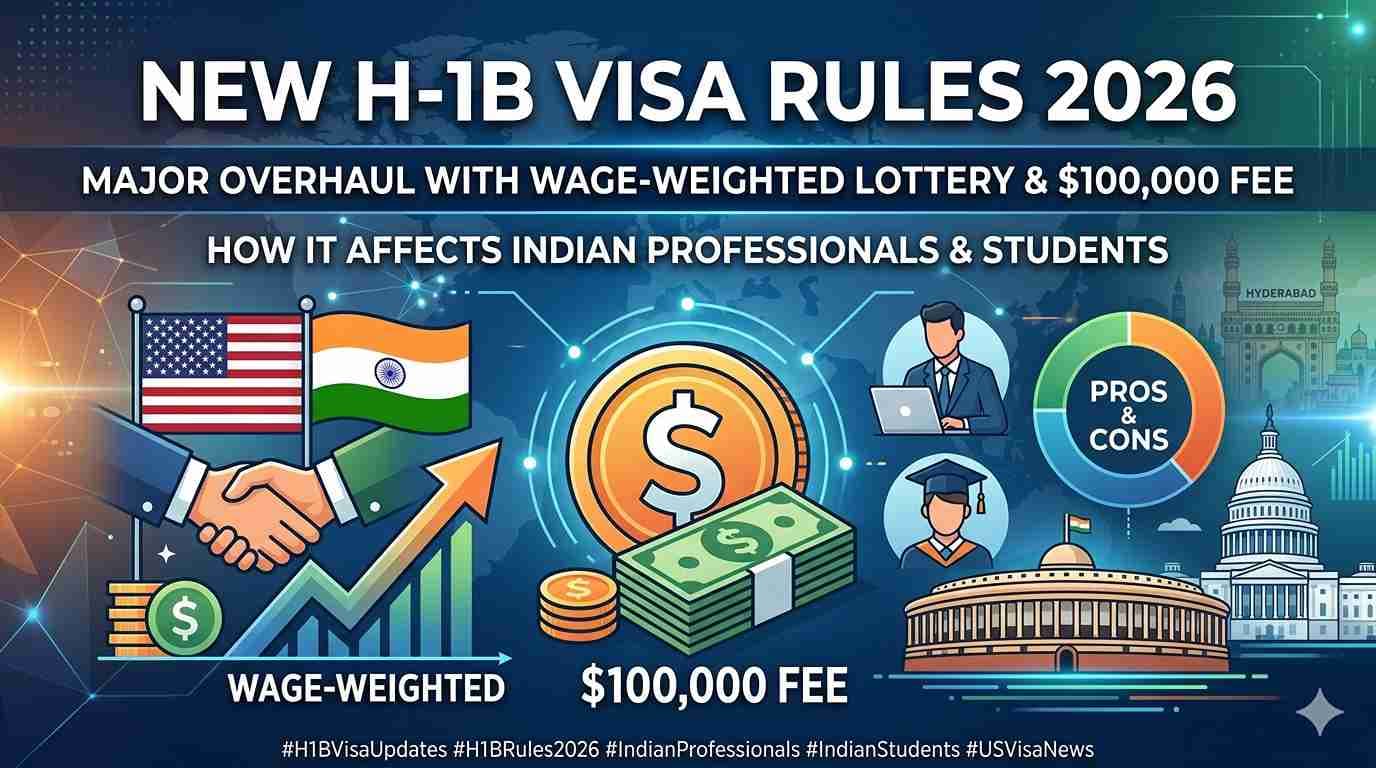
In September 2025, the White House issued a proclamation seeking to impose a $100,000 annual fee on new H-1B petitions. The proclamation faced immediate legal challenge and has been in various stages of implementation and injunction through 2026. As of September 2026, monitor USCIS + White House releases for whether the fee is being collected on current petition rounds. Employer sponsorship behaviour for the FY 2027 cap year has been affected by the uncertainty — some employers have paused new H-1B filings pending resolution.
60-Day Grace Period Elimination (RIN 1615-AD22)
See above. Pending; not yet finalised.
H-4 EAD Renewal Automatic Extension
2025-2026 extended the automatic-extension period for H-4 EAD renewals to 540 days, meaning H-4 spouses whose EAD expires while a timely-filed renewal is pending do not lose work authorisation during the extension window. This is a meaningful practical improvement.
Realistic Cost Breakdown — 2026
| Line item | Cost (USD) |
|---|---|
| H-1B registration fee (per beneficiary) | $215 |
| I-129 base filing fee (post April 2024) | $460 – $780 depending on employer size |
| ACWIA fee (American Competitiveness & Workforce Improvement Act) — employer <25 workers vs 25+ | $750 (small) / $1,500 (large) |
| Fraud prevention + detection fee (new + change of employer) | $500 |
| Asylum program fee (April 2024 addition, employer-dependent) | $300 (small) / $600 (nonprofit) / $600 (large) |
| Public Law 114-113 fee (employers with 50+ employees, >50% on H-1B/L-1) | $4,000 |
| Premium processing (I-907) — 15 business day guarantee | $2,805 |
| Attorney fees (typical range) | $2,000 – $6,000 |
| Visa stamping fees at consulate (MRV) | $205 |
Bottom-line new H-1B cost to employer: roughly $3,000 – $10,000 in government fees + attorney costs, or $6,000 – $13,000 if premium processing is used. Under US labor law, most of these fees legally must be paid by the employer — not the beneficiary.
Common Denial + RFE Patterns
- Specialty occupation not established. Vague job duties, generic titles ("IT Consultant" without specifics), or a role that clearly doesn't require a specific bachelor's specialty. RFE-heavy for consulting/staffing employers.
- Beneficiary's degree does not match the role's specialty. A three-year Indian bachelor's degree may need a supplemental credential evaluation to be recognised as US-bachelor's equivalent.
- Wage level too low. Filing a senior engineering role at Level I to reduce the prevailing wage triggers scrutiny.
- Employer-employee relationship weak. The end-client / staffing firm / vendor chain must clearly show the H-1B employer has direct supervision, control, and the right to terminate.
- Site of employment ambiguity. If the H-1B is petitioned to work at a client site, LCA must cover that site, and material changes to worksite require an amendment.
- Maintenance of status prior to change. If the applicant broke status on a prior visa, USCIS may deny the current change of status and require consular processing.
Green Card Pathway from H-1B — PERM, I-140, I-485
The most common route for an Indian H-1B professional to permanent residence:
- PERM (labor certification). Employer proves through recruitment that no qualified US worker is available. Filed with the US Department of Labor. Timeline: 6-18 months.
- I-140 (immigrant petition). Filed with USCIS after PERM approval. Establishes the applicant's priority date. Timeline: 6-18 months (premium processing available).
- I-485 (adjustment of status). Filed once the priority date is current under the monthly Visa Bulletin. Timeline: 12-24 months.
The Indian EB-2 / EB-3 backlog. Because per-country quotas cap Green Cards at 7% per country regardless of country population, the Indian queue for EB-2 and EB-3 has grown to multi-decade lengths for EB-2 (final-action dates as of mid-2026 are more than 12 years behind the current filing date) and multi-year lengths for EB-3. For most Indian H-1B professionals, "the Green Card" means "eventually" — and the extended H-1B stay (post-6-year AC21 extensions) becomes the mechanism they use to remain lawfully in the US during the wait.
See our US NRI Visa & Immigration Hub 2026 for the Green Card categories, the current backlog picture, and the tactics that shorten the wait (upgrading from EB-3 to EB-2, using an approved I-140 for portability under AC21 §106(a) 3-year extensions, etc.).
Alternatives When H-1B Isn't the Right Fit
| Visa | When it fits | Duration |
|---|---|---|
| O-1A (extraordinary ability, sciences/business/education) | Applicants with significant recognition — published research, awards, high salary, membership in exclusive associations. Growing use among senior engineers in AI/ML. | 3 years initial, 1-year extensions indefinitely |
| L-1A / L-1B (intra-company transferee) | Employees of a foreign company transferring to a US branch or subsidiary. L-1A for managers/executives, L-1B for specialised-knowledge workers. | L-1A: 7 yrs max; L-1B: 5 yrs max |
| F-1 OPT / STEM OPT | Recent graduates from US degree programs. OPT is 12 months post-graduation; STEM OPT extension adds 24 more months for STEM degrees. | Up to 36 months |
| TN (Trade NAFTA / USMCA) | Canadian + Mexican citizens only. Not applicable to Indian nationals directly. | 3 years, renewable |
| E-1 / E-2 (treaty trader/investor) | India does not have an E-visa treaty with the US. Not available to Indian nationals directly. | — |
| EB-1A (extraordinary ability Green Card, self-petitioned) | Highest tier of extraordinary-ability applicants. Can be self-petitioned (no employer sponsor required). | Green Card directly |
| EB-2 NIW (National Interest Waiver) | Applicants whose work is in the US national interest — often researchers, physicians, entrepreneurs. | Green Card directly (no PERM required) |
For Indian applicants specifically, the H-1B remains the workhorse — but the O-1A has grown notably in the AI/ML research + senior-engineering community as a way to skip the lottery entirely. The EB-2 NIW self-petition route has similarly grown for founders and researchers.
H-1B Tax Basics for Indian Holders
H-1B holders are generally US resident aliens for tax purposes once they meet the Substantial Presence Test, meaning worldwide income is subject to US tax. The US-India Double Taxation Avoidance Agreement (DTAA) provides mechanisms to avoid or reduce double taxation for Indian-source income (rental income from India property, dividends from Indian securities, capital gains).
For the tax mechanics — including FBAR/FinCEN 114 reporting for Indian bank accounts, PFIC treatment of Indian mutual funds, and the Foreign Tax Credit vs Foreign Earned Income Exclusion trade-off — see our US NRI Money & Compliance Hub 2026.
Frequently Asked Questions
Can I apply for an H-1B on my own? No. The H-1B is employer-petitioned. You need a US employer willing to sponsor before anything else can happen.
Do I have to be in the US to enter the H-1B lottery? No. You can be anywhere in the world. The lottery is on your beneficiary registration, and if selected, the petition is filed with your consular-processing address for visa stamping later.
How many chances do I get in the H-1B lottery? Each fiscal year is a fresh chance. There is no lifetime limit on registration attempts. Many Indian applicants enter the lottery multiple times before being selected.
What are my chances in the lottery? Depends on that year's registration volume vs the 85,000-slot cap. In recent post-beneficiary-centric years, chances have been ~25-40% per registration cycle. Pre-2024, chances were much lower because of registration inflation.
Can I file multiple H-1B petitions through multiple employers? Under the beneficiary-centric system, only one registration per beneficiary is counted — additional employer registrations for the same beneficiary don't multiply your lottery odds.
What happens if my H-1B petition is denied? Depends on whether you were inside or outside the US. Outside: you stay wherever you are. Inside: you may fall out of status unless a change-of-status option is filed timely; in some cases the employer can appeal (I-290B) or refile.
Can I switch jobs on an H-1B? Yes — via H-1B portability (see the Portability section above). New employer files a transfer I-129; you can begin work at the new employer on receipt (not approval).
What happens after my initial 6 years? With an approved I-140 (Green Card immigrant petition) or a PERM/I-140 pending for 365+ days, you can extend beyond 6 years indefinitely in 1-year or 3-year increments until your Green Card priority date becomes current.
Can my spouse work in the US on an H-4? Only if you (the H-1B holder) have an approved I-140 or have extended past the 6-year limit under AC21 §106(a). Then the H-4 spouse can apply for the H-4 EAD.
Can my H-1B kids study in the US? Yes. H-4 dependent children under 21 can attend K-12 and university on H-4. They cannot work on H-4 (only the H-4 EAD applies to spouses).
What happens if I'm laid off? You have 60 days (or until I-94 expiry, whichever is shorter) to file a new H-1B transfer, change status, or depart. Act early — aim to file within 30-45 days, not at day 59. See the Grace Period 2026 guide for the current rules and the pending elimination proposal.
Is the H-1B a path to a Green Card? The H-1B is dual-intent, meaning holding H-1B does not prevent applying for a Green Card. The most common path: H-1B → PERM (labour certification) → I-140 (immigrant petition) → I-485 (adjustment of status) after priority date becomes current. For Indian nationals, expect a multi-decade wait for EB-2/EB-3.
Can I do business or side-projects on an H-1B? Passive investment (stocks, real estate) is fine. Active work (running a company, freelancing, consulting) generally requires H-1B sponsorship from the entity where you do the work — meaning founding a startup while on H-1B typically requires the startup itself to become your H-1B sponsor, which is legally complex.
How is prevailing wage determined? The employer selects the wage level (I-IV) based on job duties, experience, and supervision responsibilities. The wage floor is derived from the Occupational Employment Statistics for the geographic area. LCA filing at DOL certifies the wage.
Do I need to be in India to get the H-1B visa stamped? No — you can attend the visa interview at any US consulate you're a resident of. However, most Indian applicants prefer the Indian consulates (Mumbai, Chennai, Hyderabad, Kolkata, Delhi) for language + processing familiarity. See US Visa Stamping India 2026 for current Dropbox eligibility + timeline realities.
Companion Reading
- USA Visa Grace Period New Rules 2026 — H-1B, F-1 (companion pillar)
- US NRI Visa & Immigration Hub 2026
- AI Restructuring Meets the 60-Day Clock — H-1B Career Guide
- H-1B Rules & USA Tech Layoffs — Late August 2026
- Financial Planning for One-Income H-4 Families When EAD May Lapse
- US Visa Stamping India 2026 — Dropbox, Backlogs
- Uber Layoffs 3,300 Jobs Sept 2026 — H-1B Playbook
- WSJ Ghost Jobs Report 2026 — NRI Job Seeker Guide
- US NRI Money & Compliance Hub 2026 — Tax + Remittance
- Live US tech job listings — visa-sponsorship-aware
Official Sources
- USCIS H-1B page: uscis.gov/working-in-the-united-states/h-1b-specialty-occupations
- USCIS I-129 form + instructions: uscis.gov/i-129
- USCIS filing fees (April 2024 update): uscis.gov/forms/filing-fees
- Department of Labor iCERT LCA system: icert.doleta.gov
- Visa Bulletin (monthly, for Green Card priority dates): travel.state.gov/content/travel/en/legal/visa-law0/visa-bulletin.html
- Occupational Employment Statistics wage data: bls.gov/oes
This pillar guide is a comprehensive overview of the H-1B visa as of September 3, 2026. Immigration rules change frequently — statutory changes, agency guidance, regulatory rules, and court rulings. This is informational content, not legal or immigration advice. Consult a licensed US immigration attorney for status-specific decisions and case-specific advice.
This pillar page is reviewed and updated monthly. If you spot a rule change we have missed, please email corrections@nriglobe.com. NRI Globe may earn a commission from some links on this page in future iterations; this never affects our recommendations.
Related NRI Globe Coverage
- UAE Golden Visa 2026 for Indians — Complete Guide (Eligibility, Application, Investment)
- UK Skilled Worker Visa for Indians 2026 — Eligibility, Salary, Sponsors (NRI Pillar)
- New US Visa Rules in 2026 for Indians: Complete Guide for Students, H-1B Workers & Green Card Applicants
- Germany EU Blue Card + Opportunity Card for Indians 2026 — Complete Pillar
- Recent H-1B Visa Frauds Involving Indians: Major Cases & What NRIs Must Know in 2026
- H-1B Visa Updates 2026: What Indian Professionals in the USA Need to Know
- H-1B Visa 2026 Complete Guide for Indian Nationals — Lottery, Sponsorship, Cap-Gap, Extension & FAQ
- UK ILR & British Citizenship for Indians 2026 — Complete Guide (Life in UK Test, Eligibility, Timeline)
Fresh from NRI Globe
- YouTuber Nandu's World (Rama Nandana) UK Visa & Job Fraud Case: Full Details + Key Lessons for NRIs (2026)
- Dussehra / Vijayadashami 2026 Events Country-Wise — Global NRI Directory (Ram Lila, Ravana Dahan, Durga Puja Pandals, Ayudha Puja Venues + Booking)
- Diwali 2026 Events Country-Wise — Global NRI Directory (White House, Leicester, London Trafalgar, Toronto, Auckland, Sydney Parramasala, Fiji, Mauritius, Trinidad, South Africa and More)
- Diwali / Deepavali 2026 Country-Wise NRI Celebrations — Complete Global Guide (USA, UK, Canada, Australia, Fiji, Mauritius, Trinidad, South Africa, UAE and 30+ Countries)