
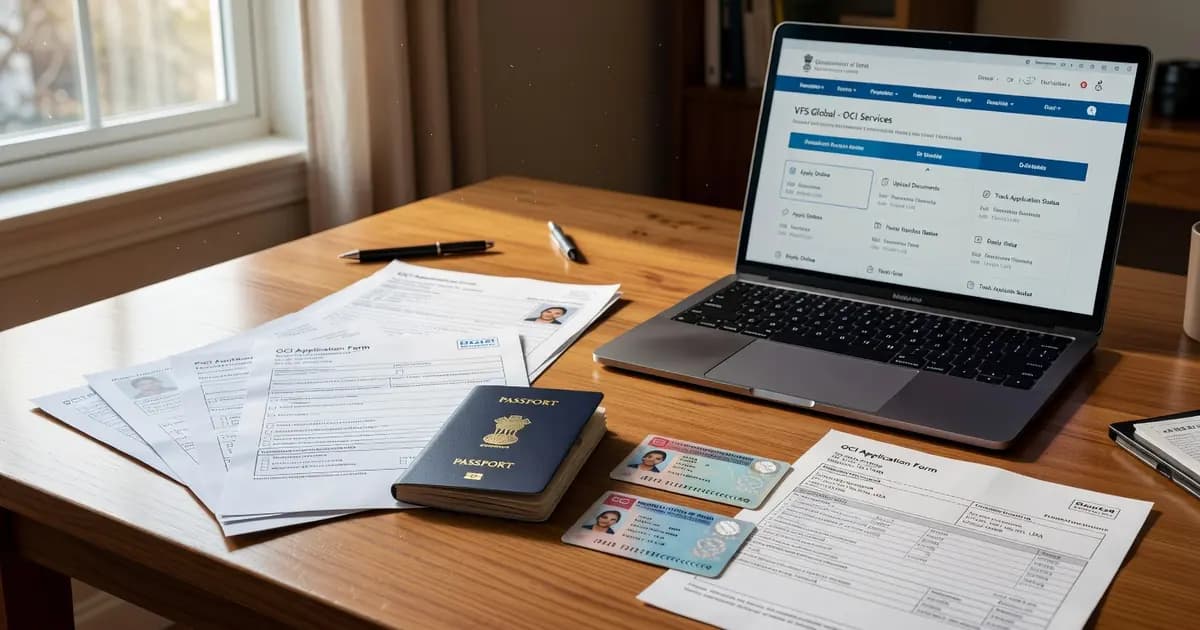
The Overseas Citizen of India (OCI) card is a lifetime visa granted to Indian-origin foreign nationals and their close relatives. It provides visa-free travel to India, indefinite residency rights and most economic + educational privileges of Indian citizens (with specific restrictions). For NRIs who have taken foreign citizenship, OCI is the essential document tying you back to India.
OCI card framework is established by the Ministry of External Affairs (MEA), Government of India, under the Citizenship Act, 1955 (Section 7A/7B). Rules on eligibility, fees and re-issue triggers are set by MEA - always verify current details at ociservices.gov.in and mea.gov.in.
Who is Eligible for OCI?
Per MEA guidelines, the following categories qualify:
- Foreign nationals who were citizens of India on or after 26 January 1950
- Foreign nationals eligible to become Indian citizens on 26 January 1950
- Foreign nationals who belonged to territories that became part of India after 15 August 1947
- Children and grandchildren of the above categories
- Great-grandchildren under specific conditions
- Minor children of the above (both parents or one parent Indian citizens)
- Spouse of Indian citizen or OCI cardholder (marriage duration >2 years typical requirement)
Not Eligible
- Citizens of Pakistan or Bangladesh (specific historical exclusion)
- Anyone who has ever been a citizen of Pakistan or Bangladesh
- Certain other exclusions per MEA discretion
OCI Card Benefits
- Multi-entry, multipurpose lifelong visa to visit India
- No registration required with FRRO/FRO for any length of stay
- Parity with NRIs in economic, financial, educational matters (with specific exceptions)
- Can hold PAN card + open NRE/NRO/FCNR bank accounts
- Can buy non-agricultural residential/commercial property
- Can invest in Indian mutual funds, stocks (via PIS), FDs, government securities
- Can practice as advocate, medical practitioner, chartered accountant (subject to professional council registration)
- Can pursue higher education at Indian universities under NRI/OCI quota
- Can apply for driving license, PAN card, Aadhaar (if physically present)
OCI Card Restrictions (Important)
- No voting rights in Indian elections
- Cannot hold constitutional posts (President, VP, MP/MLA/MLC)
- Cannot hold most Government of India employment (some exceptions for specific technical roles)
- Cannot buy agricultural land, plantations or farmhouses (FEMA + OCI rules)
- Cannot practice mountaineering, missionary or research work in restricted areas without special permit
- Cannot visit certain protected/restricted areas without permit (parts of Jammu & Kashmir, Ladakh, NE states, Andaman)
- Requires Special Permission to undertake certain professional activities
Current OCI Fees (2026)
Fees vary slightly by mission but current typical fees:
- Fresh OCI application: USD 275 (mission fee + service charge)
- OCI in lieu of PIO card (existing PIO holders): USD 25
- OCI misc. services (re-issue, address update): USD 25-50
- Loss/damage replacement: USD 100+
Verify current fees on your consulate/embassy website. Payment typically via bank draft, cashier's check, or online through the OCI Services portal.
Mandatory Re-Issue at Ages 20 and 50
Per current MEA rules, the OCI card must be re-issued at specific age milestones (this is a common source of NRI confusion):
- Re-issue at age 20: If OCI was issued before age 20, mandatory re-issue when passport is reissued after age 20. Applies once
- Re-issue at age 50: If OCI was issued before age 50, mandatory re-issue when passport is reissued after age 50. Applies once
- The re-issue is triggered by passport renewal, not the age itself
- Failure to re-issue can cause immigration issues at Indian ports of entry
When Else to Re-Issue OCI
- Change of passport (any age): update passport details on OCI portal
- Change of address (though address updates are simpler)
- Change of appearance affecting photo verification
- Card damage or loss
OCI Application Process - Step by Step
- Register + create account at ociservices.gov.in
- Fill Part A (Applicant Details) - personal info, passport, contact
- Fill Part B (Family & Address) - family, address, Indian origin proof
- Upload documents:
- Applicant's current passport (bio-data + address page)
- Old Indian passport OR birth certificate showing Indian origin
- Naturalization certificate (if not Indian-born)
- Recent 2x2 inch color photograph (white background)
- Signature scan
- Proof of parents/grandparents Indian citizenship (if applying via ancestry)
- Marriage certificate (spouse OCI applications)
- Renunciation certificate of Indian citizenship (if you renounced later)
- Pay fee online
- Submit to designated Indian mission (embassy/consulate) - physically or via courier as per mission's process
- Biometric appointment (if required by your mission)
- Wait for processing - typically 6-12 weeks (varies by mission and current backlog)
- Receive OCI card at address registered on portal
Common OCI Rejections + Fixes
- Photograph wrong size/background: use 2x2 inch, white background, recent (within 6 months)
- Signature not matching passport: match exactly the signature on your current passport bio-data page
- Missing proof of Indian origin: submit parent/grandparent's Indian passport or Indian birth certificate
- Old passport details mismatch: ensure the details in Part A exactly match your passport
- Address proof: upload utility bill or bank statement no older than 3 months
- Naturalization certificate missing: upload only if you weren't born Indian
MADAD Portal - Consular Grievance Redressal
MADAD (Ministry of External Affairs) is the official grievance redressal portal for NRIs including OCI-related issues:
- URL: madad.gov.in
- Escalate delayed OCI applications after 8 weeks with no update
- Report rejection appeals with fresh documents
- Track application status
- Consular services grievance including passport issues, birth registration, etc.
Practical Tips for NRIs
- Apply for OCI immediately after taking foreign citizenship - waiting adds complications
- Watch passport renewals at ages 20 and 50 - re-issue OCI right after
- Keep digital copies of your OCI card scanned + stored in cloud (Google Drive, iCloud)
- Take a photocopy of your OCI card + carry with your foreign passport when travelling to India
- Notify your Indian bank after each OCI re-issue to update KYC
- Track your passport expiry - avoid last-minute OCI re-issues under travel pressure
- Use MADAD portal if application is stuck >8 weeks
- Note: OCI card is a printed booklet PLUS a "U" visa sticker in your passport - both required
OCI vs PIO Card (Historical Note)
PIO (Person of Indian Origin) cards were merged into OCI in 2015. If you still hold a PIO card, apply for OCI in lieu of PIO at reduced fee (~USD 25). PIO cards are no longer accepted at Indian immigration.
FAQ
Do I need OCI to visit India?
If you hold a foreign passport with Indian origin, you can visit India on a regular tourist visa. OCI provides visa-free lifetime access and other benefits. Not mandatory but highly recommended for Indian-origin foreign nationals.
Can I hold both Indian citizenship and OCI?
No. OCI is only for foreign nationals of Indian origin. You cannot hold Indian citizenship and OCI simultaneously.
Does OCI expire?
OCI is lifetime - no expiry date on the card itself. However, must be re-issued when passport is renewed after age 20 (once) and age 50 (once).
Can OCI holders buy property in India?
Yes - residential and commercial property. Not permitted: agricultural land, plantations, farmhouses.
Do OCI holders need Aadhaar?
Aadhaar is not mandatory for NRI/OCI. However, OCI holders physically resident in India >182 days can enroll for Aadhaar. Not required for most Indian bank/financial services from abroad.
How long does OCI processing take?
Typically 6-12 weeks, varies by mission and current backlog. Escalate via MADAD after 8 weeks with no update.
Can OCI holders work in India?
Yes, in private sector. Not permitted in most government positions. Certain professions require council registration (medical, legal, CA).
Trusted Sources
- ociservices.gov.in - Official OCI portal
- mea.gov.in - Ministry of External Affairs
- madad.gov.in - Grievance redressal
- Your local Indian embassy/consulate website
Related NRI Globe Coverage
- USA Green Card for NRIs 2026
- Tirumala NRI Darshan Booking (OCI documents needed)
- All Visa & Passport Coverage
Disclaimer: Informational only. OCI rules and fees change - verify at ociservices.gov.in and mea.gov.in. Consult your local Indian embassy or an immigration consultant for case-specific advice.
More NRI Globe Coverage For You
- OCI Card 2026: Complete NRI Guide to Application, Renewal, Child Re-issue, Fees and Processing
- OCI Card 2026: Eligibility, Benefits, Application & Renewal Guide for NRIs
- OCI Card Renewal 2026: USA NRI Step-by-Step Process Guide
- OCI Card Application Complete Guide for NRIs 2026: Eligibility, Documents, Fees, Processing Timeline
- OCI Card Renewal + Reissue 2026 — Complete NRI Guide (MHA Rules, CGI Application, Timeline)
- OCI vs NRI Status: Key Differences and Benefits
- OCI Card in 2026: Eligibility, Renewal, Re-issue Rules & Common Mistakes
- OCI Card Updates 2026: Latest Rules, Reissue, PIO Deadline & e-Arrival for NRIs
- FCNR(B) Deposit Complete NRI Guide 2026 - Rates, Tenures, Tax-Free Interest (Section 10(4)), Currency Risk, USD/GBP/EUR Banks Compared
- SVBC Live Streaming Complete Guide 2026 - Watch Tirumala Live from Anywhere (YouTube, App, YuppTV, Telugu/Tamil/Kannada/Hindi Channels for NRIs)
- NRI Darshan Booking Tips for Tirumala (Tirupati) 2026 - Complete Overseas Devotees Guide (Documents, Eligibility, Supatham, ₹300 Special Entry, APNRTS, Online Booking)
- Canada PR Options for Indian Professionals & NRIs 2026 - Complete Guide (Express Entry, CRS, PNP, CEC, FSWP, Study-to-PR, Family Sponsorship)