
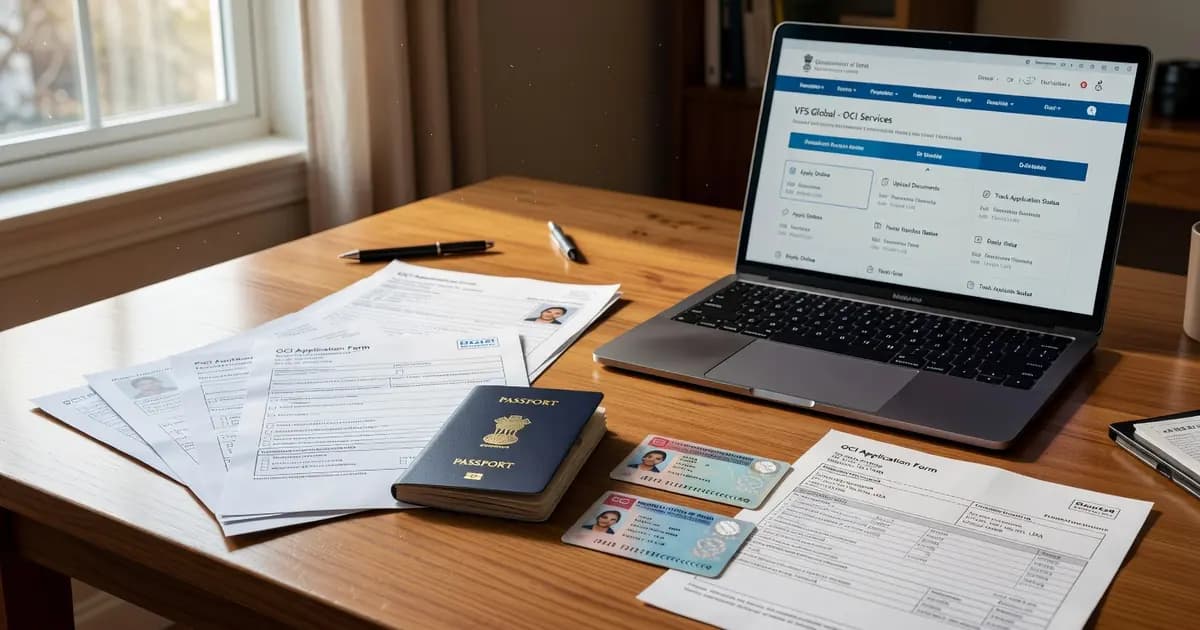
For most NRI households, the OCI card is the practical bridge between country-of-residence citizenship and lifelong India access. The card has matured into a multi-purpose instrument — lifetime visa, financial transaction enabler, education and employment access in India, and the document that lets your children inherit Indian connection without surrendering their country-of-residence citizenship. This 2026 guide walks through eligibility, application workflow, the critical child-renewal triggers most families miss, document checklist, country-by-country fees and processing times, and the common rejection reasons that produce avoidable re-submission delays.
What the OCI card is and is not
- Is: A lifetime travel and stay-in-India entitlement for non-Indian-citizens of Indian origin. Operates as a multi-entry, multi-purpose visa with no stay limit. Allows financial and property transactions in India under NRI rules. Enables admission to Indian educational institutions and certain employment.
- Is NOT: Indian citizenship. OCI holders cannot vote in Indian elections, hold constitutional office, or purchase agricultural / plantation land. Indian passport eligibility is not conferred.
- Functions as: A passport-linked entitlement — the OCI card is recognised when paired with the foreign passport on which the OCI was issued or the current passport with proper re-issue / endorsement.
Eligibility paths
An individual qualifies for OCI status if any of the following applies:
- Was an Indian citizen on or any time after 26 January 1950.
- Was eligible to be an Indian citizen on 26 January 1950.
- Is the child, grandchild or great-grandchild of someone in the above categories.
- Is the spouse of an Indian citizen or OCI holder (registered marriage of 2+ years continuous duration, subject to background verification).
- Is a minor child of OCI parents.
Bangladesh and Pakistan are excluded from eligibility under current rules — applicants who or whose ancestors held Bangladeshi or Pakistani citizenship are not eligible for OCI.
The application workflow
The OCI application is a two-stage process — online filing followed by physical document submission to the local VFS Global centre (which handles OCI processing for the Indian missions in most countries):
- Online application at the official Indian government OCI portal. The form captures personal details, family details, current and prior citizenship history, and reason for OCI application.
- Document upload at the appropriate stages — birth certificates, passports, parent / grandparent India-origin proof, marriage certificate for spouse applications, photographs to spec.
- Fee payment per the country fee schedule.
- Physical document submission at the local VFS centre — original passport, signed printed application, original supporting documents for verification.
- Background verification by the Indian Ministry of Home Affairs — the longest-variance step.
- OCI card and visa endorsement issued; passport returned with U-visa (OCI lifelong visa) sticker.
Document checklist
- Proof of current foreign citizenship: Current foreign passport (original + photocopies).
- Proof of Indian origin: Old Indian passport (if applicant or parent was previously Indian citizen); Indian birth certificate; parent / grandparent Indian passport copies; school certificates from India.
- Proof of relationship for descent-based applications: birth certificates linking applicant to Indian-origin parent / grandparent.
- Marriage certificate for spouse-based OCI applications, with the partner's Indian passport or OCI card copy.
- Photographs per the strict OCI specification (3.5cm × 3.5cm, white background, no smile, ears visible).
- Surrender certificate for applicants who renounced Indian citizenship (required if Indian passport was previously held).
- Address proof in the country of residence.
- Application fee per current schedule.
The child re-issue rules — what most parents miss
This is the single most-missed compliance point in OCI family practice. Under current rules:
- OCI card must be re-issued when the child's passport is renewed up to age 20. So a passport renewal at age 5, again at 10, again at 15, and again at 20 each triggers an OCI re-issue requirement.
- One final re-issue after age 50 when the cardholder's appearance has changed significantly.
- No further re-issue is required between ages 20-50 on routine passport renewals — but the new passport should be linked to the existing OCI card via the "new passport endorsement" process (not a full re-issue).
Families who do not re-issue at each child passport renewal find that the OCI card is technically invalid for travel — even though the card itself does not expire, the unlinked passport creates an entry-control issue at Indian immigration.
Fees and processing times by country
Fee schedules change periodically; check the current schedule on the official Indian government OCI portal before applying. Indicative 2026 fees:
- US: USD 275 for fresh OCI; USD 100 for re-issue; USD 25 for VFS service charge per applicant.
- UK: GBP 200-210 for fresh OCI; GBP 90-100 for re-issue.
- Canada: CAD 360-400 for fresh OCI; CAD 130 for re-issue.
- Australia: AUD 380-410 for fresh OCI; AUD 130 for re-issue.
- UAE: AED 1100-1200 for fresh OCI; AED 400 for re-issue.
Processing times vary substantially by country and current backlog — typically 8-16 weeks from VFS submission. Some posts have run longer during peak periods. Plan applications well ahead of intended travel.
Common rejection reasons
- Photograph specification mismatch. The strictest single requirement; non-conforming photos are the most common cause of return-for-correction.
- Insufficient India-origin proof for descent-based applications. Parent / grandparent Indian passport may be required when birth certificate alone is ambiguous.
- Missing surrender certificate for applicants who previously held Indian citizenship.
- Name spelling inconsistencies across documents — particularly for women whose names have changed via marriage.
- Old passport history gaps — all foreign passports held by the applicant should be disclosed; gaps may trigger background verification delays.
- Marriage-based applications with insufficient marriage-duration documentation (the 2-year continuous-cohabitation requirement is verified).
Special situations
- Minor born to OCI parents: Eligible from birth; apply soon after passport is issued. Use minor-OCI fee schedule.
- OCI for grandchildren of Indian citizens: Eligible; documentation requirement is heavier (grandparent's Indian passport / birth certificate / death certificate as applicable).
- OCI when prior Indian passport was held: Surrender certificate is mandatory; if not previously obtained, applies through the same process before OCI application.
- OCI for adopted children: Special documentation around adoption order and recognition; legal advice recommended.
- OCI for persons whose ancestors emigrated pre-1947: Path exists but is documentation-heavy; consider engaging specialised advisors.
What the OCI card lets you do in India
- Enter India multiple times without visa; stay indefinitely.
- Open NRE / NRO / FCNR accounts; invest in Indian equity, mutual funds, real estate (subject to NRI rules excluding agricultural land).
- Pursue education at Indian institutions under domestic-quota or NRI-quota seats (specific scheme varies).
- Take up most employment in India except where Indian citizenship is required.
- Travel domestically in India without restriction; some restricted-area permits still required for specific border / sensitive zones.
Final thoughts
The OCI card is one of the most practically useful instruments in NRI life. Getting it right the first time and maintaining the re-issue discipline for children produces a lifetime-of-India access for the family. The administrative friction of the initial application is bounded; the long-term benefit of having OCI in place is substantial.
For broader context on NRI status and the upstream banking structure that OCI enables, NRI Globe's NRE / NRO / FCNR decision tree and the NRI tax filing guide cover the financial-side framework that OCI status supports.
Informational only — fees, processing times, document requirements and rules change. Verify current information at the official Indian Government OCI portal and the local VFS centre before applying. For complex cases consult an experienced OCI-application advisor.
Continue reading — NRI Globe pillar guide: H-1B Complete Guide for Indians 2026
Related NRI Globe Coverage
- OCI Card Renewal + Reissue 2026 — Complete NRI Guide (MHA Rules, CGI Application, Timeline)
- OCI Card 2026: Eligibility, Benefits, Application & Renewal Guide for NRIs
- OCI Card in 2026: Eligibility, Renewal, Re-issue Rules & Common Mistakes
- OCI Card Application Complete Guide for NRIs 2026: Eligibility, Documents, Fees, Processing Timeline
- OCI Card Renewal 2026: USA NRI Step-by-Step Process Guide
- India Passport Renewal for NRIs 2026 — Complete Guide (CGI, VFS, Application, Timeline)
- Germany EU Blue Card + Opportunity Card for Indians 2026 — Complete Pillar
- Dubai / UAE Visa Guide 2026 — Types, Fees, NRI Application Complete Guide
Fresh from NRI Globe
- YouTuber Nandu's World (Rama Nandana) UK Visa & Job Fraud Case: Full Details + Key Lessons for NRIs (2026)
- Dussehra / Vijayadashami 2026 Events Country-Wise — Global NRI Directory (Ram Lila, Ravana Dahan, Durga Puja Pandals, Ayudha Puja Venues + Booking)
- Diwali 2026 Events Country-Wise — Global NRI Directory (White House, Leicester, London Trafalgar, Toronto, Auckland, Sydney Parramasala, Fiji, Mauritius, Trinidad, South Africa and More)
- Diwali / Deepavali 2026 Country-Wise NRI Celebrations — Complete Global Guide (USA, UK, Canada, Australia, Fiji, Mauritius, Trinidad, South Africa, UAE and 30+ Countries)