
Last verified: August 30, 2026. Applies to F-1, J-1, and I visa holders effective September 15, 2026.
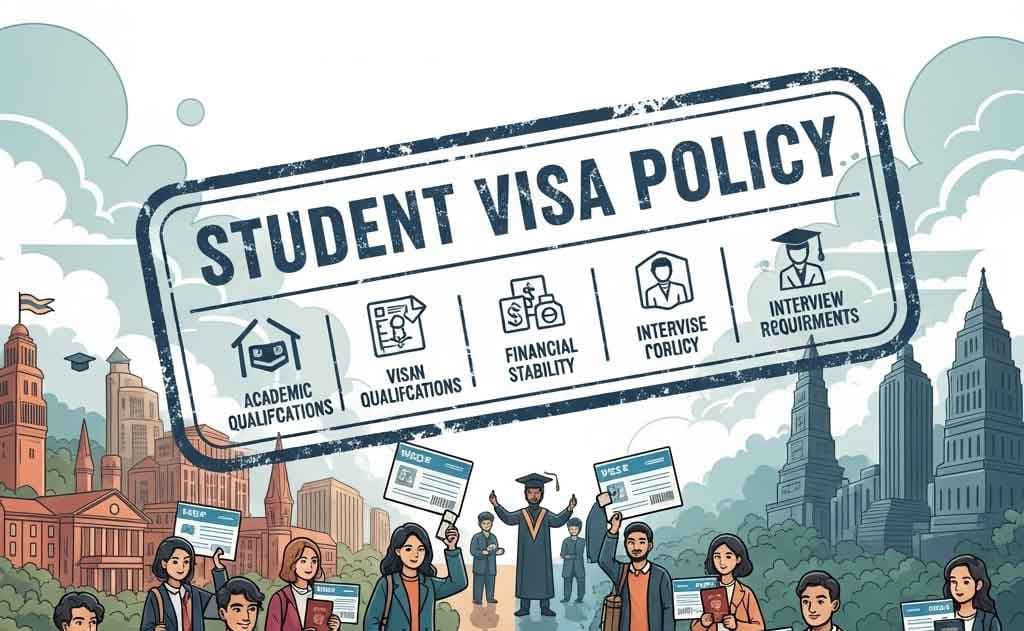
The United States is ending the open-ended "duration of status" (D/S) rule for F-1, J-1, and I visa holders effective September 15, 2026. The change replaces D/S with a formal admission-period cap and imposes new biometrics + social media history requirements. NAFSA has projected the change could reduce international student arrivals in fall 2026 by ~111,000. For Indian students — the single largest international student population in the US — and NRI parents, this is one of the most consequential rule changes in a decade.
What Is Actually Changing
Under duration of status, an F-1 student was admitted "for the length of the program" — a flexible admission period that could span multiple years without a formal extension. Effective September 15, 2026:
- F-1 students are admitted for a defined initial period of up to 4 years, with formal extensions required for programs longer than that.
- J-1 exchange visitors get up to 4 years with formal extension for longer programs.
- I visa holders (media/journalists) get similar treatment with case-specific durations.
- Biometrics at initial admission and at extension.
- Five years of social media history disclosure required.
Who Actually Needs to File Extensions
The 4-year cap is a real problem for:
- PhD programs that routinely take 5-6 years — every PhD student on F-1 must plan an extension before year 4.
- 5-year integrated masters / bachelors programs.
- Undergraduate + accelerated masters combinations that add to 5+ years.
- OPT extensions that push a student past 4 years of F-1 status.
4-year undergraduate + immediate OPT + immediate H-1B typically fits within the cap. PhD students and long-program students most affected.
What Triggers Revocation
- Failure to maintain full-time enrollment (below-full-time load without prior CGS approval).
- Unauthorized employment (working off-campus without CPT/OPT authorization).
- Failure to file extension before initial admission period expires.
- Failure to maintain valid passport (some 6-month rules apply).
- Any inconsistency between DSO reporting and student records.
Revocation is more consequential under the new rules — you cannot rely on the flexible D/S buffer anymore.
Practical Impact by Category
Fall 2026 Incoming Students
- Admission window is now formally 4 years. Plan for it explicitly.
- Have your DSO confirm your I-20 duration matches your actual program length + reasonable buffer for OPT.
- Prepare biometrics data on arrival.
- Compile 5 years of social media handles — DS-160 already required this; new rule extends to SEVIS records.
Current F-1 Students Approaching Year 4
- File your extension application at least 3 months before your admission period expires.
- Coordinate with your DSO on the paperwork — this is a new process for most schools too.
- Keep documented proof of continuous full-time enrollment.
PhD Students Anywhere in Program
- Your total time on F-1 will require at least one formal extension. Plan the paperwork with your DSO now.
- If you have already had an extension, be prepared for more scrutiny on subsequent extensions.
OPT and STEM OPT Implications
OPT authorization is separate from the F-1 admission period, but you cannot start OPT if your F-1 has expired. Similarly, STEM OPT extension requires valid F-1 status underneath. Plan the interaction carefully.
- If your F-1 admission period ends during OPT, you generally do not need a new extension — OPT authorization carries its own validity.
- If your F-1 admission period ends during a program (e.g., PhD), file the extension well in advance.
What Indian Parents Should Tell an Incoming Fall 2026 Student
- You are being admitted for a specific 4-year window. Track it.
- Your DSO is your best resource — build a relationship, not just an intake meeting.
- Do not work off-campus without CPT/OPT authorization. Ever.
- Keep your passport valid with 6+ months forward at all times.
- Maintain your DSO reporting requirements — address changes, program changes, work authorization changes.
- Do not travel outside the US on an expired visa stamp without a clear plan for return.
- Compile your social media handles for the last 5 years and keep them accessible.
FAQ
Q: Does my current F-1 status automatically convert on September 15?
Continuing F-1 students under D/S generally remain under D/S for the balance of their current program per USCIS transition guidance, but any new I-20, program change, or SEVIS renewal after Sept 15 typically triggers the new cap. Confirm with your DSO.
Q: What happens if I don't file an extension in time?
Falling out of status. Similar consequences to any status violation — future visa applications affected, potential unlawful presence issues.
Q: Does this affect H-1B eligibility after graduation?
No, provided you maintain F-1 status through graduation and follow the normal OPT-to-H-1B path.
Q: I'm on OPT already — does this change anything for me?
OPT itself is not affected. STEM OPT extension requires valid F-1 underneath, so if your F-1 admission window expires during STEM OPT, you would need to have addressed that.
Companion Reading
- OPT to H-1B Transition for Indian Students 2026
- Best AI Tools for NRI Students in USA and UK 2026
- US NRI Visa & Immigration Hub 2026
This is a summary of publicly available regulatory information as of August 30, 2026. This is not legal advice. Complex program-specific situations always warrant confirmation with your school's DSO and, where applicable, an immigration attorney.
Continue reading — NRI Globe pillar guide: Study Abroad from India — USA/UK/Canada/Australia/Germany
Related NRI Globe Coverage
- September 15, 2026 — F-1 Duration of Status Ends: Day-One Actions for Indian Students and NRI Parents
- New Immigration Restrictions: Trump’s Impact on Student Visas, OPT, and Indian Families in the US
- B-1/B-2 US Tourist Visa 2026 — Complete Guide for Indian Family Visiting NRIs (Parents, Siblings, Friends)
- H-1B 60-Day Grace Period Rules 2026: Complete NRI Guide — Portability, Status Change, DHS Proposed Elimination
- US NRI Immigration + Visa Weekly Roundup: September 1-7, 2026 (Biometric Fee Countdown, F-1 Duration, H-1B Comment Window)
- OPT to H-1B Transition for Indian Students 2026: STEM Extension, Job Search, and Backup Options
- B1/B2 Visa for Indian Parents Visiting NRI Children 2026: Application, Rejection Reasons, and Strategy Guide
- PIO vs OCI vs NRI Status in 2026: Complete Comparison Guide for Indian-Origin Families
Fresh from NRI Globe
- YouTuber Nandu's World (Rama Nandana) UK Visa & Job Fraud Case: Full Details + Key Lessons for NRIs (2026)
- Dussehra / Vijayadashami 2026 Events Country-Wise — Global NRI Directory (Ram Lila, Ravana Dahan, Durga Puja Pandals, Ayudha Puja Venues + Booking)
- Diwali 2026 Events Country-Wise — Global NRI Directory (White House, Leicester, London Trafalgar, Toronto, Auckland, Sydney Parramasala, Fiji, Mauritius, Trinidad, South Africa and More)
- Diwali / Deepavali 2026 Country-Wise NRI Celebrations — Complete Global Guide (USA, UK, Canada, Australia, Fiji, Mauritius, Trinidad, South Africa, UAE and 30+ Countries)