
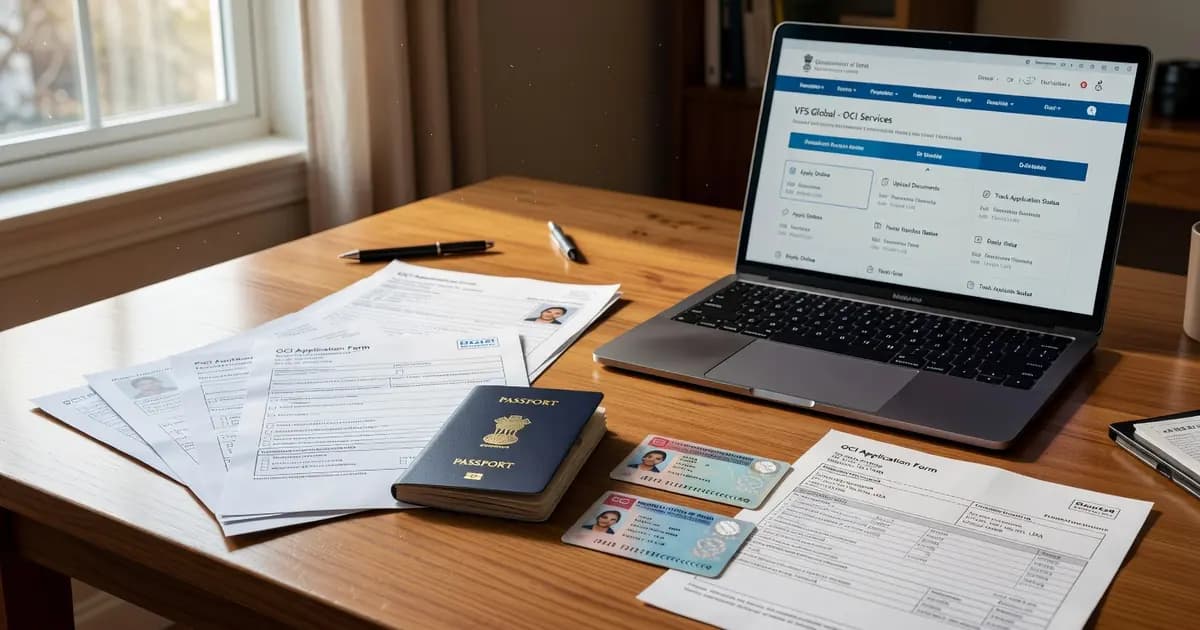
Three terms — PIO, OCI, and NRI — are often used interchangeably but mean meaningfully different things. The 2015 merger of PIO (Persons of Indian Origin) into OCI (Overseas Citizen of India) consolidated two former categories, but legacy PIO cards remained in use until specific transition deadlines. NRI (Non-Resident Indian) is a tax-residence classification, separate from both PIO and OCI which are nationality-and-immigration categories. This guide walks through what each means in 2026, the rights and restrictions of each, the banking and tax implications, and which status applies in which family situation.
The three categories — clean definitions
NRI (Non-Resident Indian)
NRI is fundamentally a tax-residence classification under the Indian Income Tax Act, not an immigration category. A person is classified as NRI for a given financial year based on physical presence in India.
- Classification rule: Individual is Non-Resident if they do NOT meet the Resident tests — i.e., physical presence in India of 182+ days in the financial year, OR 60+ days in the year combined with 365+ days across the preceding four years (with the 60-day rule reduced or modified for specific income brackets per recent budget cycles).
- Citizenship: The NRI classification applies REGARDLESS of citizenship — both Indian citizens living abroad AND foreign citizens of Indian origin (OCI cardholders) can be NRIs for tax purposes if they don't meet Resident tests.
- Validity: Annual — re-determined each financial year based on physical presence.
- Indian passport: NRIs who are Indian citizens hold Indian passports; NRIs who are OCI cardholders hold foreign passports.
OCI (Overseas Citizen of India)
OCI is a permanent multi-purpose visa-like entitlement conferred on foreign citizens of Indian origin who meet specific eligibility criteria. Despite the name, OCI is NOT Indian citizenship.
- Eligibility: Foreign citizens who were Indian citizens on or after 26 January 1950, eligible to be Indian citizens on that date, or the spouse / child / grandchild / great-grandchild of such persons. Bangladeshi and Pakistani citizens excluded.
- Rights: Lifelong multi-entry / multi-purpose India access; financial transactions on NRI rules; education and most employment in India; real estate purchase (residential and commercial — not agricultural).
- Restrictions: No voting rights in Indian elections; no constitutional office eligibility; no agricultural / plantation land purchase; no Indian passport eligibility.
- Issuance: Lifelong OCI card with passport-linked endorsement. Re-issue triggers for children up to age 20 (concurrent with each passport renewal).
PIO (Person of Indian Origin) — legacy category
PIO was a separate category until 2015 when the Government of India merged it into the OCI framework.
- 2015 merger: The PIO Card scheme was discontinued; existing PIO cardholders were given a transition period to convert to OCI.
- Legacy PIO cards: Some PIO cards were extended in validity through specific dates and required conversion to OCI before the deadline.
- Current status (2026): The PIO category does not exist for new applicants. Anyone whose situation would have qualified for PIO status now applies for OCI. Legacy PIO cardholders who did not convert may have status complications.
- Rights and restrictions while PIO was active: Slightly different from current OCI — visa-based, with renewal requirements; OCI is structurally stronger (lifelong, no renewal).
Side-by-side comparison
| Dimension | NRI | OCI | PIO (legacy) |
|---|---|---|---|
| Category type | Tax-residence classification | Multi-purpose lifelong visa-like status | Visa-based status (discontinued 2015) |
| Citizenship held | Could be Indian OR foreign | Foreign citizen of Indian origin | Foreign citizen of Indian origin |
| Indian passport eligibility | If Indian citizen, yes | No | No |
| India entry requirement | Passport (Indian or foreign with visa) | OCI card + foreign passport | PIO card + foreign passport (legacy) |
| Stay limit in India | No limit (NRI status reverts to Resident at 182 days) | No limit — lifelong stay permitted | Specific limits varied by category |
| Banking | NRE / NRO / FCNR accounts | NRE / NRO / FCNR accounts | NRE / NRO / FCNR accounts |
| Indian property purchase | Residential + commercial (not agricultural) | Residential + commercial (not agricultural) | Residential + commercial |
| Voting in India | Indian-citizen NRIs can vote (specific procedures) | No | No |
| Education access in India | Indian-citizen basis or NRI quota | Generally treated as Indian citizen for admission | Specific PIO-quota provisions varied |
Household scenarios
Scenario 1: Family with Indian-citizen parents + US-born children
- Parents: NRI (tax classification) if not resident in India; Indian citizens holding Indian passports.
- Children: US citizens by birth; eligible for OCI as children of Indian-citizen parents who themselves are descent-eligible. Both rights — parents' NRI status + children's OCI status.
- Operational: Parents file Indian taxes as NRI for India-source income; children's OCI confers lifelong India access.
Scenario 2: Parents naturalised to US citizenship, children US-born
- Parents: Foreign (US) citizens; eligible for OCI based on prior Indian citizenship. After OCI obtained, parents are OCI cardholders.
- Parents' tax status: NRI for Indian tax purposes based on physical-presence test (since they don't meet 182-day rule).
- Children: US citizens; eligible for OCI as children of OCI parents.
- Operational: All family members hold OCI; parents file as NRI for India tax; children's OCI confers lifelong India access.
Scenario 3: Indian-citizen mother + foreign-citizen father + dual-citizenship-question child
- Specific eligibility depends on country of birth of child + national laws of father's country + India's framework on Indian citizenship by descent.
- Indian children of one Indian-citizen parent + one foreign-citizen parent are typically eligible for Indian citizenship by descent, subject to registration requirements.
- OCI is typically not the right framework for children with Indian citizenship by descent — they remain Indian citizens until/unless they renounce.
Scenario 4: NRI returning to India permanently
- Tax status transition: NRI to Resident over the return-year + RNOR (Resident but Not Ordinarily Resident) transitional status for 2-3 years.
- OCI status: Independent of tax-residence classification — OCI remains valid even when the cardholder is Resident in India.
- Indian citizenship reapplication: Possible for those who renounced earlier — specific eligibility and waiting periods apply.
Banking implications
- NRE / NRO / FCNR accounts are available to NRIs regardless of citizenship — Indian citizens abroad AND OCI cardholders both qualify.
- Resident savings accounts — when NRI status reverts to Resident (typically on permanent return to India), NRE/NRO conversion to resident accounts required. RNOR transitional status preserves some NRI account benefits.
- OCI without NRI status — OCI cardholders who become Indian-tax-Resident lose some NRI banking benefits.
Tax implications
- NRI tax: Only India-source income subject to Indian tax. Schedule FA + FSI in ITR-2.
- OCI without NRI: If OCI cardholder is also Indian-tax-Resident, global income subject to Indian tax.
- Country-of-residence tax: Independent of Indian status — US citizens are subject to US tax on global income; UK Self Assessment for UK residents; etc.
- DTAA application: Cross-border tax credit framework via India-country DTAA prevents double taxation. NRI Globe's NRI tax filing guide covers the framework in detail.
Common confusion points
- "I have OCI, so I'm an NRI" — Not necessarily. OCI is immigration status; NRI is tax-residence status. The same person can be OCI + NRI, OCI + Resident, or even Indian-citizen + NRI.
- "PIO and OCI are the same" — Now substantially yes for new applicants. PIO category was discontinued; new applications go through OCI. Legacy PIO cards were transitioned.
- "As OCI, I can vote in India" — No. Voting rights are reserved for Indian citizens. OCI cardholders cannot vote.
- "My NRI status is permanent" — No. NRI status is annual. Spend 182+ days in India and the status changes to Resident.
- "OCI = dual citizenship" — No. India does not permit dual citizenship. OCI is a multi-purpose visa-like entitlement, not Indian citizenship.
Final thoughts
Understanding the distinct meanings of PIO (legacy), OCI, and NRI prevents downstream confusion in banking, tax filing, education access, and family planning. The 2015 merger of PIO into OCI simplified things for new applicants; the NRI tax-classification remains an annual independent determination based on physical presence. For most NRI households in 2026, the operational answer is: hold OCI cards (for foreign-citizen members) + maintain NRI status appropriately for tax purposes + plan family transitions deliberately when status changes.
For broader OCI framework, NRI Globe's OCI card complete guide covers the application + re-issue framework. For NRI tax framework, see the tax filing guide. For OCI for newborns specifically, see the newborn OCI guide.
Informational only — Indian citizenship and immigration framework provisions change. For specific status determinations involving complex family situations, consult qualified Indian immigration counsel.
Continue reading — NRI Globe pillar guide: H-1B Complete Guide for Indians 2026
Related NRI Globe Coverage
- US NRI Documents & Travel Hub 2026 — Passport, OCI, e-Arrival, PIO Conversion, Minor Kids
- OCI Card Updates 2026: Latest Rules, Reissue, PIO Deadline & e-Arrival for NRIs
- OCI vs NRI Status: Key Differences and Benefits
- OCI Card Renewal + Reissue 2026 — Complete NRI Guide (MHA Rules, CGI Application, Timeline)
- EB-1 vs EB-2 Green Card Backlogs for India — September 2026 Visa Bulletin Comparison (4-5 Years vs 179 Years)
- H-1B 60-Day Grace Period Rules 2026: Complete NRI Guide — Portability, Status Change, DHS Proposed Elimination
- September 15, 2026 — F-1 Duration of Status Ends: Day-One Actions for Indian Students and NRI Parents
- End of "Duration of Status" — What Fall 2026 Indian F-1 Students and NRI Parents Must Know (Effective Sept 15)
Fresh from NRI Globe
- YouTuber Nandu's World (Rama Nandana) UK Visa & Job Fraud Case: Full Details + Key Lessons for NRIs (2026)
- Dussehra / Vijayadashami 2026 Events Country-Wise — Global NRI Directory (Ram Lila, Ravana Dahan, Durga Puja Pandals, Ayudha Puja Venues + Booking)
- Diwali 2026 Events Country-Wise — Global NRI Directory (White House, Leicester, London Trafalgar, Toronto, Auckland, Sydney Parramasala, Fiji, Mauritius, Trinidad, South Africa and More)
- Diwali / Deepavali 2026 Country-Wise NRI Celebrations — Complete Global Guide (USA, UK, Canada, Australia, Fiji, Mauritius, Trinidad, South Africa, UAE and 30+ Countries)