
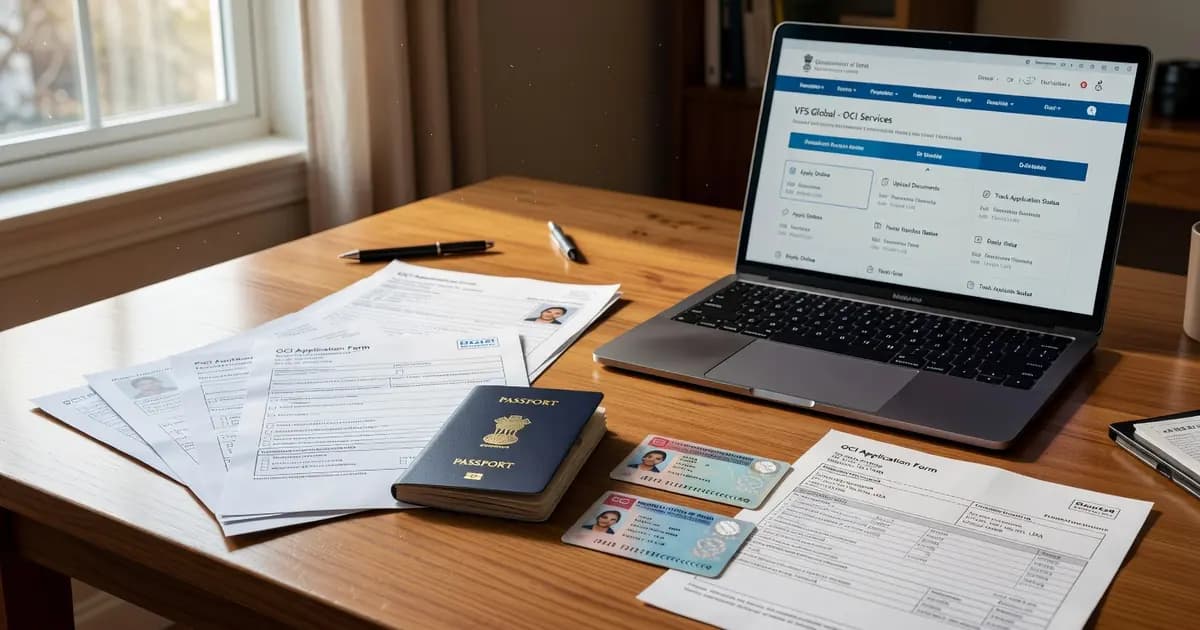
For NRI parents whose newborn child holds country-of-residence citizenship by birth (the US, UK, Canada, Australia all confer citizenship on most children born in their territory), applying for an OCI card for the child is among the most useful early-parenting administrative actions. The OCI confers lifelong India-access rights — multi-entry visa, education access, financial transaction enablement — and the application process is meaningfully smoother for newborns than for older children. This guide walks through the eligibility framework, document checklist, country-specific workflow, fees, and the early-application strategy that produces the smoothest outcomes.
Eligibility for newborn OCI
A newborn child is eligible for OCI status under the standard eligibility framework if any of the following apply:
- Both parents (or one parent) hold OCI cards — the most common newborn pathway. The child is automatically eligible as a minor child of OCI cardholders.
- One or both parents are descent-eligible Indian-origin individuals who themselves meet the OCI eligibility framework — the child inherits descent-based eligibility.
- Specifically: One parent was an Indian citizen on or after 26 January 1950, or eligible to be an Indian citizen on that date — the child's grandparent-based descent qualification is also relevant for second-generation NRIs.
The application classification for newborns is typically "Minor OCI" — a streamlined category with lower fees and simpler documentation than adult or older-minor applications. The eligibility verification chain — establishing that the parents qualify — is what drives the documentation requirements.
The application workflow
- Online application at the official Indian government OCI portal (ociservices.gov.in). The form captures child details, parent details, family eligibility history.
- Document upload at the appropriate stages — child's birth certificate, parents' passports + OCI cards (or descent-eligibility documentation), photographs, signed declarations.
- Fee payment per the country fee schedule (lower than adult OCI).
- Physical document submission at the local VFS centre — original child's passport (required), original supporting documents for verification, signed printed application.
- Background verification by the Indian Ministry of Home Affairs — typically streamlined for newborn applications.
- OCI card issuance and U-visa endorsement on the child's passport.
Document checklist for newborn OCI
- Child's foreign passport — original required. Issue the passport BEFORE starting OCI application; cannot apply for OCI without a passport.
- Child's birth certificate — official certified copy from the issuing authority (US state vital records, UK GRO, etc.). Long-form birth certificate naming both parents preferred.
- Both parents' current passports (or one parent's, depending on application path).
- Parents' OCI cards if the eligibility path is via OCI-parent inheritance.
- Parents' Indian-origin proof if descent-based: Indian birth certificates, old Indian passports, grandparent documentation as applicable.
- Marriage certificate for parents — establishes the family relationship for descent-eligibility chain.
- Photographs per the strict OCI specification — for newborns specifically, the photograph requirements have specific accommodations but still require front-facing clear images on white background.
- Signed declarations / Annexures as required by the application form.
- Address proof for the country of residence.
- Application fee per current minor-OCI schedule.
Country-specific fees and processing
Fee schedules change periodically; check the current schedule on the official Indian government OCI portal before applying. Indicative 2026 fees for minor OCI:
- US: USD 175-225 minor OCI (vs USD 275 for adult), plus VFS service charge.
- UK: GBP 130-160 minor OCI.
- Canada: CAD 200-260 minor OCI.
- Australia: AUD 250-310 minor OCI.
- UAE: AED 700-900 minor OCI.
Processing times vary substantially by country and current backlog — typically 8-16 weeks from VFS submission for newborn applications. Some posts have run longer during peak periods.
Early-application strategy
The strongest single strategic recommendation: apply for newborn OCI within the first 12 months of birth, ideally within the first 6 months. The reasoning:
- Documentation is freshest. Birth certificate is recent, parents' passports are typically current, marriage certificate and supporting documents are organized from prior life events.
- Photographs are easier. Newborn photograph requirements have specific accommodations; getting photographs that meet spec is easier in the first months when the child can be photographed in a controlled environment.
- Travel planning to India. Many NRI families plan first-India-visit-with-baby trips in the 6-18 month window for grandparent introductions. Having OCI in hand before this travel substantially simplifies the trip.
- Avoids passport-renewal coordination complexity. First child's passport renewal (around age 5 for typical 5-year initial validity) triggers OCI re-issue — handling these as separate transactions later requires careful coordination. Doing OCI early avoids the re-issue pressure window.
- Educational planning continuity. Schools and other institutions occasionally request OCI documentation; having it from infancy avoids late-application pressure.
Implications for India-side family visits
With OCI in hand, the newborn travels to India with:
- No visa required for entry — OCI permits multi-entry, multi-purpose access.
- No stay-limit restrictions — OCI cardholders can stay in India indefinitely.
- Healthcare access on standard terms — many Indian private hospitals treat OCI cardholders identically to Indian residents.
- Family registration continuity — many Indian-side family records and traditions accommodate the OCI cardholder as fully part of the family in operational terms.
Long-term implications
The newborn's OCI card carries lifelong India-access entitlement with specific re-issue triggers worth knowing about now:
- Re-issue at every passport renewal up to age 20. The child's first passport (5-year validity) renews around age 5; second renewal around age 10; third around age 15; fourth around age 20. OCI re-issue required at each.
- One final re-issue after age 50 when adult appearance has changed significantly.
- No re-issue between age 20-50 on routine passport renewals — just passport endorsement linking new passport to existing OCI.
- Educational access — OCI cardholders generally treated as Indian citizens for admission to most Indian educational institutions, with specific institution-by-institution rules. NRI Globe's children's education in India guide covers the admissions framework.
- Career flexibility — OCI enables the child to work in India as an adult without separate work-visa procedures. Useful even if not currently planned.
- Financial transactions in India — OCI enables banking accounts, investments, property purchase (residential and commercial) on NRI rules.
What OCI does not confer
- Indian citizenship. OCI is a multi-purpose lifelong visa, not citizenship. The child remains a citizen of the country of birth.
- Voting rights in India. Not conferred by OCI.
- Constitutional office eligibility. Not conferred.
- Agricultural land purchase. Restricted (inheritance permitted; direct purchase not).
- Indian passport eligibility. Not conferred.
Final thoughts
Newborn OCI is one of the highest-leverage early-parenting administrative actions for NRI families. The first-12-months strategy produces the smoothest outcomes — documentation is fresh, photographs are easier, travel planning slots cleanly, and re-issue cascade pressure is avoided. The lifelong India-access entitlement compounds in value across decades of family life across two countries.
For broader OCI framework including the re-issue triggers in detail, see NRI Globe's complete OCI card guide. For the broader NRI immigration framework, see the parent visa pathways guide.
Informational only — OCI eligibility criteria, fees, processing times, and document requirements change. Verify current information at the official Indian Government OCI portal and the local VFS centre before applying. For complex cases, consult an experienced OCI-application advisor.
Continue reading — NRI Globe pillar guide: Canada Express Entry for Indians
Related NRI Globe Coverage
- OCI Card Renewal + Reissue 2026 — Complete NRI Guide (MHA Rules, CGI Application, Timeline)
- B1/B2 Visa for Indian Parents Visiting NRI Children 2026: Application, Rejection Reasons, and Strategy Guide
- OCI Card 2026: Complete NRI Guide to Application, Renewal, Child Re-issue, Fees and Processing
- OCI Card 2026: Eligibility, Benefits, Application & Renewal Guide for NRIs
- OCI Card Application Complete Guide for NRIs 2026: Eligibility, Documents, Fees, Processing Timeline
- PAN Card + Aadhaar for NRIs 2026 — Linking, Application, Complete Guide (Tax + Financial Transactions)
- UAE Golden Visa 2026 for Indians — Complete Guide (Eligibility, Application, Investment)
- India Passport Renewal for NRIs 2026 — Complete Guide (CGI, VFS, Application, Timeline)
Fresh from NRI Globe
- YouTuber Nandu's World (Rama Nandana) UK Visa & Job Fraud Case: Full Details + Key Lessons for NRIs (2026)
- Dussehra / Vijayadashami 2026 Events Country-Wise — Global NRI Directory (Ram Lila, Ravana Dahan, Durga Puja Pandals, Ayudha Puja Venues + Booking)
- Diwali 2026 Events Country-Wise — Global NRI Directory (White House, Leicester, London Trafalgar, Toronto, Auckland, Sydney Parramasala, Fiji, Mauritius, Trinidad, South Africa and More)
- Diwali / Deepavali 2026 Country-Wise NRI Celebrations — Complete Global Guide (USA, UK, Canada, Australia, Fiji, Mauritius, Trinidad, South Africa, UAE and 30+ Countries)