
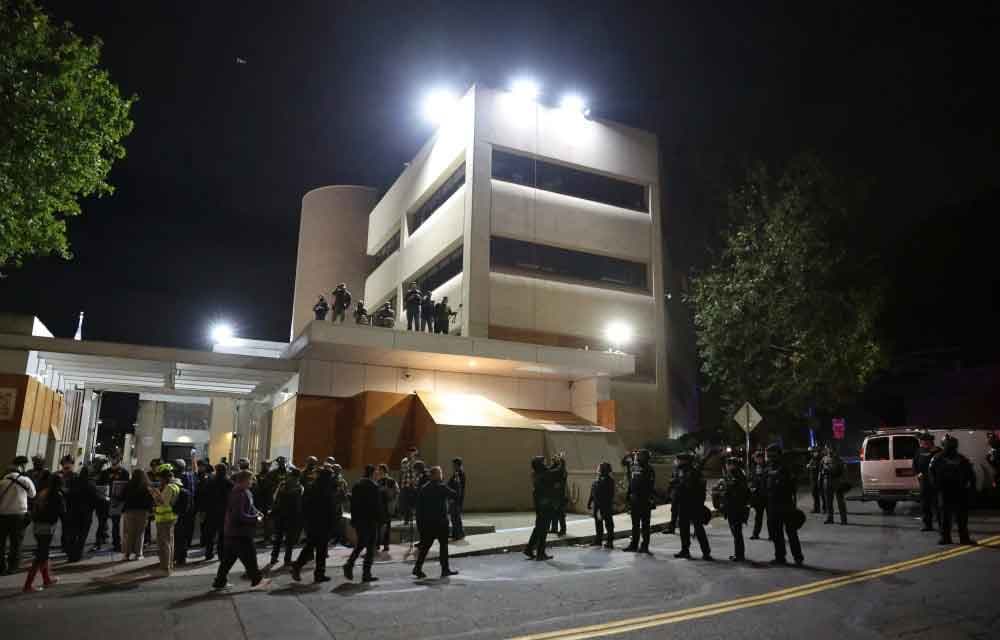
PORTLAND, OR – A federal judge in Oregon, U.S. District Judge Karin J. Immergut, issued a temporary restraining order on Saturday, October 4, 2025, halting the Trump administration's plan to deploy 200 members of the Oregon National Guard to Portland. The decision marks a significant legal challenge to executive authority over domestic military deployment and raises critical questions about federalism, civil rights, and the role of the judiciary in constraining executive power during periods of civil unrest.
Background of the Controversy
Portland has been a focal point for protests in recent years, often centered around issues of social justice, racial equity, and political polarization. The protests, which have occasionally turned violent, prompted Trump to call for the deployment of the Oregon National Guard to restore order. The move was met with swift opposition from Oregon state officials, including Governor Tina Kotek, who argued that the deployment infringed on state rights and risked escalating tensions in the city.
The federal government's attempt to intervene in local law enforcement has been a recurring point of contention. Critics argue that deploying the National Guard could lead to further unrest, citing past incidents where federal forces clashed with protesters. Supporters of the deployment, however, claim that local authorities have failed to manage the situation effectively, necessitating federal action. Legal scholars have pointed to the Posse Comitatus Act of 1878, which restricts the use of federal military forces in domestic law enforcement, as a key constraint on such deployments.
The Court's Ruling
The injunction, issued by U.S. District Judge Karin J. Immergut, temporarily halts the deployment pending further legal review. The judge's ruling emphasized concerns about the legality of federal overreach into state matters and the potential for civil rights violations. The decision also pointed to the need for clearer justification for deploying military forces in a domestic setting, particularly in the absence of a declared state of emergency. Judge Immergut noted that the plaintiffs—including state officials and civil rights organizations—had demonstrated a likelihood of success on the merits of their constitutional claims.
Legal experts suggest that the case could set a significant precedent for the balance of power between federal and state governments under the Tenth Amendment and the constitutional framework governing the National Guard. The judge has scheduled a follow-up hearing to determine whether the injunction will be made permanent or lifted, allowing both sides to present additional arguments. Constitutional law scholars from major universities have indicated that this case may eventually reach the U.S. Supreme Court, given its implications for separation of powers and federalism.
Reactions and Implications
The ruling has drawn varied responses. Oregon officials and protest organizers have largely welcomed the decision, viewing it as a defense of local control and a check on federal authority. Governor Tina Kotek released a statement affirming that "this is a victory for the people of Portland and for the principle that states have the right to manage their own affairs without federal military intervention."
On the other hand, Trump and his supporters have criticized the ruling, arguing that it undermines efforts to maintain law and order. In a statement, Trump called the decision "a dangerous precedent that emboldens chaos and lawlessness." His administration is expected to appeal the ruling, potentially escalating the matter to higher courts. White House officials have indicated that they believe the federal government has clear authority to deploy the National Guard in response to civil unrest that threatens interstate commerce and federal interests.
The case also raises broader questions about the role of the National Guard in domestic conflicts and the potential politicization of military deployments. As protests continue in Portland and other cities, the outcome of this legal battle could shape how future administrations address civil unrest. Legal analysts at the Department of Justice and independent constitutional scholars have noted that the ruling may influence how federal law enforcement and military resources are deployed in response to domestic disturbances.
Impact on NRI and Indian-American Communities
While this case centers on Portland and federal-state relations, it carries significant implications for Indian-Americans and the broader NRI community. Many NRIs and Indian-Americans live and work in Portland and other major U.S. cities where civil unrest has occurred. The precedent set by this ruling—regarding the balance between federal authority and civil liberties—directly affects the legal protections available to all residents, including immigrant communities.
Indian-Americans, who constitute one of the fastest-growing immigrant groups in the United States, have a vested interest in robust civil rights protections and the rule of law. The outcome of this case will influence how federal power can be exercised during periods of domestic unrest, which could affect the safety and legal standing of immigrant communities. Additionally, NRIs working in law, business, and civil society have been active in monitoring federal overreach and advocating for constitutional protections. The ruling reinforces the principle that even executive action must be subject to judicial review—a cornerstone of the legal system that protects all residents, regardless of immigration status.
For Indian-American business owners and professionals in Portland's tech and finance sectors, the stability provided by this judicial check on executive power is relevant to long-term investment and community planning. The case also resonates with NRI advocacy organizations that have historically supported civil liberties and constitutional governance in the United States.
What's Next?
The upcoming hearing will be a critical moment in determining whether the Oregon National Guard can be deployed to Portland. Legal analysts anticipate that the case could reach the U.S. Supreme Court if the dispute remains unresolved. In the meantime, Portland remains a flashpoint for debates over free speech, public safety, and the limits of federal power. The U.S. Citizenship and Immigration Services and other federal agencies continue to monitor the situation as it may affect federal law enforcement coordination in the region.
For now, the judge's ruling has paused Trump's plans, giving state officials and local communities a reprieve. However, the underlying issues driving the protests—and the political divisions surrounding them—are far from resolved. The Trump administration has indicated it will pursue an expedited appeal, potentially requesting an emergency stay of the injunction from the U.S. Court of Appeals for the Ninth Circuit.
Updates on this developing story will be provided as the legal proceedings advance and as the follow-up hearing date approaches.
Related NRI Globe Coverage
- Trump Orders Federal Takeover of D.C. Police, National Guard Deployment Amid Crime Concerns
- Federal Appeals Court Strikes Down Trump’s Tariffs as Illegal Overreach: A Blow to Trade Policy
- D.C. Under Watch: National Guard Deployed Amid Pro–
- US Gas Prices on Track to Top $4 Per Gallon on Labor Day 2026 for the First Time Ever
- India's National Symbols: Emblem, Animal, Bird, Flower, Tree, Fruit and River
- Vande Mataram: National Song, History and How It Differs from the Anthem
- The Indian National Flag: History, Design and the Meaning of Every Element
- How to Dispose of a Damaged National Flag Respectfully
Fresh from NRI Globe
- YouTuber Nandu's World (Rama Nandana) UK Visa & Job Fraud Case: Full Details + Key Lessons for NRIs (2026)
- Dussehra / Vijayadashami 2026 Events Country-Wise — Global NRI Directory (Ram Lila, Ravana Dahan, Durga Puja Pandals, Ayudha Puja Venues + Booking)
- Diwali 2026 Events Country-Wise — Global NRI Directory (White House, Leicester, London Trafalgar, Toronto, Auckland, Sydney Parramasala, Fiji, Mauritius, Trinidad, South Africa and More)
- Diwali / Deepavali 2026 Country-Wise NRI Celebrations — Complete Global Guide (USA, UK, Canada, Australia, Fiji, Mauritius, Trinidad, South Africa, UAE and 30+ Countries)