
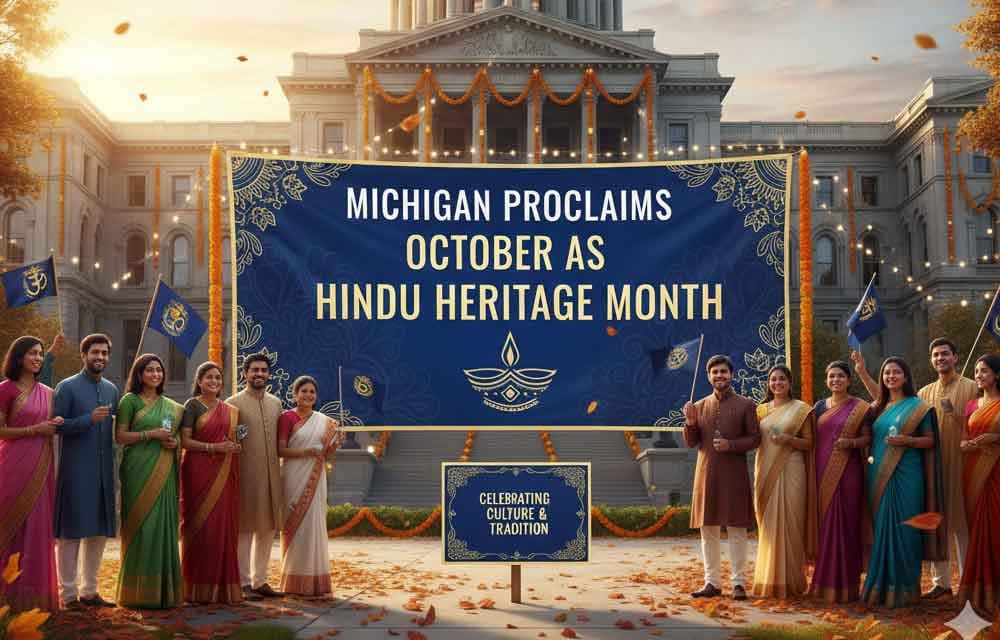
Honoring Culture, Contributions and Community
This October, the State of Michigan proudly declares Hindu Heritage Month, acknowledging the deep cultural, spiritual, and social contributions of Hindu Americans across the state.
Governor Gretchen Whitmer's official proclamation recognizes that Hinduism is the third largest religion in the world, with millions of followers in the United States, including many in Michigan. It highlights that Hindu Americans are among the nation's fastest-growing communities and that their traditions often serve as a source of inspiration, reflection, and contemplation.
During October, the culture, history, traditions, achievements, and contributions of Hindu Americans are recognized and celebrated both nationwide and within Michigan. The proclamation also emphasizes that Michigan embraces the diversity represented in its communities and aims to promote understanding and appreciation of Hindu heritage.
With this step, Michigan joins a growing list of U.S. states that formally recognize Hindu Heritage Month through gubernatorial proclamations.
Why This Matters for NRIs and Indian Americans
For the Indian diaspora and Hindu Americans nationwide, Michigan's proclamation represents a significant milestone in cultural recognition and civic inclusion. The U.S. Census Bureau estimates that over 2 million Hindu Americans reside in the United States, with substantial populations concentrated in states like Michigan, California, Texas, and New Jersey. Michigan's formal acknowledgment of Hindu Heritage Month signals that the state government recognizes and values the contributions of this growing community.
For NRIs and first-generation Indian Americans, such proclamations carry deep symbolic weight. They affirm that Hindu heritage—encompassing philosophy, arts, sciences, and spiritual traditions—is recognized as integral to American pluralism. This recognition extends beyond ceremonial gestures; it creates pathways for Hindu Americans to participate more visibly in civic life, educational institutions, and interfaith dialogues. Second-generation Indian Americans, in particular, benefit from official acknowledgment that their ancestral traditions are respected within their adopted homeland.
The proclamation also addresses a longstanding gap in representation. While other religious and cultural communities have received formal recognition through national months and observances, Hindu Americans have historically received less institutional attention despite their significant demographic presence and contributions to American society. Michigan's action helps correct this imbalance and encourages other states to follow suit.
Visibility and Recognition
Proclamations like Michigan's bring Hindu culture and history into public view. This aids interfaith understanding and counters misconceptions. Official recognition from state government validates the presence and contributions of Hindu Americans in civic and cultural spheres.
Community Pride and Empowerment
Formal acknowledgment from the government helps Hindu Americans feel seen and valued. It reinforces that their heritage is part of the American story and encourages younger generations to take pride in their cultural identity.
Educational Outreach
The month provides a structured occasion to host lectures, school programs, cultural performances, exhibitions, temple tours, film screenings, and panel discussions—inviting broader audiences to learn about Sanatana Dharma, Hindu philosophy, arts, festivals, and contributions in science, technology, and the arts.
Building Alliances and Solidarity
Having a designated month allows collaborations with interfaith groups, civic institutions, libraries, schools, and local governments to foster joint celebrations, dialogues, and acts of service.
Suggested Activities and Events
- Host "Open Temple" Days inviting non-Hindu neighbors to visit and learn about traditions, symbols, and festivals.
- Curate exhibits or art shows on Hindu themes such as rangoli, classical dance, and mythological storytelling.
- Organize panel discussions featuring scholars and community leaders on Hindu philosophy, yoga, meditation, and service.
- Partner with schools and libraries to offer reading lists and educational toolkits on Hindu culture.
- Launch or expand community service projects, demonstrating Hindu values of selfless service.
- Highlight stories of local Hindu American leaders and changemakers in Michigan.
- Encourage local governments and city councils to issue similar proclamations recognizing Hindu Heritage Month.
A Broader Movement
Michigan's proclamation is part of a growing national movement. States such as Mississippi, Texas, and Florida have also declared October as Hindu Heritage Month. The observance aligns with the national Hindu American Awareness and Appreciation Month initiative, which advocates for education, inclusion, and recognition of Hindu contributions to American society.
These proclamations help foster greater understanding, unity, and mutual respect among diverse communities, reaffirming that the values of Sanatana Dharma—truth, peace, compassion, and service—are universal and timeless.
Impact on Hindu American Demographics and Representation
According to data from the U.S. Citizenship and Immigration Services, Indian-origin immigrants represent one of the largest and fastest-growing immigrant populations in the United States. A significant portion of this population practices Hinduism, making Hindu Americans a demographically important and economically influential community. Hindu Americans have established themselves prominently in fields including medicine, engineering, technology, academia, and business—sectors tracked by the Bureau of Labor Statistics.
Michigan, home to one of the largest concentrations of Indian Americans in the Midwest, has witnessed the growth of numerous Hindu temples, cultural organizations, and community centers. The state's proclamation acknowledges this demographic reality and the economic and cultural vitality that the Hindu American community brings to Michigan's cities and towns.
For NRIs considering relocation or long-term settlement in the United States, such state-level recognition signals a welcoming environment for cultural and religious expression. It reduces concerns about assimilation pressure and validates the possibility of maintaining Hindu traditions while fully participating in American civic life.
Interfaith Dialogue and Social Cohesion
Hindu Heritage Month proclamations serve as catalysts for interfaith engagement. By dedicating a month to Hindu culture and contributions, states create formal opportunities for Hindu Americans to educate their neighbors about their traditions, philosophy, and values. This structured dialogue helps combat stereotypes and fosters genuine cross-cultural understanding.
For the Indian diaspora, interfaith initiatives are particularly important. Many NRIs navigate multiple cultural and religious contexts—maintaining connections to Hindu traditions while building lives in secular, pluralistic societies. Official recognition of Hindu Heritage Month validates this dual identity and encourages Hindu Americans to share their heritage with confidence.
The proclamation also strengthens social cohesion by demonstrating that state government recognizes and respects religious and cultural diversity. This inclusive approach benefits all minority communities and reinforces the principle that America's strength lies in its pluralism.
Conclusion
Michigan's recognition of Hindu Heritage Month is more than a symbolic gesture. It's a celebration of a thriving community and a call to deepen understanding across cultures. This proclamation affirms that Hinduism's philosophy, arts, and values are woven into the American experience and that Hindu Americans—including NRIs and their families—are valued members of Michigan's civic fabric.
The proclamation reminds us of the ancient ideal, Vasudhaiva Kutumbakam — "The world is one family." For the Indian diaspora, it signals that their heritage, contributions, and presence are recognized and celebrated in their adopted homeland.
Related NRI Globe Coverage
- Magha Month 2026: A Practical Guide for NRIs and Hindu Diaspora
- France News This Week: April 2026 – Diplomatic Tensions, Rising Fuel Costs, and a Touch of National Heritage
- Supreme Court on Hindu Marriage: Rituals Are Mandatory
- Buddhist Mantra, Hindu Essence: Om Mani Padme Hum
- Middle East’s First Hindu Stone Temple Opens in Abu Dhabi
- Most Powerful Hindu Mantras for NRIs Worldwide
- Magha Pournami 2026: Complete Guide for Hindu Devotees in the USA
- Magha Masam: Sacred Significance and Spiritual Importance in Hindu Culture – A Guide for Global NRIs
Fresh from NRI Globe
- YouTuber Nandu's World (Rama Nandana) UK Visa & Job Fraud Case: Full Details + Key Lessons for NRIs (2026)
- Dussehra / Vijayadashami 2026 Events Country-Wise — Global NRI Directory (Ram Lila, Ravana Dahan, Durga Puja Pandals, Ayudha Puja Venues + Booking)
- Diwali 2026 Events Country-Wise — Global NRI Directory (White House, Leicester, London Trafalgar, Toronto, Auckland, Sydney Parramasala, Fiji, Mauritius, Trinidad, South Africa and More)
- Diwali / Deepavali 2026 Country-Wise NRI Celebrations — Complete Global Guide (USA, UK, Canada, Australia, Fiji, Mauritius, Trinidad, South Africa, UAE and 30+ Countries)