
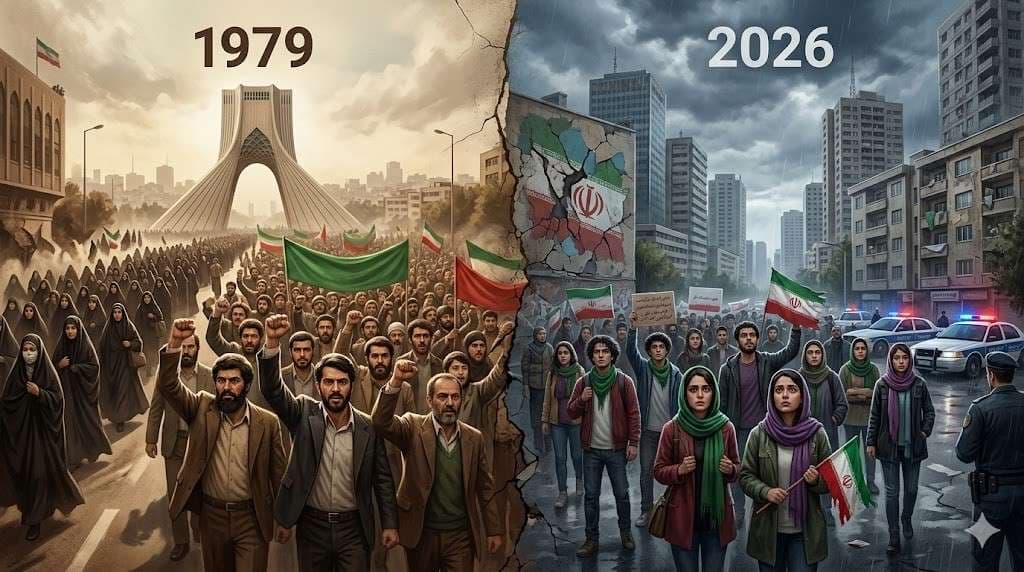
By NRIGlobe Desk | Updated March 2026
Forty-seven years ago, in 1979, Iran underwent one of the most dramatic transformations in modern history. A broad-based popular uprising toppled the 2,500-year-old monarchy of Shah Mohammad Reza Pahlavi and established the Islamic Republic under Ayatollah Ruhollah Khomeini. What began as a coalition of secular leftists, nationalists, students, and religious conservatives against autocracy and Western influence quickly consolidated into a theocratic state. Fast-forward to March 2026: Iran finds itself in the throes of another historic upheaval — nationwide protests sparked by economic collapse, fresh U.S.-Israeli military strikes, and reports of Supreme Leader Ali Khamenei’s death, raising questions about regime survival and a potential new chapter.
This is the complete story of Iran from 1979 to now: a journey of revolutionary zeal, eight years of devastating war, nuclear ambitions, economic sanctions, waves of protests, and today’s existential crisis. For the global Indian diaspora — many with deep historical and economic ties to Iran through trade, energy, and culture — understanding this arc offers critical insights into one of the world’s most geopolitically significant nations.
1979: The Islamic Revolution – Birth of a New Republic
The roots of 1979 lie in the Shah’s White Revolution (1960s–1970s) — rapid modernization, land reforms, and Western alignment that alienated traditional clergy, bazaar merchants, and the poor while fueling inequality and repression via SAVAK secret police.
- 1978: Protests erupt in Qom (January) and spread via “40-day mourning cycles.” Black Friday massacre in Tehran (September) kills dozens.
- January 1979: Shah flees Iran (officially a “vacation”).
- February 1, 1979: Khomeini returns triumphantly from exile in France.
- February 11, 1979: Armed forces declare neutrality; revolution victorious.
- April 1, 1979: Referendum establishes Islamic Republic (98% approval).
- November 1979: Students seize U.S. Embassy in Tehran — 52 Americans held hostage for 444 days.
The new constitution enshrined Velayat-e Faqih (Guardianship of the Islamic Jurist), making the Supreme Leader the ultimate authority. Khomeini sidelined moderate allies, enforcing strict Islamic social codes and anti-Western policies.
1980s–1990s: War, Consolidation, and Reconstruction
- 1980–1988: Iran-Iraq War (Saddam Hussein’s invasion, backed by West and Gulf states). Over one million dead; chemical weapons used against Iran. War ended in stalemate but forged national resilience and IRGC (Revolutionary Guards) power.
- 1989: Khomeini dies. Ali Khamenei (former president) becomes Supreme Leader; Akbar Hashemi Rafsanjani becomes president, focusing on reconstruction.
- 1990s: Pragmatic reforms; Iran rebuilds but faces U.S. sanctions and isolation.
2000s–2010s: Nuclear Ambitions and Sanctions
- 2005–2013: Mahmoud Ahmadinejad’s presidency — populist rhetoric, Holocaust denial, accelerated nuclear program.
- 2013–2021: Hassan Rouhani’s moderate era brings hope.
- July 2015: JCPOA (nuclear deal) signed with P5+1 (U.S., UK, France, China, Russia, Germany). Iran curbs enrichment; sanctions lifted in exchange.
- 2018: President Trump withdraws from JCPOA, reimposes “maximum pressure” sanctions. Iran’s economy contracts sharply.
2020s: Protests, Regional Power, and Cracks in the System
- 2019–2020: Fuel price protests crushed; U.S. kills Qasem Soleimani (IRGC commander); Iran downs Ukrainian airliner by mistake.
- 2022: Death of Mahsa Amini in morality police custody sparks “Woman, Life, Freedom” protests — largest since 1979. Hundreds killed; internet blackouts.
- 2024: Reformist Masoud Pezeshkian elected president amid low turnout, promising moderation — but real power remains with Khamenei and IRGC.
- 2025: Israel-Iran direct conflict (12-day war) damages Iranian nuclear sites (Fordow, Natanz); U.S. joins strikes. Economy collapses further: rial hits record lows (over 1.4 million to $1), inflation soars above 40%, food prices up 70%+.
2026: The Breaking Point – Protests, Leadership Vacuum, and Strikes
By late 2025, economic freefall (currency crash, hyperinflation) ignited protests starting December 28 in Tehran’s Grand Bazaar. What began as merchant strikes over prices spread to all 31 provinces, universities, and traditionally loyal areas. Slogans evolved from economic grievances to “Death to the Dictator” and, in some places, calls for the return of the Pahlavi dynasty.
- January–February 2026: Protests intensify despite brutal crackdown (thousands killed, tens of thousands arrested). Statues toppled, infrastructure attacked.
- Early 2026: Supreme National Security Council announces Khamenei’s death. Official 40-day mourning and strikes declared — but public response includes celebrations, dancing, and defiance in cities like Tehran, Isfahan, and Karaj.
- March 2026: U.S.-Israeli strikes target Iranian leadership and sites amid escalating tensions. Regime faces internal fractures, possible succession crisis (no clear successor), and weakened regional posture after losses to Israel and proxy setbacks.
Iran today is isolated internationally (snapback sanctions reimposed), economically devastated (middle class hollowed out, brain drain, water/energy crises), and socially fractured. Youth (over 60% under 30) reject compulsory hijab and clerical rule. Yet the Islamic Republic’s institutions — IRGC, Basij militia — remain entrenched.
1979 vs 2026: Stark Contrasts
Political System 1979: Revolution promised freedom from monarchy and foreign interference; broad coalition. 2026: Theocratic system under Supreme Leader (now in transition); widespread calls for its end.
Economy 1979: Oil boom under Shah created inequality. 2026: Sanctions + mismanagement = hyperinflation, poverty, currency collapse — worse than many wartime economies.
Society & Rights 1979: Women gained some rights under Shah; revolution rolled many back. 2026: “Woman, Life, Freedom” symbolizes rejection of mandatory hijab and gender apartheid; massive youth disillusionment.
International Standing 1979: Hostage crisis isolated Iran. 2026: Nuclear program advanced but damaged by strikes; regional influence (via proxies) diminished; closer ties with Russia/China but facing new U.S. pressure.
Public Mood 1979: Hope and euphoria for change. 2026: Despair mixed with defiance — protests echo 1979 scale but target the Islamic Republic itself.
The Road Ahead for Iran and the World
As of March 2026, Iran stands at a crossroads. The Islamic Republic that emerged in 1979 has survived wars, sanctions, and protests — but the combination of economic ruin, leadership vacuum, and external strikes has created conditions unlike any since the revolution. Whether this leads to collapse, managed transition, or renewed repression remains uncertain.
For the Indian diaspora and global observers, Iran’s story matters deeply: energy security, regional stability, and the universal quest for dignity and freedom. The unfinished echo of 1979 still reverberates in 2026 — this time, the people’s demands may prove unstoppable.
NRIGlobe.com brings you balanced, in-depth stories on global affairs and diaspora perspectives. Share your thoughts on Iran’s journey in the comments below.
Related NRI Globe Coverage
- Trump Says US 'Essentially Taken Over' Iran (May 2026): Context, Operation Epic Fury & Current Status
- Shadows Over the Gulf: The Fragile 2026 Iran War Ceasefire — May 8 Update for NRIs
- Trump Extends Iran Ceasefire: NRI Safety and Finance Updates
- Iran Blockade 2026: Impact on NRIs & Gas Prices
- US-Iran Talks Collapse: 21-Hour Islamabad Timeline
- Trump’s Iran Ceasefire Claim Faces New Doubts
- Iran War 2026: Why Fuel Prices Still Rising in India
- Why US Chose Pakistan in Iran Conflict Explained
Fresh from NRI Globe
- YouTuber Nandu's World (Rama Nandana) UK Visa & Job Fraud Case: Full Details + Key Lessons for NRIs (2026)
- Dussehra / Vijayadashami 2026 Events Country-Wise — Global NRI Directory (Ram Lila, Ravana Dahan, Durga Puja Pandals, Ayudha Puja Venues + Booking)
- Diwali 2026 Events Country-Wise — Global NRI Directory (White House, Leicester, London Trafalgar, Toronto, Auckland, Sydney Parramasala, Fiji, Mauritius, Trinidad, South Africa and More)
- Diwali / Deepavali 2026 Country-Wise NRI Celebrations — Complete Global Guide (USA, UK, Canada, Australia, Fiji, Mauritius, Trinidad, South Africa, UAE and 30+ Countries)