
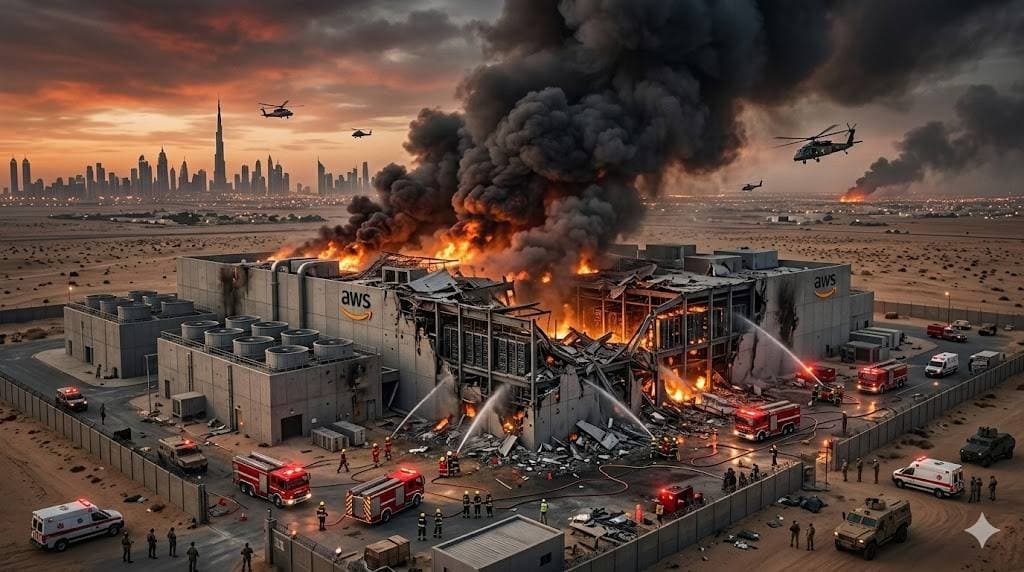
The First Cloud Infrastructure Casualty of War: AWS Data Center in UAE Hit Amid Escalating Iran Conflict
Hyderabad, March 2, 2026 – In a historic first, a major hyperscale cloud provider's data center has suffered physical damage from what appears to be kinetic military action, as Amazon Web Services (AWS) reported an incident at its UAE facility during heightened regional conflict involving Iran, the United States, and Israel.
According to AWS's official status updates on its Health Dashboard, at approximately 4:30 AM PST on March 1, 2026 (around 4:30 PM Dubai time), one Availability Zone (mec1-az2) in the ME-CENTRAL-1 Region (Middle East - UAE) was "impacted by objects that struck the data center, creating sparks and fire." The UAE fire department responded by shutting off power to the facility and its generators to extinguish the blaze. AWS confirmed that restoration efforts would take several hours, but other Availability Zones in the region remained operational, minimizing widespread disruption for customers with properly architected multi-zone redundancy.
The neutral phrasing—"objects struck"—has drawn attention from observers, as it avoids specifying missiles, drones, or debris from interceptions. This linguistic choice reflects the unprecedented nature of the event: no established corporate communications protocol exists for describing wartime physical strikes on civilian cloud infrastructure.
The incident unfolded against the backdrop of intense retaliatory strikes by Iran following reported U.S. and Israeli attacks on Iranian targets, including operations that reportedly resulted in high-level casualties in Tehran. Iranian missile and drone barrages targeted multiple Gulf locations over the weekend, including sites in the UAE such as Dubai International Airport, the iconic Burj Al Arab hotel (where debris sparked a minor fire on the facade), Jebel Ali Port (where interception debris caused a berth fire), and other areas in Dubai and Abu Dhabi. These attacks caused civilian casualties, injuries, and infrastructure damage across the region, with reports of fires, explosions, and debris fallout.
While AWS has not linked the data center strike directly to Iranian actions, the timing and context have led analysts and media outlets to speculate that falling debris from intercepted projectiles—or potentially a direct hit—caused the damage. Some reports, including from sources like Data Center Dynamics and social media discussions, have suggested the facility may support workloads for regional governments, financial institutions, and possibly military-related operations, though no official confirmation exists that it was a deliberate target. Claims in some outlets (e.g., Jerusalem Post coverage) that the site was primarily used by Israel's military remain unverified in primary AWS statements or mainstream reports.
This event shatters long-held assumptions in cloud architecture. Enterprise and government planning typically accounts for natural disasters, power outages, and cyberattacks—but not ballistic threats or drone warfare. AWS's multi-AZ design proved resilient here, as workloads in other zones continued unaffected, but the incident exposes concentration risks in the Middle East regions of major providers (AWS, Azure, Google Cloud, and Oracle all have footprints in the UAE corridor, marketed for its stability and connectivity).
Broader implications are already emerging:
- Geopolitical Risk Reassessment: Cloud regions once chosen for business advantages may now require wartime threat modeling, including proximity to conflict zones.
- Insurance and Pricing Shifts: War-risk exclusions in policies could tighten further, following precedents from the Ukraine conflict, potentially driving up costs for Middle East-hosted services.
- Disaster Recovery Overhaul: Enterprises may accelerate failover to distant regions or hybrid setups, treating regional clusters as vulnerable in active theaters.
Cybersecurity experts have highlighted the "objects struck" euphemism as emblematic of an industry grappling with new realities—where the most critical digital infrastructure intersects with physical warfare.
AWS emphasized that customer impact was limited due to redundancy, and services are progressively restoring. No injuries at the data center were reported, and investigations continue.
As the region stabilizes, this incident marks a turning point: cloud infrastructure is no longer insulated from kinetic conflict. The vocabulary—and pricing—for such events may indeed be "priced in" by markets imminently.
Sources: AWS Health Dashboard updates
Continue reading — NRI Globe pillar guide: UAE Golden Visa Complete Guide
Related NRI Globe Coverage
- Iranian Drones Strike AWS Data Centers in UAE & Bahrain 2026: First-Ever Attack on Cloud Infrastructure Explained
- Why US Chose Pakistan in Iran Conflict Explained
- BREAKING: UAE Rejects Simple Ceasefire with Iran, Demands Full Resolution of Threats – Ambassador Yousef Al Otaiba Signals Support for Reopening Strait of Hormuz
- 90 Lakh Indians in Gulf Face Iran War Risk
- Thousands Dead, Millions Displaced: The Human Toll of the 2026 US-Israel War on Iran as Infrastructure Threats Escalate
- Canada News This Week: April 2026 – Pride in Space, Political Pressure at Home, and Global Ripples from the Iran Conflict
- From Vegas Lights to India’s Data Centers: AWS
- Iran-Israel Conflict: Risks of Nuclear Escalation if Supreme Leader Assassinated
Fresh from NRI Globe
- YouTuber Nandu's World (Rama Nandana) UK Visa & Job Fraud Case: Full Details + Key Lessons for NRIs (2026)
- Dussehra / Vijayadashami 2026 Events Country-Wise — Global NRI Directory (Ram Lila, Ravana Dahan, Durga Puja Pandals, Ayudha Puja Venues + Booking)
- Diwali 2026 Events Country-Wise — Global NRI Directory (White House, Leicester, London Trafalgar, Toronto, Auckland, Sydney Parramasala, Fiji, Mauritius, Trinidad, South Africa and More)
- Diwali / Deepavali 2026 Country-Wise NRI Celebrations — Complete Global Guide (USA, UK, Canada, Australia, Fiji, Mauritius, Trinidad, South Africa, UAE and 30+ Countries)