
By Priya Sharma, Senior Editor – NRI Affairs & Global Indian Economy | NRIGlobe.com
Introduction: Why India Is Among the Hardest Hit Nations
The 2026 Iran War, which began on February 28 when the US and Israel launched airstrikes on Iran, has escalated into a full regional crisis with Iran closing the Strait of Hormuz. This critical chokepoint carries nearly 20% of global oil and a massive share of India’s energy imports.
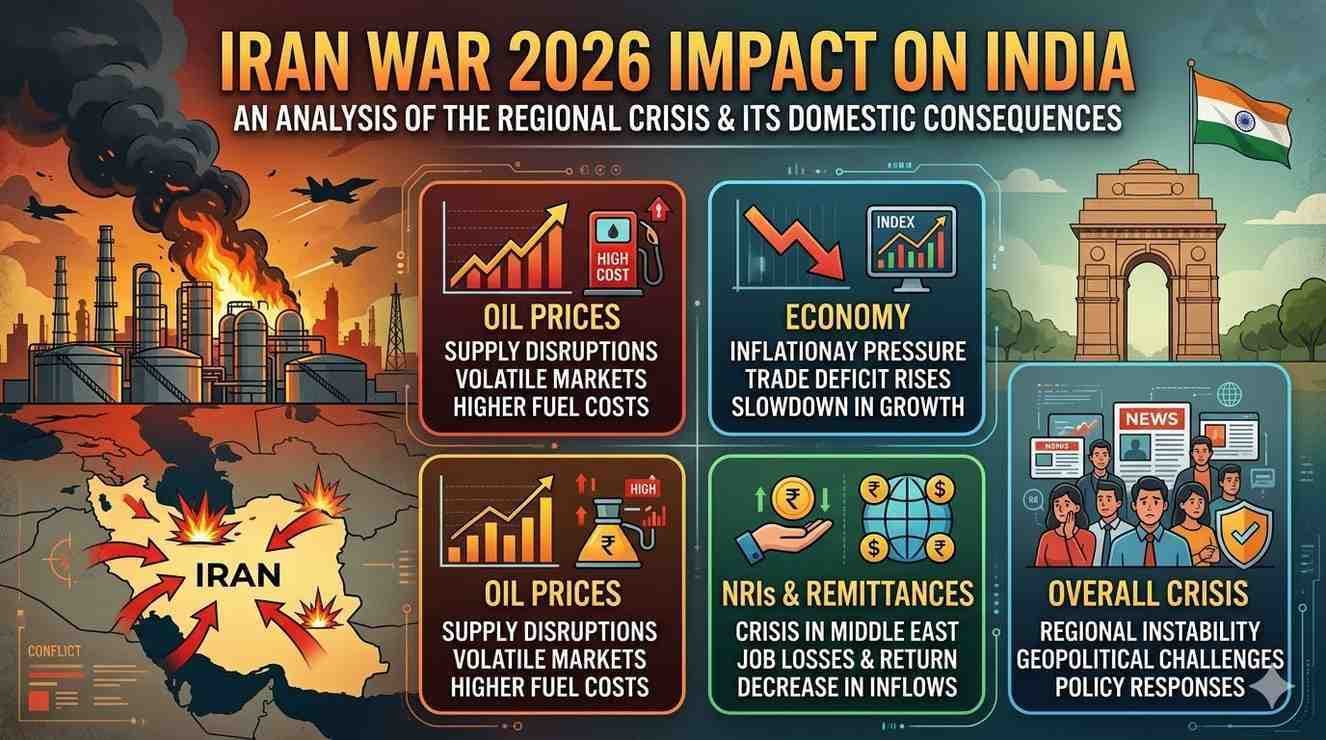
India is not directly involved in combat, yet experts call it “the biggest casualty” of the war. Half of India’s crude oil, 60% of LNG, and over 90% of LPG imports pass through the Strait. The result? Brent crude jumped from $80 to over $120 per barrel in days, cooking gas shortages hit households, the rupee hit record lows, and millions of NRIs in the Gulf face uncertainty.
This article breaks down the country-wide impact on India in clear, data-backed sections – written for NRIs, PIOs, and Indian families tracking how global events affect life back home and abroad.
1. Energy & Oil Crisis: LPG Shortage Hits Every Kitchen
- Strait of Hormuz blockade has disrupted 90% of India’s LPG imports and 55% of crude oil supply.
- Household cooking fuel spending rose 7% in the first two weeks. Industries and hotels are rationing LPG; some states report cylinder shortages.
- India’s strategic petroleum reserves cover only 40-74 days at current consumption. The government has prioritised domestic LPG over industrial use.
Real impact on Indians: Higher petrol, diesel, and cylinder prices are already visible at pumps and in kirana stores. Farmers face rising fertiliser and irrigation costs, threatening food prices.
2. Economic Ripple Effect: Rupee, Inflation & GDP Growth at Risk
- Current Account Deficit widening: Every $10 rise in oil prices adds ~50 basis points to India’s CAD.
- Rupee depreciation: Already at record lows; analysts warn of a “slow bleed” if the war prolongs due to higher import bills and falling remittances.
- Inflation fear: Cooking gas crunch and transport costs are pushing retail inflation higher. Jefferies and Citi have cut India’s 2026 growth forecasts.
Sector-wise impact:
- Agriculture & Food: Fertiliser imports (63% from Middle East) disrupted → higher food prices.
- Exports: Basmati rice shipments stuck at ports; Middle East accounts for 17% of India’s total exports.
- Manufacturing & Diamonds: 47% of diamond imports and key polymers from the region affected.
3. NRI & Remittances Crisis: $50 Billion Lifeline Under Threat
India has ~9-10 million citizens working in GCC countries (UAE, Saudi Arabia, Qatar, Oman, Kuwait, Bahrain). They send home $50 billion annually – a vital support for families in Kerala, Uttar Pradesh, Bihar, Tamil Nadu, and Punjab.
Current risks for NRIs:
- Over 220,000 Indian nationals already repatriated due to job losses and safety concerns.
- Prolonged war could trigger reverse migration (“triple threat”: high energy costs + falling remittances + returning workers).
- Short-term: Some repatriation may temporarily boost rupee inflows, but long-term income opportunities are shrinking.
For NRIs abroad: Airspace restrictions, flight cancellations, and economic slowdown in Gulf economies are real. Many are delaying family visits or investments in India.
4. Government Response & What NRIs Should Know
Prime Minister Narendra Modi has addressed the nation, assuring “sufficient energy supplies” and prioritising citizen safety. He personally spoke to Iranian President Masoud Pezeshkian seeking unhindered passage for Indian ships and energy.
Key measures taken:
- Diversifying oil imports and activating emergency reserves.
- Prioritising LPG for households.
- MEA and Indian embassies in Gulf countries monitoring NRI safety and evacuation plans.
Advice for NRIs & families in India:
- Monitor rupee movement and delay large forex transfers if possible.
- Gulf-based NRIs: Stay in touch with Indian embassies; update emergency contacts.
- Back home: Stock essential fuel and non-perishables; explore solar/LPG alternatives.
- Diversify investments – consider gold or domestic stocks as hedges against oil volatility.
Conclusion: A Wake-Up Call for Energy Security
The 2026 Iran War is not just a Middle East story – it is directly reshaping household budgets, NRI livelihoods, and India’s growth trajectory. While India maintains strategic neutrality, the economic pain is nationwide and immediate.
NRIGlobe will continue tracking developments, including NRI evacuation updates, oil price trends, and government schemes.
What do you think? Share your experience in the comments – are you an NRI in the Gulf feeling the impact? Or a family in India facing higher gas prices?
Sources & Further Reading (for transparency & EEAT): All data drawn from Reuters, Al Jazeera, Bloomberg, The Hindu, Economic Times, and official statements as of March 24, 2026.
Author Bio: Priya Sharma is a 12-year veteran journalist specialising in NRI affairs and global Indian economy. She has reported from Dubai, London, and New Delhi for leading publications and holds a Master’s in International Relations from JNU.
Share this article with your NRI network. Stay informed, stay safe. NRIGlobe – Global Indian News That Matters
Related NRI Globe Coverage
- Iran Blockade 2026: Impact on NRIs & Gas Prices
- Shadows Over the Gulf: The Fragile 2026 Iran War Ceasefire — May 8 Update for NRIs
- Trump Extends Iran Ceasefire: NRI Safety and Finance Updates
- Iran War 2026: Why Fuel Prices Still Rising in India
- Iran War Latest Updates April 2026: US Fighter Jet Shot Down, Trump Warns of More Strikes, Strait of Hormuz Crisis Deepens
- NATO Split on US Iran War 2026: Impact on India
- Iran War 2026: Impact on NRIs in USA
- GCC News March 2026: Iran War Hits NRIs Hard
Fresh from NRI Globe
- YouTuber Nandu's World (Rama Nandana) UK Visa & Job Fraud Case: Full Details + Key Lessons for NRIs (2026)
- Dussehra / Vijayadashami 2026 Events Country-Wise — Global NRI Directory (Ram Lila, Ravana Dahan, Durga Puja Pandals, Ayudha Puja Venues + Booking)
- Diwali 2026 Events Country-Wise — Global NRI Directory (White House, Leicester, London Trafalgar, Toronto, Auckland, Sydney Parramasala, Fiji, Mauritius, Trinidad, South Africa and More)
- Diwali / Deepavali 2026 Country-Wise NRI Celebrations — Complete Global Guide (USA, UK, Canada, Australia, Fiji, Mauritius, Trinidad, South Africa, UAE and 30+ Countries)