
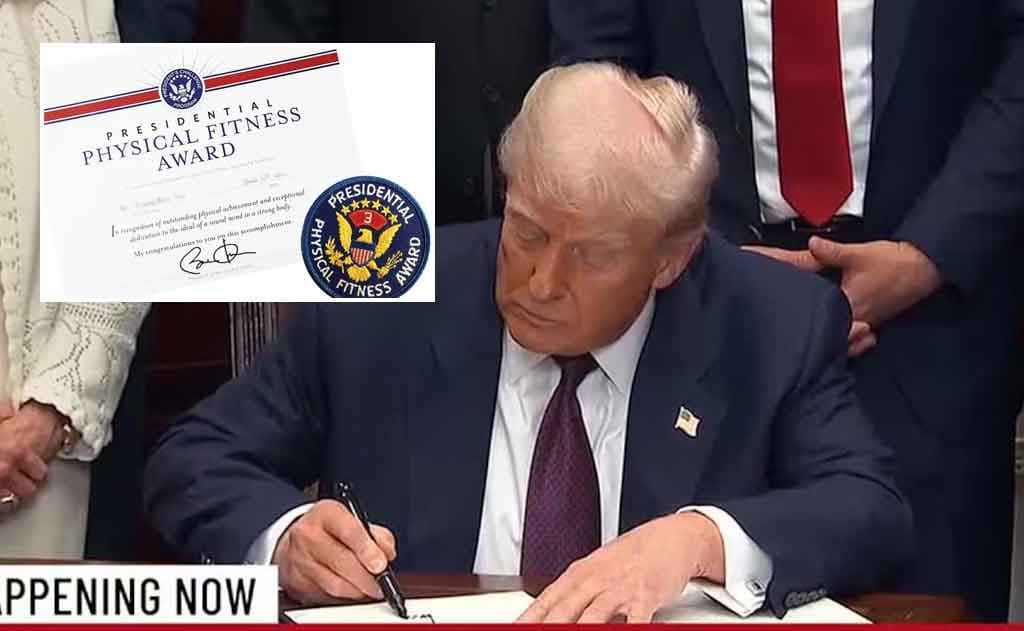
The Presidential Fitness Test is returning to public schools after more than a decade. Reports from mid-2025 indicate that an executive order directed the President's Council on Sports, Fitness, and Nutrition to restore the program, with official announcements referenced on the White House website.
TL;DR
- An executive order reinstates the test that ended in 2013.
- Five classic exercises are expected to return with possible updates.
- Supporters cite obesity trends; critics fear competitive pressure on students.
- Implementation timeline targets the 2026-2027 school year.
Origins of the Presidential Fitness Test
The roots of the Presidential Fitness Test stretch back to the 1950s, when research comparing American and European children raised concerns about youth strength and flexibility. President Eisenhower responded by establishing a youth fitness advisory body in 1956, and the formal test and award structure took shape under subsequent administrations. Historical records from what was then the Department of Health, Education, and Welfare suggest the initial push was partly motivated by military readiness concerns following World War II physical examinations. That historical context matters because it frames the program not simply as a school wellness initiative but as a broader national-interest project — a framing that has resurfaced in recent official statements supporting the revival.
Later iterations under Presidents Kennedy and Johnson added recognition programs — including a Presidential Physical Fitness Award — to honor top performers. Comparative analysis of fitness program goals shows the original version emphasized percentile rankings, while the 2013 replacement prioritized personal progress and habit formation. The reinstated version appears to blend both approaches, according to early official statements. That hybrid design reflects a broader shift in exercise science thinking: population-level benchmarks remain useful for tracking trends, while individual progress metrics tend to produce more sustained behavioral change. For Indian-American families, these policy milestones intersect with immigration patterns that accelerated after 1965. Many parents who arrived via H-1B visas or family sponsorship recall limited physical education access during their own schooling in India, and they now weigh similar trade-offs for children enrolled in U.S. districts with large diaspora populations.
State-level variations add another layer of complexity. California and New York maintained modified fitness assessments after the national program ended, while Texas incorporated elements into its required curriculum. NRI households often relocate across states for employment, exposing students to inconsistent standards. A student who completed one set of fitness benchmarks in a New Jersey district may encounter an entirely different framework after a family moves to a Texas suburb. The revived test could reduce such disparities if federal guidelines standardize reporting requirements across districts, giving mobile families a more predictable framework regardless of where they settle.
Core Exercises Expected in the Revived Test
Five stations formed the backbone of the pre-2013 assessment. Schools will likely see similar items unless the President's Council on Sports, Fitness, and Nutrition publishes formal modifications. The table below compares historical benchmarks for 17-year-olds at the 85th percentile, drawn from the program's archival records.
| Exercise | Boys | Girls | Primary Measure |
|---|---|---|---|
| Sit-ups (60 s) | 55 | 44 | Core endurance |
| Pull-ups | 13 | 1 | Upper-body strength |
| One-mile run | 6:06 | 8:17 | Aerobic capacity |
| V-sit reach | Variable | Variable | Hamstring flexibility |
| Shuttle run | Variable | Variable | Agility |
Alternative options such as push-ups or the flexed-arm hang have historically accommodated different ability levels. The pull-up standard, for instance, has long been debated because upper-body strength develops unevenly across age groups and body types, and the flexed-arm hang offers a more accessible alternative for students still building that capacity. Some fitness professionals have raised questions about whether traditional sit-ups remain the optimal measure of core endurance, with discussions in the broader exercise science community pointing toward isometric alternatives; however, no official consensus has been published by the council at this stage. Any formal changes to the exercise list would be announced through the White House and the President's Council on Sports, Fitness, and Nutrition.
CDC data on adolescent obesity rates, which reached roughly 22 percent for ages 12–19 in recent surveys, provide important context for the program's return. Indian-American youth show lower average BMI than some other demographic groups yet face rising risks tied to sedentary study habits. Families balancing weekend math classes with limited recess time may view the test as an external prompt to schedule daily movement. Districts could adapt the mile run for students with asthma, a condition tracked in higher numbers among urban South Asian populations per CDC asthma surveillance reports. The shuttle run component tests quick directional changes relevant to sports such as badminton and cricket, both popular among diaspora communities.
Flexibility items like the V-sit reach allow participation without specialized equipment. Schools in areas with high NRI enrollment — including parts of New Jersey and California — already stock yoga mats for after-school programs; these could easily double for warm-up routines ahead of testing days. Updated guidance may incorporate body-weight options that align with cultural preferences for low-cost activities over gym memberships, making the program more accessible across income levels. For families who prioritize at-home practice, the largely equipment-free nature of most stations means students can rehearse the movements in limited space, an advantage in apartment-dense urban communities where outdoor access may be restricted.
Reactions and Implementation Questions
Public statements from administration officials highlight competition and national pride as motivating factors. Some kinesiology researchers prefer an emphasis on lifelong activity patterns over norm-referenced scoring, arguing that ranking students against peers can discourage those who start below average. School environment and the framing chosen by individual teachers appear to influence whether students experience the test as encouraging or stressful. Research on youth fitness programs more broadly suggests that how an assessment is introduced — whether as a personal challenge or a competitive ranking — can meaningfully affect student engagement and self-perception, though the specific dynamics of any revived program will depend on implementation choices made at the district level. Physical education teachers will likely receive updated professional development materials to help them present the test in ways that motivate rather than alienate students across different fitness starting points.
Original observation: Indian-American families often balance academic priorities with extracurricular sports; the test's return may prompt additional conversations about physical education time versus homework load in districts with large diaspora populations. Parent-teacher associations in Silicon Valley and suburban Houston have begun informal surveys on equipment needs and staff training requirements ahead of any rollout. Those conversations reflect a wider tension familiar to many immigrant communities: physical activity is broadly valued, but structured school time devoted to fitness can feel like it competes with the academic preparation that many families see as a pathway to college admissions and professional stability.
Teachers note that students whose parents work extended hours in technology or healthcare fields sometimes arrive with lower baseline activity levels. CDC Youth Risk Behavior Survey data indicate that only a minority of high school students currently meet aerobic and muscle-strengthening guidelines on most days — a gap the revived program aims to address. Framing the test around personal improvement rather than class rankings may reduce anxiety reported by first-generation students whose families prioritize GPA metrics for college admissions. Several districts are reportedly exploring opt-in practice sessions during the transition year to help students build familiarity with the exercises before formal scoring begins. Such practice windows could be especially helpful for students who have had limited exposure to structured physical education, whether because of prior schooling in countries with different PE traditions or because of pandemic-era disruptions that reduced in-person activity time.
Comparative examples from other nations offer useful reference points. Singapore's National Physical Fitness Award reports school-level aggregates without naming individual students, a model that some U.S. officials have referenced during early briefings. That approach preserves accountability at the institutional level while reducing the social pressure that can accompany public individual rankings. For NRI parents familiar with India's Fit India Movement, launched in 2019, the domestic revival offers a parallel policy tool that could complement rather than compete with academic goals. The shared emphasis on measurable physical benchmarks may resonate with families accustomed to structured assessment frameworks in both educational systems. Understanding that parallel can help diaspora parents contextualize the revived test not as an unfamiliar American imposition but as part of a broader global recognition that youth physical health benefits from periodic, structured measurement.
Next steps
Parents can contact local school boards for updates on rollout dates and any modifications to the standard exercise list. Districts may offer practice sessions or modified standards during the transition year. Checking official announcements through the White House and CDC websites, both cited as sources for this article, will provide the most current guidance as implementation details are finalized. Families who want to prepare students in advance can review the historical exercise descriptions available through archived program materials and encourage consistent daily movement as a baseline, regardless of how the final standards are structured.
Sources
Related NRI Globe Coverage
- Youth Congress Activists Arrested Following Shirtless Protest at India AI Impact Summit
- American Jewish Committee Defends India Against Trump Administration Criticism
- India's Agni-5 Missile Test Powers Up Strategic Defense
- Trump’s Bold Push to Ban Mail-In Voting Before 2026: A Constitutional Clash Looms
- Texas Senate Approves GOP-Favored Redistricting Map: Implications for NRIs and Indian-American Representation
- UN vs. Israel: What Palestine’s Statehood Push Means for Global Diplomacy
- Trump Administration Ends 988 Suicide & Crisis Lifeline’s LGBTQ+ Youth Service: Impact on Americans and NRIs
- High-Profile Murders: American Idol Executive Robin Kaye and Husband Thomas DeLuca Killed in Encino Home – Suspect Arrested
Fresh from NRI Globe
- YouTuber Nandu's World (Rama Nandana) UK Visa & Job Fraud Case: Full Details + Key Lessons for NRIs (2026)
- Dussehra / Vijayadashami 2026 Events Country-Wise — Global NRI Directory (Ram Lila, Ravana Dahan, Durga Puja Pandals, Ayudha Puja Venues + Booking)
- Diwali 2026 Events Country-Wise — Global NRI Directory (White House, Leicester, London Trafalgar, Toronto, Auckland, Sydney Parramasala, Fiji, Mauritius, Trinidad, South Africa and More)
- Diwali / Deepavali 2026 Country-Wise NRI Celebrations — Complete Global Guide (USA, UK, Canada, Australia, Fiji, Mauritius, Trinidad, South Africa, UAE and 30+ Countries)