
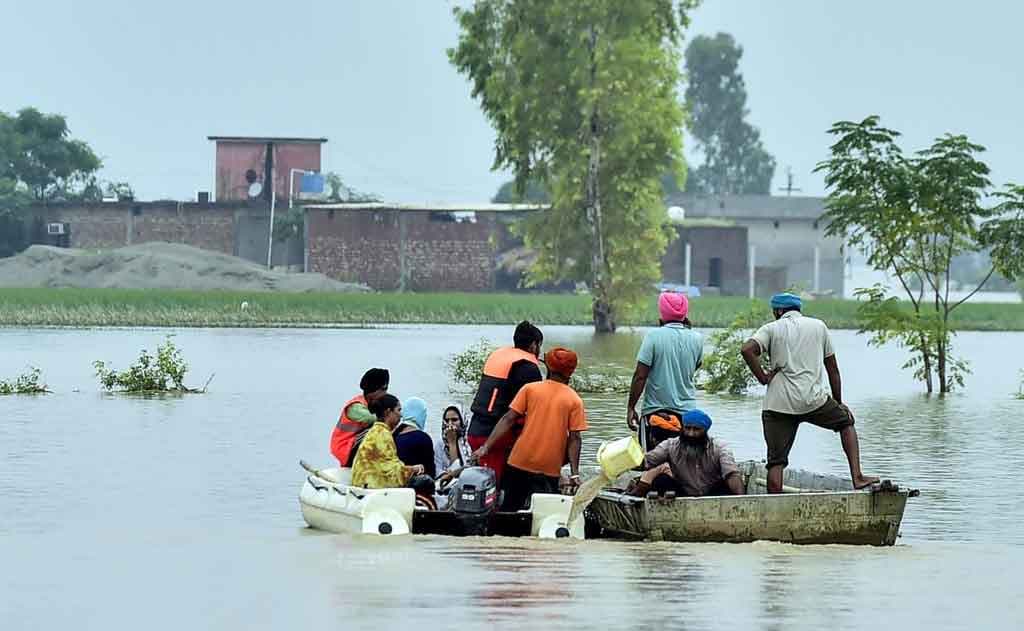
Chandigarh, September 3, 2025 – Punjab, India, is grappling with its most severe flooding in nearly four decades, with over 1,400 villages submerged and at least 30 lives lost due to relentless monsoon rains and the overflow of major rivers, including the Sutlej, Beas, and Ravi. The crisis, exacerbated by heavy rainfall in neighboring Himachal Pradesh and Jammu and Kashmir, as well as controlled water releases from dams, has prompted a massive response from the state government, central authorities, and rescue agencies. Chief Minister Bhagwant Mann has described the situation as the “worst floods in recent history,” warning that conditions may deteriorate further as the monsoon season continues.
Unprecedented Rainfall and River Overflow
Punjab recorded 253.7 mm of rainfall in August 2025, a staggering 74% above the normal of 146.2 mm and the highest in 25 years, according to the India Meteorological Department (IMD). This deluge, combined with heavy rain in the upstream catchment areas of Himachal Pradesh and Jammu and Kashmir, has caused the Sutlej, Beas, and Ravi rivers, along with seasonal rivulets like the Ghaggar, to swell beyond their capacity. The release of water from dams, including Bhakra, Pong, and Ranjit Sagar, has further aggravated flooding in over 10 districts, including Pathankot, Gurdaspur, Fazilka, Kapurthala, Tarn Taran, Ferozepur, Hoshiarpur, Amritsar, Patiala, and Sangrur.
The Ravi River has been particularly destructive, with water levels reaching 14.11 lakh cusecs at Madhopur barrage, flooding areas like Ajnala in Amritsar and submerging 15 villages. The Ghaggar River in Patiala and Sangrur saw water levels surge to 70,000 cusecs at Bhankharpur, though some relief was reported as levels receded later. The IMD has issued a red alert for continued heavy rainfall in Punjab and neighboring states until September 7, raising fears of further inundation.
Devastation and Human Toll
As of September 2, 2025, at least 30 people have died in rain-related incidents across Punjab, with Pathankot reporting six deaths, Hoshiarpur three, and Amritsar, Ludhiana, Mansa, Rupnagar, and Barnala each recording three fatalities. Single deaths were reported in Bathinda, Gurdaspur, Patiala, Mohali, and Sangrur, primarily due to drowning or collapsing structures. Three individuals remain missing in Pathankot following flash floods last week.
Over 1,400 villages have been inundated, with Gurdaspur alone accounting for 323 affected villages, followed by Pathankot (81) and others. The floods have displaced thousands, with 6,582 people shifted to 122 relief camps across the state. Ferozepur hosts the highest number of camp residents (3,450), followed by Hoshiarpur and Pathankot. Crops on approximately 3 lakh acres of farmland have been destroyed, impacting rice, sugarcane, maize, vegetables, and cotton fields, posing a severe threat to Punjab’s agricultural economy, often referred to as India’s breadbasket.
Rescue and Relief Efforts
Rescue operations are underway on a war footing, involving the Indian Army, Air Force, Border Security Force (BSF), National Disaster Response Force (NDRF), State Disaster Response Force (SDRF), and Punjab Police. Over 16,000 people have been rescued, with 4,729 currently housed in 77 relief camps. The state has established 511 relief camps, 351 medical sites, and 321 veterinary facilities to support displaced residents and livestock. More than 15,000 police officers are deployed, and 800 boats and 1,300 rescue personnel are assisting in evacuation efforts, particularly in rural areas near riverbanks.
Chief Minister Mann has personally overseen operations, visiting flood-affected areas like Ferozepur by boat. He has assured residents of comprehensive relief, stating, “Every effort will be made to bail them out in this hour of crisis.” Punjab Governor Gulab Chand Kataria is touring affected districts, including Ferozepur, Tarn Taran, Amritsar, Gurdaspur, Pathankot, Hoshiarpur, and Anandpur Sahib, to assess the situation. Prime Minister Narendra Modi, upon returning from China on September 1, spoke with Mann, pledging full central government support.
Political Controversy and Infrastructure Concerns
The floods have sparked political debate, with Punjab Congress president Amrinder Singh Raja Warring accusing the state government of “criminal negligence” due to mismanagement of dams and water headworks. He criticized the failure to release water gradually from upstream dams like Madhopur, where two floodgates crashed under pressure, exacerbating flooding in Pathankot. “Why was the water not released in advance to minimize devastation?” Warring questioned, calling for accountability.
Punjab Finance Minister Harpal Singh Cheema countered by accusing the central government of ignoring the crisis, noting that Mann had requested the release of ₹60,000 crore in pending state funds to aid rehabilitation. Congress leader Rahul Gandhi, supporting the state’s concerns, emphasized the need for “mission mode” action to address the scale of the devastation.
Infrastructure issues have compounded the crisis. In Sialkot, blocked sewers and poor waste management have worsened flooding, with stagnant water mixing with sewage, raising fears of diseases like cholera and hepatitis. The state has responded by distributing chlorine tablets and potable water purification facilities, as ordered by Chief Minister Mann.
Economic and Agricultural Impact
The flooding threatens Punjab’s agricultural sector, a cornerstone of India’s food security. The destruction of crops on 3 lakh acres, particularly rice and cotton, is expected to drive up local prices and impact exports. Rice prices, initially projected at ₹3,200–3,600 per 40kg, may rise to ₹5,000–5,500 due to flood damage, according to exporters. Cotton losses could further strain Pakistan’s textile industry, which accounts for over half of its exports, especially under new U.S. tariffs.
Farmers like Muhammad Amjad in Chiniot, who lost 13 of his 15 acres of rice and potato fields, face significant financial setbacks. Experts warn that recovery costs could run into billions of rupees, with food insecurity looming if farmers are not supported. “Farmers grow the food that sustains us all. If they are left alone in times of disaster, the whole nation will suffer,” said activist Aamer Hayat Bhandara.
Broader Regional Context
The floods in Punjab are part of a broader wave of extreme weather across South Asia, driven by climate change. In neighboring Pakistan, Punjab province faces its worst flooding in history, with 2 million people affected and 481,000 evacuated due to the simultaneous overflow of the Sutlej, Chenab, and Ravi rivers. India’s release of water from overfull dams, including Bhakra and Thein, has contributed to cross-border flooding, prompting rare diplomatic communication between New Delhi and Islamabad.
The IMD predicts heavy rainfall across northwest India, including Punjab, until September 7, with a low-pressure system likely to intensify the crisis. Schools and higher educational institutions in Punjab will remain closed until September 3, and authorities have urged residents near riverbanks to relocate to relief camps.
Conclusion
Punjab’s worst floods since 1988 have left a trail of destruction, with over 1,400 villages underwater, 30 deaths, and widespread agricultural losses. As rescue and relief efforts intensify, the state faces challenges of infrastructure, disease risks, and economic recovery. With the monsoon season ongoing and more rain forecast, the government’s response, supported by central agencies, will be critical to mitigating further damage. The crisis underscores the growing impact of climate change on South Asia, necessitating long-term strategies to address extreme weather and its devastating consequences.
Related NRI Globe Coverage
- Australian Cricket Great Damien Martyn Battles Meningitis in Induced Coma
- Historic Flash Floods Devastate Milwaukee, Wisconsin State Fair Canceled
- Flash Floods Ravage Alamance County: Rescue Operations Underway
- American Hero Scott Ruskan Saves 165 Lives in Texas Flash Floods: A Coast Guard Story of Bravery
- Catastrophic Texas Floods: Death Toll Rises to 51, 27 Girls Missing from Camp Mystic
- Latest Update on Camp Mystic Floods: Search Continues for Missing Campers in Texas Hill…
- YouTuber Nandu's World (Rama Nandana) UK Visa & Job Fraud Case: Full Details + Key Lessons for NRIs (2026)
- US Crime News 2026 — Top Trend Categories NRIs Are Watching (Organized Retail Theft, Auto Theft, Cybercrime, Hate Crimes, Fentanyl, AI-Enabled Fraud)
Fresh from NRI Globe
- Dussehra / Vijayadashami 2026 Events Country-Wise — Global NRI Directory (Ram Lila, Ravana Dahan, Durga Puja Pandals, Ayudha Puja Venues + Booking)
- Diwali 2026 Events Country-Wise — Global NRI Directory (White House, Leicester, London Trafalgar, Toronto, Auckland, Sydney Parramasala, Fiji, Mauritius, Trinidad, South Africa and More)
- Diwali / Deepavali 2026 Country-Wise NRI Celebrations — Complete Global Guide (USA, UK, Canada, Australia, Fiji, Mauritius, Trinidad, South Africa, UAE and 30+ Countries)
- Dussehra / Vijayadashami 2026 Country-Wise NRI Celebrations — USA, UK, Canada, Australia, New Zealand, UAE, Singapore, Germany, Netherlands and More