
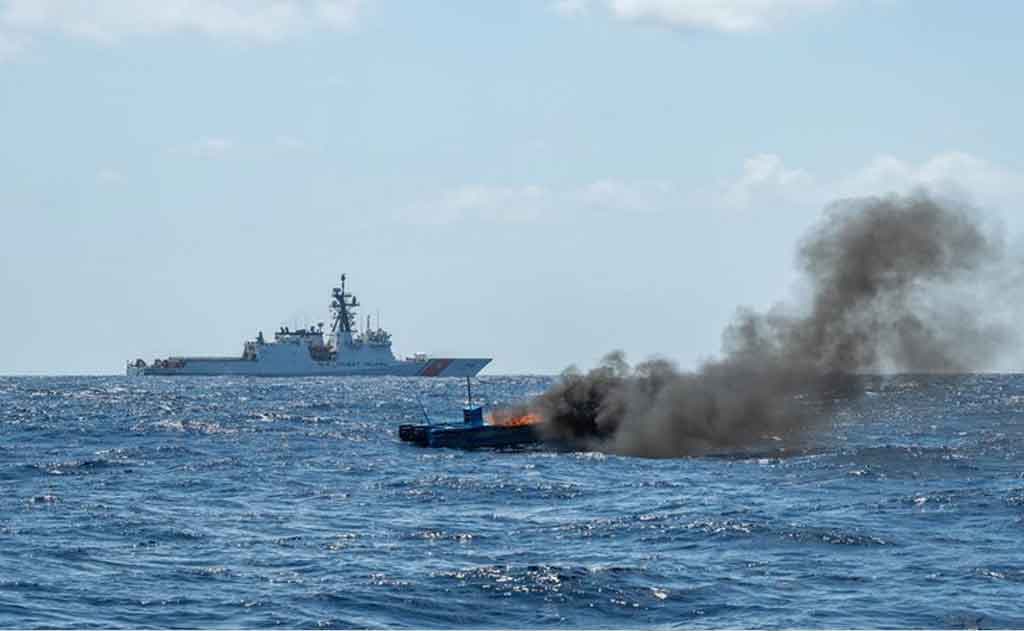
Washington, D.C., September 3, 2025 – President Donald Trump announced on Tuesday that the U.S. military conducted a lethal strike against a suspected drug-carrying vessel originating from Venezuela in the southern Caribbean, killing 11 alleged members of the Tren de Aragua cartel. The operation, described as a "kinetic strike," marks a significant escalation in the Trump administration’s aggressive campaign to combat Latin American drug cartels and curb the flow of illegal narcotics into the United States.
Details of the Strike
The strike occurred on September 2, 2025, in international waters within the U.S. Southern Command (SOUTHCOM) area of responsibility. President Trump, speaking at a press conference in the Oval Office, stated, “We just, over the last few minutes, literally shot out a boat, a drug-carrying boat, a lot of drugs on that boat.” He later elaborated on his Truth Social platform, sharing a black-and-white video that appeared to show drone footage of a speedboat exploding and catching fire. “The strike resulted in 11 terrorists killed in action. No U.S. forces were harmed in this strike,” Trump wrote, identifying the vessel’s crew as members of Tren de Aragua, a Venezuelan gang designated as a Foreign Terrorist Organization by the U.S. in February 2025.
Secretary of State Marco Rubio confirmed the operation, describing it as a “lethal strike” against a vessel operated by a “designated narco-terrorist organization.” Rubio, speaking to reporters before departing for a diplomatic trip to Mexico and Ecuador, suggested the drugs were likely destined for Trinidad and Tobago or another Caribbean nation, though Trump maintained the narcotics were headed to the United States. Rubio emphasized the administration’s commitment to combating drug trafficking, stating, “The president is going to be on offense against drug cartels and drug trafficking in the United States. It destabilizes not just the country but the entire Caribbean basin.”
Context and Escalation
The operation follows a significant U.S. military buildup in the Caribbean, with the deployment of at least eight warships, including three Arleigh Burke-class destroyers (USS Gravely, USS Jason Dunham, and USS Sampson), three amphibious assault ships (San Antonio, Iwo Jima, and Fort Lauderdale), a nuclear-powered fast-attack submarine, and surveillance aircraft. Over 4,500 sailors and Marines, including a 2,200-strong rapid-response expeditionary unit, are stationed in the region as part of a broader counter-narcotics mission. This deployment, initiated in August 2025, is aimed at disrupting drug cartels, particularly those allegedly linked to Venezuelan President Nicolás Maduro.
The Trump administration has accused Maduro of leading the Cartel of the Suns, a Venezuela-based drug trafficking organization, and of supporting Tren de Aragua, which it claims is responsible for mass murder, drug trafficking, sex trafficking, and acts of violence across the Western Hemisphere. In July 2025, Trump signed a secret directive authorizing military force against Latin American cartels designated as terrorist organizations. The U.S. has also increased its bounty for Maduro’s arrest to $50 million, up from $15 million during Trump’s first term, citing his alleged ties to narcotics trafficking.
Venezuelan Response
Venezuelan officials have strongly rejected these accusations, with Maduro calling the U.S. military buildup an “extravagant, unjustifiable, immoral, and absolutely criminal and bloody threat.” On September 1, Maduro announced the deployment of 15,000 Venezuelan troops to the border with Colombia and urged 4.5 million civilian militia members to prepare for potential U.S. aggression. Venezuelan Communications Minister Freddy Nanez questioned the authenticity of the strike video, suggesting it may have been created with artificial intelligence, though initial checks by Reuters found no evidence of manipulation.
Maduro has accused the Trump administration of using drug trafficking allegations as a pretext for regime change. Venezuelan authorities claim Tren de Aragua was dismantled in a 2023 prison raid and is no longer active in the country. A declassified U.S. National Intelligence Council report from May 2025 supports this claim, stating that Maduro’s government “probably does not have a policy of cooperating with” Tren de Aragua and is “not directing” its operations in the U.S., though it acknowledges Venezuela provides a “permissive environment” for the gang’s activities.
Regional and International Reactions
The strike has raised concerns about escalating tensions in the Caribbean, with fears of a potential military clash between U.S. and Venezuelan forces. Countries in the region have urged caution, with some warning against U.S. intervention in Venezuela. China condemned the U.S. military buildup as “foreign interference in regional affairs,” while Paraguayan President Santiago Peña Palacios expressed support for Trump’s anti-cartel policies, designating the Cartel of the Suns a terrorist organization.
Former DEA Acting Administrator Derek Maltz praised the strike as a rare and overdue use of military force against drug traffickers, noting, “I don’t know off the top of my head of any military strikes on boats that are loaded with drugs; I don’t remember that in my time in the DEA.” However, the decision to destroy the vessel rather than seize it and apprehend its crew marks a departure from traditional U.S. interdiction practices, which typically involve Coast Guard and law enforcement operations under bilateral agreements with regional partners.
Implications
The strike underscores the Trump administration’s shift toward militarized counter-narcotics operations, raising questions about the legal authority for such actions and their potential to destabilize the region. Critics argue that targeting vessels in international waters without congressional approval or a UN mandate could violate international law and risk unintended escalations. The operation also highlights ongoing U.S.-Venezuela tensions, with Maduro’s government framing the U.S. actions as an attempt to overthrow his regime.
As the U.S. continues its naval presence in the Caribbean, the international community watches closely, wary of the broader implications for regional stability and U.S. foreign policy in Latin America. Trump’s warning on Truth Social—“Please let this serve as notice to anybody even thinking about bringing drugs into the United States of America. BEWARE!”—signals that more such operations may follow.
Sources: Reuters, CNN, The New York Times, AP News, USA Today, The Guardian, Fox News, India Today, Bloomberg, NPR, Al Jazeera, The Miami Herald, USNI News, The Conversation, Yahoo News, KATV, Newsweek, The Washington Post