
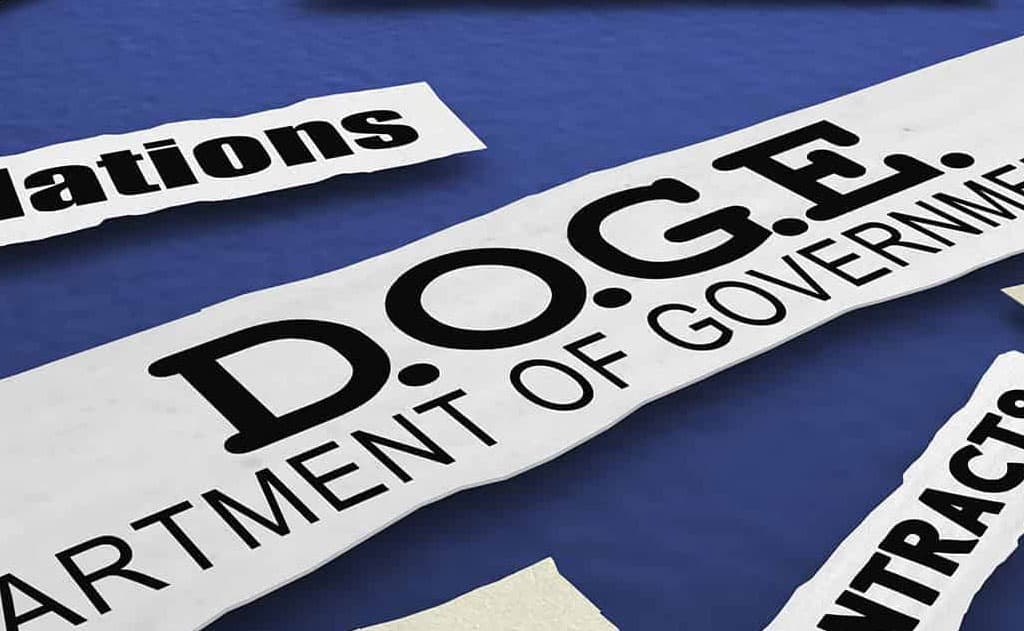
July 18, 2025 – In a razor-thin 214-212 vote, the U.S. House of Representatives passed President Donald Trump’s $9.4 billion Department of Government Efficiency (DOGE) spending cuts package on June 13, 2025, advancing a key component of his second-term agenda. The bill, which claws back funding for foreign aid, public broadcasting, and other programs, now awaits the president’s signature. This legislative move, driven by the Trump administration and influenced by DOGE recommendations, has sparked heated debate and carries significant implications for Non-Resident Indians (NRIs) and Americans alike. Here’s a detailed look at the bill, its contents, and its potential impact.
What’s in the $9.4 Billion DOGE Cuts Package?
The rescissions package, formally known as HR4, targets $9.4 billion in previously approved federal funding, with the following key cuts:
- Foreign Aid Reductions ($8.3 billion): The bill slashes $4.15 billion from programs aimed at boosting economies and democratic institutions in developing countries, alongside $496 million from humanitarian assistance programs providing food, water, and healthcare in disaster- and conflict-affected regions. Notably, an initial proposal to cut $400 million from PEPFAR (President’s Emergency Plan for AIDS Relief), a bipartisan program credited with saving 26 million lives, was removed after pushback from Senate Republicans.
- Public Broadcasting Cuts ($1.1 billion): Funding for the Corporation for Public Broadcasting (CPB), which supports NPR and PBS, is eliminated, prompting concerns about access to local programming and emergency alert systems, particularly in rural areas like Alaska.
- DOGE’s Role: The cuts align with recommendations from the Department of Government Efficiency, led by Elon Musk and Vivek Ramaswamy, aimed at reducing federal spending and prioritizing “American taxpayers first.” The White House and House Speaker Mike Johnson have framed these cuts as a step toward “fiscal discipline.”
The bill passed the House with four Republicans—Mark Amodei (NV), Brian Fitzpatrick (PA), Nicole Malliotakis (NY), and Mike Turner (OH)—joining all 208 Democrats in opposition. It now heads to President Trump’s desk, with a Senate vote pending before the July 18 deadline, after which the funds would be released if Congress fails to act. Senate Republicans plan to pass it via a filibuster-proof process, though some, like Sens. Susan Collins (ME) and Lisa Murkowski (AK), have voiced concerns over specific cuts.
Impact on Non-Resident Indians (NRIs)
The DOGE cuts package could affect NRIs in several ways, particularly those with ties to India or other developing nations:
- Reduced Foreign Aid to India: The $8.3 billion cut to foreign aid includes programs supporting economic and democratic development in countries like India. While India is less reliant on U.S. aid compared to decades past, programs like USAID support initiatives in healthcare, education, and women’s empowerment. NRIs with family or investments in India may notice reduced U.S.-funded support for community development projects, potentially impacting rural and underserved areas. For instance, cuts to humanitarian assistance could affect disaster relief efforts, which India has benefited from during events like cyclones or floods.
- Immigration and Remittance Concerns: The bill is part of a broader Republican agenda that includes increased immigration enforcement, as seen in the “One Big Beautiful Bill Act,” which allocates $175 billion for border security and deportation operations. NRIs on visas or with family members seeking U.S. entry may face stricter immigration policies, complicating family reunification or professional mobility. Additionally, any economic ripple effects from reduced federal spending could influence remittance flows, as NRIs sent $100 billion to India in 2024, according to World Bank estimates.
- Cultural and Media Impact: The defunding of NPR and PBS may resonate with NRIs who value public broadcasting for its coverage of global issues, including U.S.-India relations. These outlets often provide nuanced reporting on diaspora communities, which could be diminished, leaving NRIs with fewer reliable sources for balanced news.
Impact on Americans
The cuts package has far-reaching consequences for Americans across various sectors:
- Healthcare and Humanitarian Concerns: While the PEPFAR cuts were removed, the broader $8.3 billion reduction in foreign aid could weaken U.S. global health initiatives, indirectly affecting Americans working in international development or those concerned with global stability. For example, reduced funding for UNICEF, as proposed by the administration, may limit U.S. influence in international humanitarian efforts, potentially impacting national security.
- Public Broadcasting and Rural Communities: The $1.1 billion cut to CPB has drawn criticism, particularly from rural Americans who rely on PBS and NPR for emergency alerts and educational programming. Sen. Lisa Murkowski highlighted that in Alaska, these services are critical for disaster warnings, such as boil water advisories. Americans in rural areas may face reduced access to reliable information, potentially exacerbating disparities in connectivity.
- Economic and Political Ramifications: The cuts are a small fraction of the $3.4 trillion deficit increase projected from the broader “One Big Beautiful Bill Act,” which includes tax cuts and Medicaid reductions. While the DOGE package aims to curb spending, critics argue it disproportionately affects vulnerable populations while offering minimal fiscal relief. House Minority Leader Hakeem Jeffries called the cuts “reckless,” warning they could undermine national security and public services. The bill’s passage may also fuel political polarization, with Democrats planning to leverage it in the 2026 midterms.
- Taxpayer Sentiment: Posts on X reflect strong MAGA support for defunding NPR, PBS, and USAID, with users like @MAGAVoice and @CubanOnlyTrump celebrating the cuts as a victory for fiscal conservatism. However, opposition from moderates and Democrats suggests a divided public, with some Americans concerned about losing trusted media and aid programs.
Political Context and Senate Outlook
The House vote, described as a “critical step” by Speaker Mike Johnson, faced resistance from within the GOP, with four Republicans voting against it due to concerns over rural impacts and program cuts. In the Senate, the bill faces scrutiny from Sens. Susan Collins, Lisa Murkowski, and Mitch McConnell, who voted against advancing it on July 16, though a compromise on rural broadcasting funding secured Sen. Mike Rounds’ support. Vice President JD Vance may need to break a tie in the Senate’s final vote, expected before the July 18 deadline.
President Trump has been vocal, posting on Truth Social, “The Rescissions Bill is a NO BRAINER, and every single Republican in Congress should vote, ‘YES.’ MAKE AMERICA GREAT AGAIN!” His pressure, combined with late-night negotiations, swayed GOP holdouts, but the bill’s narrow passage underscores party divisions. Democrats, led by Sen. Chuck Schumer, warn that such cuts erode bipartisan spending agreements and threaten the legislative branch’s role.
What’s Next?
With the bill awaiting President Trump’s signature, its passage into law seems likely, given Republican control of Congress and the administration’s push. The Senate’s amendments, including protections for PEPFAR and rural broadcasting, aim to address concerns, but the broader cuts remain contentious. For NRIs, the reduction in foreign aid could strain U.S.-India development ties, while Americans face potential disruptions in public media and global influence. As the 2026 midterms loom, the bill’s fallout will likely shape political narratives, with Democrats vowing to highlight its impact on vulnerable communities.
Stay tuned to NRIGlobe for updates on this legislation and its effects on the Indian diaspora and American society. Share your thoughts on social media with #DOGECuts2025 and join the conversation about America’s fiscal future.
Follow NRIGlobe for the latest in global news, policy updates, and diaspora insights.
Related NRI Globe Coverage
- WEF Davos 2026 Day 2: Key Highlights & Global Takeaways
- Trumps FEMA Budget Cuts: Balancing Efficiency and Disaster Preparedness
- US Midterms 2026 Key Issues Affecting NRIs — H-1B Reform, Tariffs, Taxes, Immigration, Tech Jobs
- US Midterms November 3, 2026 — Complete NRI Voter Guide (Registration, Mail-In Ballot, Key Races)
- How Trump's 2026 Tariffs & Greenland Row Affect India
- Trump's Greenland Interest: Strategic Priorities and Global Reactions – An NRI Perspective
- USA Tech Layoffs January 2026: How AI-Driven Cuts Are Impacting
- Madras High Court Clears Path for Thalapathy Vijay's Jana Nayagan
Fresh from NRI Globe
- YouTuber Nandu's World (Rama Nandana) UK Visa & Job Fraud Case: Full Details + Key Lessons for NRIs (2026)
- Dussehra / Vijayadashami 2026 Events Country-Wise — Global NRI Directory (Ram Lila, Ravana Dahan, Durga Puja Pandals, Ayudha Puja Venues + Booking)
- Diwali 2026 Events Country-Wise — Global NRI Directory (White House, Leicester, London Trafalgar, Toronto, Auckland, Sydney Parramasala, Fiji, Mauritius, Trinidad, South Africa and More)
- Diwali / Deepavali 2026 Country-Wise NRI Celebrations — Complete Global Guide (USA, UK, Canada, Australia, Fiji, Mauritius, Trinidad, South Africa, UAE and 30+ Countries)