
By Sreekanth B Published: February 28, 2026 | 1:30 PM IST NRI Globe News Desk, Hyderabad
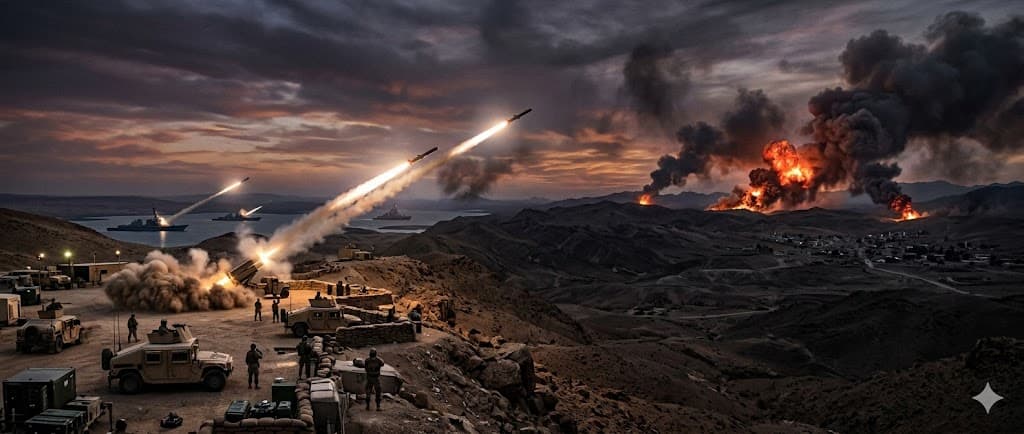
In a dramatic escalation of the ongoing 2026 Iran–United States crisis, reports indicate that the United States has launched cruise missiles from positions in Syria toward multiple targets inside Iran. This marks the second major military confrontation involving Iran in less than a year, following the 2025 Twelve-Day War with Israel, in which the US also participated. The strikes, conducted jointly with Israel, have triggered massive explosions in key Iranian cities, including Tehran, Isfahan, Qom, and Khorramabad, according to eyewitness accounts and semiofficial Iranian media.
Details of the Strikes
Eyewitnesses and social media reports from the region describe cruise missiles traversing Syrian and Iraqi airspace en route to Iran. Videos circulating online show missiles filmed near Saladin Governorate in Iraq, heading toward Tehran. Multiple sources, including posts on X (formerly Twitter), confirm that the US initiated the barrage from Syrian territory, despite ongoing US military withdrawals from northeastern Syria bases like Qasrak and al Shaddadi. The Wall Street Journal reports that the US and Israel plan several days of intensive attacks, focusing on Iranian military infrastructure, air defenses, and potentially nuclear-related sites.
Specific weapons involved include cruise missiles, likely Tomahawk variants launched from US-guided missile destroyers or ground-based systems in Syria, supplemented by Israeli-launched projectiles. Iranian state media, such as Fars News Agency, reported "massive explosions" in Tehran, attributing them to "enemy aggression." Targets appear to include Islamic Revolutionary Guard Corps (IRGC) facilities, missile launchers, and air defense systems, aiming to degrade Iran's ballistic missile capabilities, which remain a significant threat despite damage from previous conflicts.
The strikes come amid Iran's internal turmoil, with nationwide protests against the regime resulting in over 30,000 deaths and mass detentions since 2025. US President Donald Trump has repeatedly threatened military action, citing Iran's nuclear ambitions, support for proxy groups like Hezbollah and the Houthis, and suppression of dissent. In recent weeks, the US amassed unprecedented airpower in the Middle East, including two carrier strike groups (USS Gerald R. Ford and USS Abraham Lincoln), fighter jets, and air defense systems.
Iranian Response and Regional Implications
Iranian officials have condemned the attacks as "acts of terrorism" and vowed a "decisive and regret-inducing" response. IRGC commanders have mobilized forces, conducted missile exercises, and repositioned assets in mountainous regions to evade detection. Iran's proxies, including Hezbollah in Lebanon and Kata'ib Hezbollah in Iraq, have issued warnings of retaliation, potentially targeting US bases in the Gulf or Israeli territory.
The strikes risk broader regional instability, with potential disruptions to the Strait of Hormuz—a critical oil chokepoint. Gulf states have warned that Iran's remaining missile arsenal could inflict damage on US interests, including bases in Qatar and Kuwait. European Union officials expressed concern over escalation, while China and Russia, Iran's arms suppliers, have remained silent amid reports of recent deals for anti-ship missiles and air defense systems.
Background and Lead-Up
Tensions trace back to the 2025 Israel-Iran War, where US forces joined Israel in striking three key Iranian nuclear sites (Fordow, Isfahan, and Natanz), setting back Iran's program by months. Iran retaliated with missiles on US bases but adhered to a fragile ceasefire. Recent negotiations in Oman stalled over US demands for uranium transfers, halting nuclear and missile development, and ending proxy support.
Iran's military buildup, including deals with Russia for Verba MANPADS and discussions with China for CM-302 anti-ship missiles, has heightened fears of a wider conflict. The US withdrawal from Syrian bases, intended to refocus resources, ironically coincides with these strikes, suggesting residual US capabilities in the region.
Global Reactions
- India: The Indian government has not issued an official statement but is monitoring the situation closely, given the large NRI population in the Gulf and potential oil price spikes affecting remittances and energy security.
- United Nations: Secretary-General António Guterres called for immediate de-escalation and a return to diplomacy.
- Stock Markets: Oil prices surged 15% in early trading, with Brent crude exceeding $120 per barrel.
NRI Globe will continue to monitor this developing story and provide updates as more details emerge. For NRIs in the Middle East, stay safe and follow local advisories.
Related NRI Globe Coverage
- US-Iran Nuclear Talks Begin in Oman Amid Rising Tensions
- New Zealand Protest Targets Sikh Procession: Rising Tensions
- What Are Sleeper Cells? How They Work and How the USA Plans to Handle Them Amid Tensions with Iran
- Khamenei Responds to Israel-Iran Tensions: Latest Developments
- Iran-Israel Tensions Escalate: Is Ayatollah Ali Khamenei Dead? Unraveling the Rumors
- Trump Says US 'Essentially Taken Over' Iran (May 2026): Context, Operation Epic Fury & Current Status
- Shadows Over the Gulf: The Fragile 2026 Iran War Ceasefire — May 8 Update for NRIs
- Trump Extends Iran Ceasefire: NRI Safety and Finance Updates
Fresh from NRI Globe
- YouTuber Nandu's World (Rama Nandana) UK Visa & Job Fraud Case: Full Details + Key Lessons for NRIs (2026)
- Dussehra / Vijayadashami 2026 Events Country-Wise — Global NRI Directory (Ram Lila, Ravana Dahan, Durga Puja Pandals, Ayudha Puja Venues + Booking)
- Diwali 2026 Events Country-Wise — Global NRI Directory (White House, Leicester, London Trafalgar, Toronto, Auckland, Sydney Parramasala, Fiji, Mauritius, Trinidad, South Africa and More)
- Diwali / Deepavali 2026 Country-Wise NRI Celebrations — Complete Global Guide (USA, UK, Canada, Australia, Fiji, Mauritius, Trinidad, South Africa, UAE and 30+ Countries)