
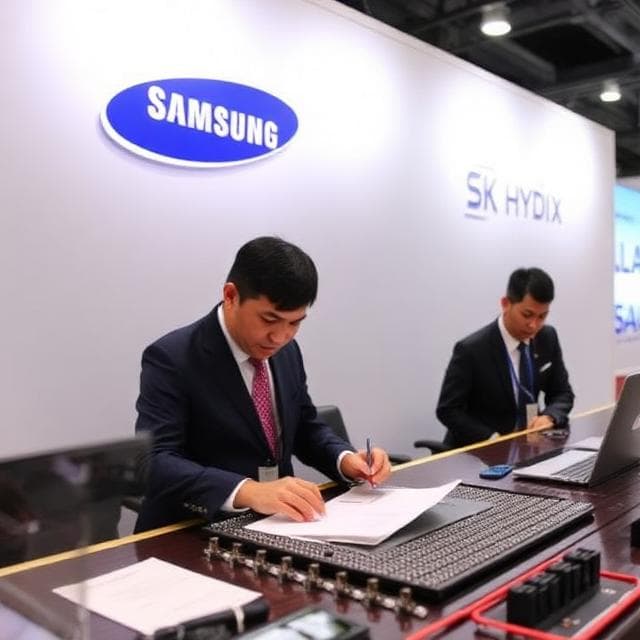
US Greenlights Samsung and SK Hynix Chip Tools to China: A Lifeline for Korean Tech Giants and Big Relief for NRIs in Semiconductors
In a major year-end decision, the US has approved annual licenses allowing Samsung and SK Hynix to ship American chipmaking equipment to their factories in China for 2026. Here's why this matters deeply for the thousands of Indian tech professionals working in the global semiconductor supply chain
For the thousands of Non-Resident Indians (NRIs) building careers at Samsung Electronics, SK Hynix, Qualcomm, Nvidia, or any of the dozens of chip design and manufacturing firms across the US, South Korea, Taiwan, and Singapore, the last week of 2025 brought welcome news.
On December 30, reliable sources confirmed that the US Department of Commerce has granted annual licenses to South Korea’s memory chip leaders—Samsung Electronics and SK Hynix—permitting them to continue importing critical US-made semiconductor equipment into their massive production facilities in China throughout 2026.
This decision ends months of uncertainty that had many Indian engineers, managers, and executives closely watching Washington’s every move. After all, disruptions in these plants could ripple through global supply chains, affect project timelines, stock options, and even job stability for NRIs deeply embedded in the world’s most strategic industry.
From Uncertainty to One-Year Clarity
Until now, Samsung and SK Hynix operated in China under broad Validated End User (VEU) waivers that were set to expire on December 31, 2025. Earlier in the year, the US revoked those indefinite exemptions, raising fears of case-by-case approvals—or worse, outright denials.
The new system replaces waivers with renewable annual licenses—a middle path that gives the companies breathing room while allowing Washington annual oversight.
Key highlights:
- Licenses cover the full calendar year 2026.
- Focused on maintaining existing legacy memory production (DRAM and NAND flash), not enabling cutting-edge nodes.
- Equipment from leading US suppliers like Applied Materials, Lam Research, and KLA can continue flowing.
Samsung and SK Hynix declined to comment officially, but industry insiders describe the mood in Seoul as one of cautious relief.
Why China Factories Are Still Vital for Samsung and SK Hynix
For many NRIs who have worked on cross-border projects or rotated through Asian fabs, these Chinese plants are familiar territory.
- Samsung’s Xi’an NAND Plant: Produces roughly 35-40% of the world’s NAND flash memory—the storage inside SSDs, smartphones, USB drives, and data centers.
- SK Hynix’s Wuxi DRAM Fab and Dalian Facility: Account for about 40% of global DRAM and a significant slice of NAND.
These are not experimental outposts but mature, high-volume factories running proven “legacy” nodes that remain in massive demand—especially as AI servers gobble up high-bandwidth memory (HBM) and traditional memory alike.
Without regular tool imports for maintenance, upgrades, and yield improvements, output would gradually decline, sending shockwaves through pricing and availability.
The Indian Connection: Why NRIs in Semiconductors Are Breathing Easier
The global chip industry employs tens of thousands of skilled Indian professionals—many on H-1B, L-1, or global assignments.
- Samsung’s semiconductor division has a sizable Indian talent pool in Austin, San Jose, and Seoul.
- SK Hynix’s R&D centers and partnerships draw heavily from IIT/IISc alumni.
- Downstream, Indian teams at Nvidia, AMD, Micron, and Broadcom depend on stable memory supply for GPU and CPU roadmaps.
A sudden halt in Chinese production could have triggered:
- Delayed product launches
- Higher component costs passed to consumers and enterprises
- Potential layoffs or hiring freezes in an already cautious 2025 job market
Instead, the annual license provides predictability—critical for long-term career planning, stock-based compensation, and family decisions for NRIs abroad.
Balancing Act: US National Security vs. Global Supply Chain Stability
The decision reflects Washington’s nuanced approach in the ongoing US-China tech rivalry.
Goals remain firm:
- Prevent China’s domestic champions (SMIC, CXMT, YMTC) from acquiring advanced tools.
- Limit upgrades that could boost military or AI surveillance capabilities.
Yet completely choking allied companies would boomerang:
- Hand market share to Chinese firms
- Spike memory prices globally
- Hurt American equipment makers who sell billions to Korean customers
The annual review system allows the US to monitor shipments while avoiding self-inflicted wounds.
Looking to 2026: Opportunities and Remaining Questions
With stability secured for the next year, attention turns to:
- Will TSMC receive similar treatment for its Nanjing fab?
- How will renewal work in late 2026—especially under evolving US leadership?
- Can Korean firms accelerate diversification (e.g., new US/Texas fabs under CHIPS Act incentives)?
For Indian professionals, the bigger picture is promising:
- Continued AI boom driving memory demand
- Growing Indian semiconductor initiatives (Micron Gujarat, Tata-PSMC) creating eventual reverse opportunities
- Stable global chains supporting career growth abroad
Final Thoughts: A Reprieve That Buys Time
This year-end approval isn’t a full rollback of restrictions—it’s a pragmatic pause that recognizes reality: The semiconductor world remains deeply interconnected.
For NRIs riding this high-stakes industry wave, it means one more year of relative calm to excel, upskill, and plan the next move—whether deepening roots abroad or eyeing opportunities back home as India’s own chip ecosystem rises.
The US-China chip saga continues, but for now, the production lines in Xi’an and Wuxi will keep running smoothly into 2026.
Are you an NRI working in semiconductors? How has the US-China tech tension affected your career plans? Share your experiences in the comments—we’d love to hear from the diaspora powering this critical industry!
Published on www.nriglobe.com | December 30, 2025
Keywords: US Samsung SK Hynix China license 2026, semiconductor equipment China approval, NRI semiconductor careers, Samsung Xi'an plant, SK Hynix Wuxi fab, US export controls chips India, memory chip supply chain NRIs, Indian engineers Samsung SK Hynix
Related NRI Globe Coverage
- AI's Impact on H-1B Tech Jobs in 2026 — What Indian Tech Workers in USA Need to Know
- Big Tech’s AI Power Shift: Apple, Google, OpenAI & Grok
- Tech-Powered New Year's Resolutions for 2026: AI, Green Tech, and EVs Perfect for NRIs Abroad
- AI-Powered Coding: How U.S. Tech Giants Are Transforming Software Development
- AI Data Center Cooling Methods Explained — Air vs Direct-to-Chip Liquid vs Immersion (2026 Rack Density Guide)
- Best AI Tools for NRIs in 2026 — ChatGPT, Claude, Gemini, Perplexity, Notion AI and Practical Uses for Immigration, Family and Productivity
- NYC Passes SF as Largest US Tech Talent Hub 2026 — CBRE NRI Guide
- Google Gemini 4 "Performing Well" in Pretraining — 2026 AI Race Update
Fresh from NRI Globe
- YouTuber Nandu's World (Rama Nandana) UK Visa & Job Fraud Case: Full Details + Key Lessons for NRIs (2026)
- Dussehra / Vijayadashami 2026 Events Country-Wise — Global NRI Directory (Ram Lila, Ravana Dahan, Durga Puja Pandals, Ayudha Puja Venues + Booking)
- Diwali 2026 Events Country-Wise — Global NRI Directory (White House, Leicester, London Trafalgar, Toronto, Auckland, Sydney Parramasala, Fiji, Mauritius, Trinidad, South Africa and More)
- Diwali / Deepavali 2026 Country-Wise NRI Celebrations — Complete Global Guide (USA, UK, Canada, Australia, Fiji, Mauritius, Trinidad, South Africa, UAE and 30+ Countries)